The Uncreated Word
Islam fought a fifteen-year inquisition over whether the Quran is created, and a Christian monk posed the decisive dilemma a century earlier. What the createdness controversy opens up for a conversation about John 1.
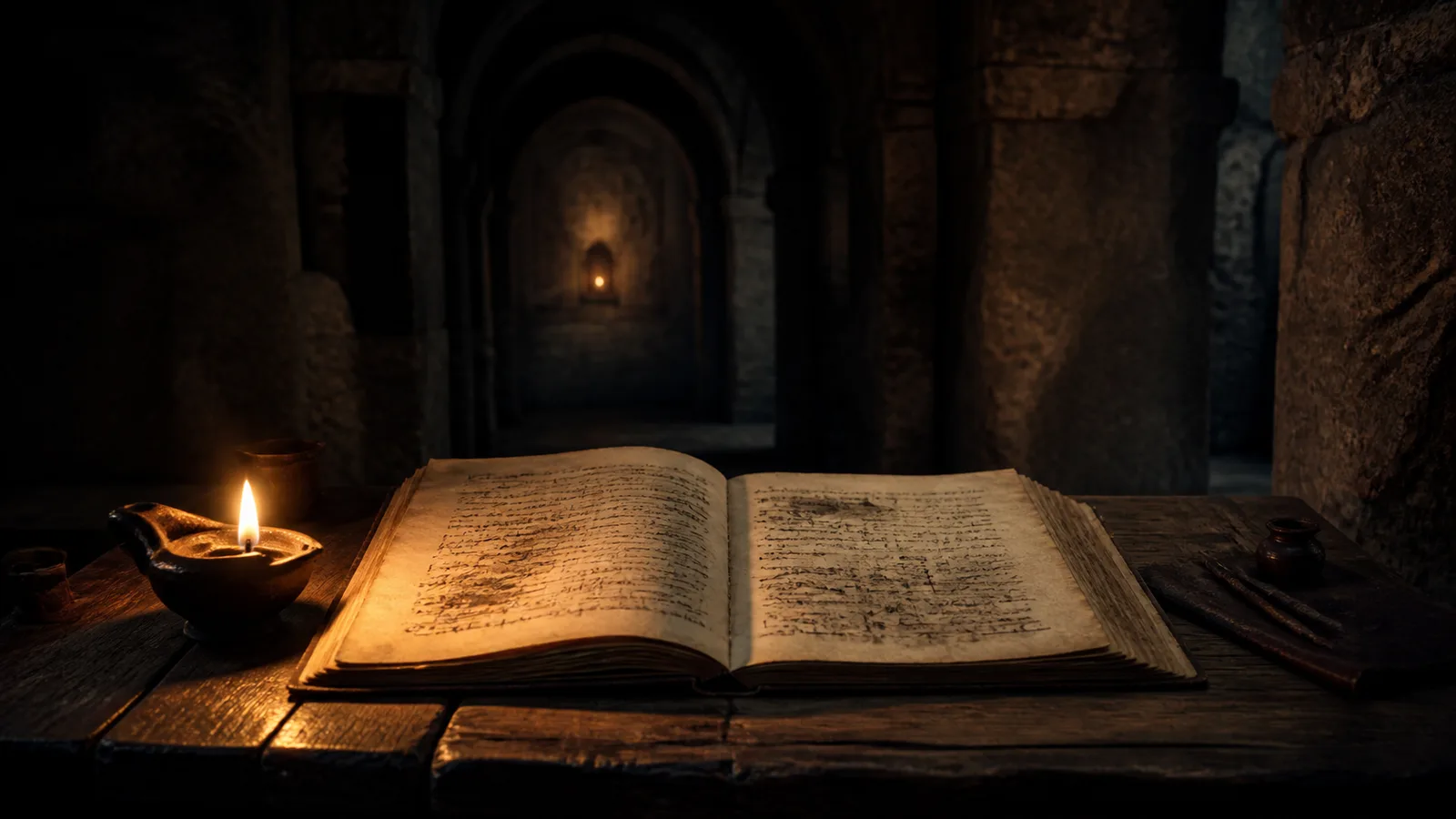
In 833, the caliph al-Ma’mun was on campaign near the Byzantine frontier when he sent a letter back to his deputy in Baghdad. It ordered the interrogation of the city’s judges and hadith scholars, with their posts at stake and prison behind that. The examination turned on a single theological question: is the Quran created?
That letter launched the mihna, a state inquisition that ran about fifteen years, from 833 to roughly 848, under three successive caliphs. Most scholars, put to the question, gave the answer the state wanted. The famous holdout was Ahmad ibn Hanbal, Baghdad’s most immovable traditionist. He was chained, hauled before al-Ma’mun’s successor al-Mu’tasim, and flogged, and he still would not say the Quran was created. When the caliph al-Mutawakkil abandoned the policy around 848, Ibn Hanbal came out an icon, and the position he was beaten for, that the Quran is the uncreated and eternal speech of God, hardened into a defining mark of Sunni orthodoxy that stands to this day (chronology and cast).
Sit with that scene for a second. An empire jailed and whipped its own judges over the metaphysical status of a book. I want to walk you through why, for two reasons. First, the losing side’s argument is one you have probably heard from a Muslim friend, aimed at the Trinity. Second, a Christian monk working inside the caliphate’s own civil service saw this collision coming a full century before the whips came out, and what he saw is still the most useful door I know of into a conversation about John 1.
What the fight was about#
The rationalist school called the Mu’tazila held that the Quran is created (khalq al-Qur’an). Their reasoning was a defense of tawhid, God’s absolute oneness: if the Quran is eternal and uncreated, then something eternal exists alongside God, and an eternal thing alongside God looked to them like a second eternal, a rival to the one God (Madelung’s account of the controversy’s origins, summarized by Khalil Andani). Al-Ma’mun backed this position with state power.
The traditionists answered that the Quran is kalam Allah, the speech of God, and God’s speech is an attribute of God himself. An eternal God does not acquire the ability to speak at some point in time. Call his speech created and you have said there was a time when God was speechless.

Both sides could point to the Quran’s own text. One verse says God “appointed” or made the revelation an Arabic Quran (Quran 43:3), which sounds like an act in time. Another locates it on a heavenly “guarded tablet” (Quran 85:21–22), which sounds like pre-existence. The dispute had real internal fuel, and it had political fuel too, since a created Quran left more room for a caliph to sit above it as interpreter (Andani, summarizing Madelung).
The traditionists won. Since the mihna’s collapse, mainstream Sunni Islam in its Ash’ari, Maturidi, and Hanbali streams has confessed the Quran as God’s uncreated, eternal speech (the doctrine and its settlement). Keep that on the table. Sunni Islam affirms, as orthodoxy sealed by its own martyrs, an eternal, uncreated Word subsisting with God.
If you’ve read the first Understanding Islam piece, you know the Quran’s textual history, how the book on the shelf got there. This is a different question. This is what Islam says the book is, and the answer is far stranger and far closer to Christian territory than most Christians suspect.
A monk asked the question first#
John of Damascus died around 749, eighty years before al-Ma’mun’s letter. He had served in the financial administration of the Umayyad caliphate in Damascus before entering the monastery of Mar Saba, so he wrote about Islam as an insider to its empire, not a rumor-collector. In his catalog of heresies he included a chapter on “the Ishmaelites,” and in the disputation material connected with it he coached Christians on what to ask a Muslim (the scholarly translation of the chapter; the standard academic edition is Daniel Sahas, John of Damascus on Islam, Brill, 1972).
His opening move was to quote the Quran’s own words about Jesus. “The Messiah, Jesus son of Mary, was only a messenger of Allah, and His word which He conveyed unto Mary, and a spirit from Him” (Quran 4:171, Pickthall). The Quran itself calls Christ God’s Word and a Spirit from him. So John taught Christians to ask the question Baghdad would later ask at swordpoint: this Word of God, is it created or uncreated?
Then he traced both branches. If the Word is uncreated, the Muslim has affirmed something eternal existing with God, which is exactly what the Christian means by the Logos, the claim Muslims call shirk when we make it. If the Word is created, then God once existed without his Word and his Spirit, which John said mutilates God, and he noted that his Muslim contemporaries themselves recoiled from saying it (John’s text).
The argument did not stay in one monastery. Theodore Abu Qurra, a bishop writing in Arabic around 800, redeployed it inside Islam’s own theological vocabulary, and the patriarch Timothy I reasoned along the same lines in his famous dialogue before the caliph al-Mahdi around 782. For nearly a century before the mihna, Christians under the caliphate were pressing one dilemma: your own book calls Jesus the Word of God, so tell us what a Word of God is.
Then Islam tore itself apart over that very question, and settled it, permanently, on the side of uncreated.
How hard the parallel cuts#
Here I need to slow down and calibrate, because this is where Christian use of the mihna usually goes wrong in one of two directions.
The maximal version says Islam’s whole createdness controversy was the Christian Logos controversy transposed. That thesis has a serious scholarly pedigree: Harry Wolfson argued in The Philosophy of the Kalam (Harvard, 1976) that the two positions map almost term for term, uncreated Quran onto the Nicene eternal Logos, created Quran onto the Arian created one. But the genealogy is contested. Wilferd Madelung and others have shown the controversy had sufficient drivers inside Islam itself, the Quran’s own tension between 43:3 and 85:21–22 plus the caliphate’s political theology, without needing Christian input to explain it (Andani’s summary of Madelung’s case). So state it the way the evidence sits: the parallel is acknowledged on all sides; the borrowing is a live scholarly dispute, not a settled fact.
The cruder version says Muslims secretly believe in two gods, Allah and the eternal Quran, a binity with the serial numbers filed off. That overstates it, and a Muslim with any theological training will dismantle it. Orthodox kalam classifies the Quran as an eternal attribute (sifa) of the one divine essence, not a second being, and it refined the position further: God’s internal speech (kalam nafsi) is eternal and uncreated, while the recited sounds, the ink, and the paper in your hands are created. That distinction was forged partly under exactly this Christian pressure (the doctrinal settlement; Andani on the kalam debates). A Christian should notice, and say out loud, that our own Trinitarian grammar makes a formally similar move: the persons are not separable beings either. If “attribute, not hypostasis” is special pleading, someone will ask why “person, not separate being” isn’t. Don’t throw stones from inside that particular glass house.
Here is what the parallel honestly buys, and it is plenty. The standard Muslim objection to the Trinity runs: anything eternal alongside God is a second god. But that is precisely the Mu’tazilite argument against the uncreated Quran, and Sunni Islam rejected it. Rejected it so firmly that men took the lash rather than concede it. Sunni orthodoxy itself is the proof that “eternal, uncreated, subsisting with God, yet not a second god” is a coherent thing to say, because Sunni orthodoxy says it every day about the Quran. The objection proves too much, and the mihna is Islam’s own receipt.
That’s not a gotcha to spring on someone. It’s a symmetry to point at, slowly, as a question.
The bridge to John 1#
The engineering habit I can’t turn off is looking at two systems under the same load, because they tend to fail, or hold, at the same joint. Christianity and Islam both confess one eternal God who speaks. Both were forced to answer what his speech is. Both concluded, against their own rationalists, that the Word of God is uncreated and eternal, or God was once mute and God changes. Same load path, same joint, same resolution. The difference is what each says that eternal Word finally did.
I learned this question too late to ask it. Years ago in the Bay Area I spent long evenings talking about programming and about God with a devout young neighbor from North Africa, the man I wrote about in the Your Muslim Neighbor series. He prayed in front of me without embarrassment, and I sat there defending Christianity, because back then I only knew my half of the conversation. In all those hours I never once asked him whether he believed the Quran was created or eternal. I didn’t know the question existed, let alone that his own tradition had bled over it. I don’t know what he would have said. I do know the evenings would have gone somewhere different, because for once I would have been asking about his book instead of defending mine.

Here’s how I’d actually use this over coffee, in order.
First, ask before asserting. “Can I ask you something about the Quran? Do you believe it’s created, or eternal?” Most devout Sunnis will answer eternal, uncreated, some will tell you the story of Ahmad ibn Hanbal with real pride, and now your friend has personally handed you the category the whole conversation needs. You didn’t import it from Nicaea. It came from Baghdad.
Second, receive the answer with respect, because it deserves it. Ibn Hanbal under the whip is a moving story of conviction against state power. Say so.
Third, open the Quran’s own verse, not yours. “The Messiah, Jesus son of Mary, was… His word which He conveyed unto Mary, and a spirit from Him” (Quran 4:171, Pickthall). Then ask John of Damascus’s twelve-century-old question as an honest question: if God’s Word is uncreated when it’s the Quran, what is God’s Word when your book gives that title to Jesus?
Fourth, and only now, open John. “In the beginning was the Word, and the Word was with God, and the Word was God” (John 1:1). “And the Word became flesh and dwelt among us, and we have seen his glory” (John 1:14). Your friend already inhabits a theology in which God’s eternal Word enters the world, on his account as an Arabic recitation, on ours as a Galilean carpenter. Where I’ll plant my own flag, plainly labeled as my conviction: a word becomes fully legible only in a life. Ink can tell you commands; only a person can show you the character of the one who gave them. That is what John 1:14 claims God did.
You are not proving the Trinity from the mihna. You are showing that the category Islam calls unthinkable is one it already thinks, and then walking through the door its own scripture leaves open at 4:171. The conversation that starts there is about Jesus, which is the only place it was ever going to be worth ending up.
Read John 1:1–18 this week with the mihna in your head. Then ask a Muslim friend the createdness question, and listen longer than feels natural before you say anything at all.
Go deeper#
- Daniel Sahas, John of Damascus on Islam (Brill, 1972). The standard academic edition and study of the earliest Christian theological engagement with Islam; the key chapter in translation.
- Harry Wolfson, The Philosophy of the Kalam (Harvard, 1976). The classic case that Islam’s createdness controversy transposes the Logos controversy; read alongside Madelung’s internal-drivers counter-case.
- The mihna. A solid orientation to the inquisition’s chronology; the specialist literature is John Nawas and Christopher Melchert.
- James White, What Every Christian Needs to Know About the Qur’an. The most careful popular-level Christian treatment, and a model for raising these questions without torching the friendship.