Answering Islam's Questions
The three questions every Christian eventually hears from a Muslim friend, answered from the sources: the corrupted-Bible claim, the three-gods claim, and the challenge that Jesus never claimed to be God.

Stay friends with a Muslim long enough and three questions will find you. They tend to arrive in the same order, asked sincerely, usually by someone who has thought harder about your scriptures than you have about his. How can you trust a Bible that has been changed? How can one God be three? Where did Jesus ever say, “I am God”?
I got my turn at questions like these in a Bay Area living room, years before I could answer any of them well. The neighbor I wrote about in part 2 of the Muslim Neighbor series was devout, hospitable, and glad to spend an evening on God, and I spent those evenings on defense with half the equipment. I couldn’t tell you now which question arrived in which words. What I remember is being asked reasonable things by a sincere man and reaching for answers I didn’t own yet. Earning them took years of reading both books. This article is the card I wish I’d had in my pocket then.
The questions aren’t threats. They’re doors. Peter told scattered, pressured Christians to be “always being prepared to make a defense to anyone who asks you for a reason for the hope that is in you; yet do it with gentleness and respect” (1 Peter 3:15). Notice the verse assumes the asking. A friend who raises these three has done you the favor Peter anticipated, and each question, answered honestly, opens onto exactly the ground a Christian should want to stand on. So take them one at a time, sources in hand.
”Your Bible has been corrupted”#
The doctrine behind this question is called tahrif: God gave real revelations to Moses and Jesus, the Torah and the Injil (Gospel), but Jews and Christians corrupted the texts, so God sent the Quran to restore what was lost. Your friend likely learned it early, and it does the work of explaining why the Bible he respects in principle disagrees with the Quran he trusts in fact.
Start where he would least expect: inside the Quran. “Let the People of the Gospel judge by that which Allah hath revealed therein” (Quran 5:47, Pickthall). That is a command to Christians of Muhammad’s own day to judge by the Gospel they were then holding. The Quran also directs Muhammad himself toward those same scriptures: “And if thou (Muhammad) art in doubt concerning that which We reveal unto thee, then question those who read the Scripture (that was) before thee” (Quran 10:94, Pickthall). And it states a general principle: “Perfected is the Word of thy Lord in truth and justice. There is naught that can change His words” (Quran 6:115, Pickthall). The Quran does condemn certain people who “write the Scripture with their own hands” and sell it as God’s (Quran 2:79), a real charge of forgery against real individuals. But a book that tells seventh-century Christians to judge by the Gospel in their possession cannot coherently mean that the Gospel in their possession was already destroyed.
Now the manuscripts. The New Testament’s 27 documents were copied for three centuries by scattered, often persecuted congregations, in Greek and then in Syriac, Latin, and Coptic, with no authority anywhere capable of recalling and standardizing the copies. The surviving harvest of that uncontrolled process is about 5,800 catalogued Greek manuscripts plus thousands more in the early translations. Uncontrolled transmission is the killer detail, and it cuts the opposite way from what most people assume. To corrupt a text transmitted like that, someone would have to alter copies held by rival communities on three continents in four languages, simultaneously and identically. What actually happens when a text changes in one place is that the change survives as one divergent branch among the witnesses, visible and localizable. And that is precisely what we find with the handful of passages that did shift: Mark 16:9–20 and John 7:53–8:11 sit in double brackets in the church’s own critical editions, flagged for any reader. The roughly 400,000 counted variants, overwhelmingly trivial slips, read less like wreckage than like an audit trail, because every reading left tracks. The New Testament never had an Uthman with the power to burn the rivals (the Quran’s own standardization story, from Sahih al-Bukhari 4987, is in the first Understanding Islam piece); Christianity’s messy openness is the very thing that makes tahrif checkable, and when you run the check, tahrif fails.
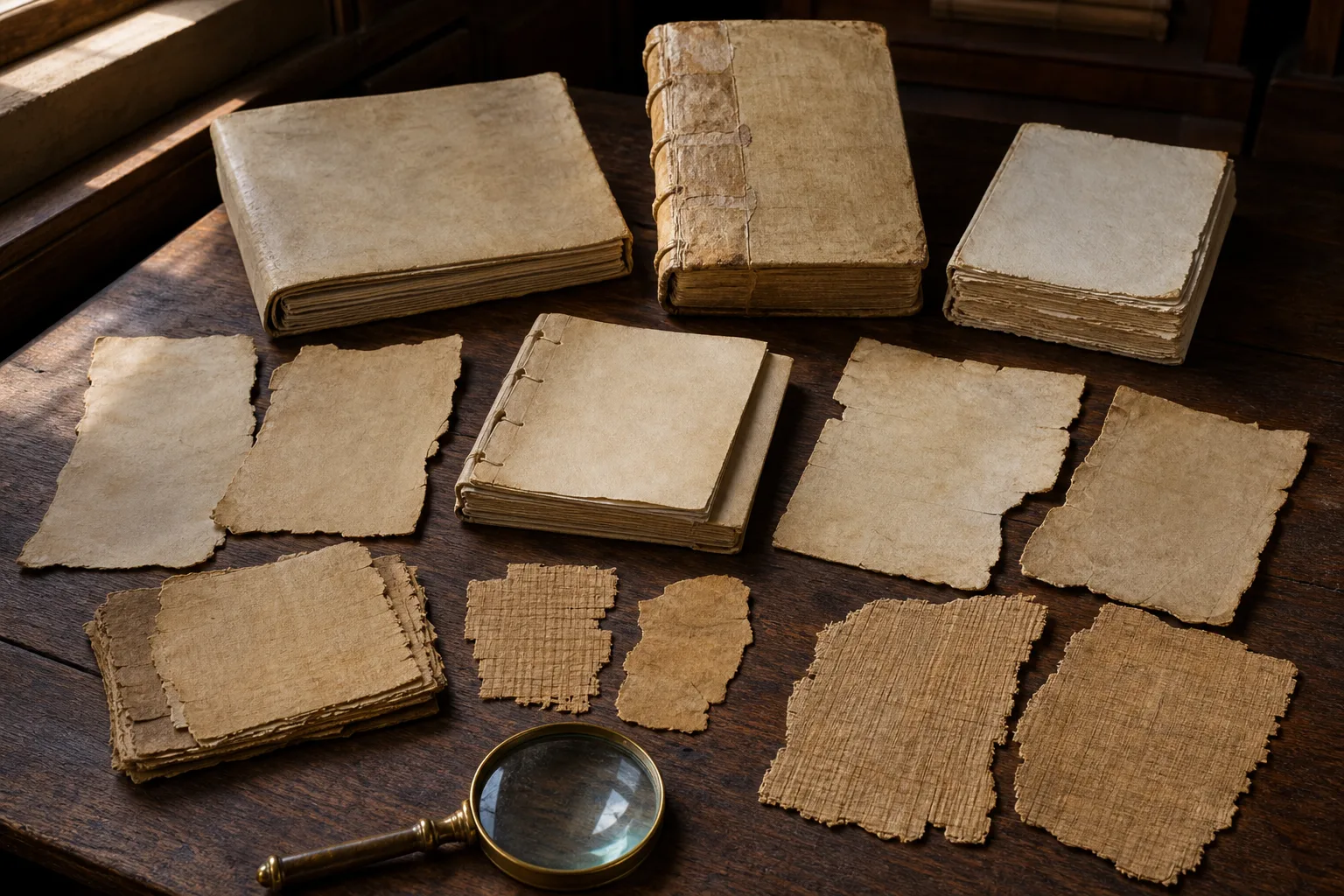
Which leaves the claim with a timing problem it cannot survive. Suppose the corruption happened before Muhammad. Then the Quran erred when it certified the scriptures of its own day, told the People of the Gospel to judge by them, and declared that none can change God’s words. Suppose instead the corruption came after Muhammad, sometime past 632. Then it is refuted by the manuscripts on the shelf: Codex Sinaiticus and Codex Vaticanus are complete New Testaments from the 300s, two-plus centuries before Muhammad’s birth, and any corruption introduced after 632 would show up instantly against them. None does. Either horn costs the objection everything.
One honest caveat, because your friend may raise it and he’d be right to. A thoughtful Muslim can retreat to a softer position: the text stands, but Christians misinterpret it. That is a different claim, and a better conversation, because now the two of you are reading the same Gospel together and arguing about what it means. Welcome that outcome. It’s the one Q 5:47 pointed at all along.
”The Trinity is three gods”#
Begin with what the doctrine actually asserts, because most Muslims have never heard it from a Christian, and frankly many Christians couldn’t supply it. Christians confess the Shema exactly as Jesus recited it: “Hear, O Israel: The Lord our God, the Lord is one” (Mark 12:29, quoting Deuteronomy 6:4). The doctrine of the Trinity says there is one God, one divine being, and that Father, Son, and Holy Spirit are each fully that one God without being each other. The Athanasian Creed makes the fences explicit: one God in Trinity, “neither confounding the persons nor dividing the substance.” Three gods is not a rough approximation of this. Three gods is the specific error the creed was written to condemn, on pain of exclusion from the faith. When your friend says three gods would be idolatry, agree with him without blinking. Christians are forbidden to believe it too, and always have been.
Then look at what the Quran condemns. “Say not ‘Three’” (Quran 4:171, Pickthall); “they surely disbelieve who say: Lo! Allah is the third of three” (Quran 5:73). And in the most detailed passage, God interrogates Jesus at the judgment: “O Jesus, son of Mary! Didst thou say unto mankind: Take me and my mother for two gods beside Allah?” (Quran 5:116, Pickthall). Read it slowly. The triad in view is Allah, Jesus, and Mary. Christian writers have pointed out for centuries that no Christian creed or council ever placed Mary inside the Godhead, so whatever 5:116 refutes, it is not the doctrine any creed teaches. Muslim exegesis answers that the verse condemns the excessive veneration of Mary in Christian practice rather than defining the Trinity (Ibn Kathir reads it as a public chastisement of Christians; modern Muslim treatments make the same move), and that reading deserves to be stated fairly. But notice what follows on either reading: the Quran then contains no description, and therefore no refutation, of one being in three persons. What it anathematizes at 5:116, the creeds anathematize too. The conversation you want is the one that starts after both of you agree on that.
This objection is not a modern debating trick, and treating it as one insults its seriousness. The oldest securely dated monumental Islamic text in existence, the Dome of the Rock inscription of 691, is an anti-Trinitarian sermon in mosaic: “Do not say ‘Three’… far be it from Him that He should have a son.” Islam has been making this argument in public for thirteen centuries, which is exactly why a Christian owes it a real answer rather than a wince.
The deeper engine under the objection is a metaphysical instinct: anything eternal alongside God is a second god. If you’ve read the previous piece in this series, you already know the surprise. That instinct is the Mu’tazilite argument against the uncreated Quran, and Sunni Islam examined it in a fifteen-year inquisition and rejected it. Sunni orthodoxy confesses an eternal, uncreated Word subsisting with God and denies that this makes two gods. A Christian and a Sunni Muslim are, on this one point, standing closer together than either of them was told.
”Jesus never claimed to be God”#
Concede the surface immediately. No verse records the four words “I am God,” and pretending otherwise burns your credibility for nothing. But the demand hides an assumption worth naming: that a first-century Jew could only claim deity by reciting a formula. In the world of the Gospels, some things said “God” far louder than the sentence would have, and the people in the room heard them at full volume every time.
Watch what Jesus does with sin. Four men lower a paralytic through a roof, and Jesus says, “Son, your sins are forgiven.” The scribes react instantly: “Why does this man speak like that? He is blaspheming! Who can forgive sins but God alone?” (Mark 2:5–7). Their theology was correct. The paralytic had never wronged Jesus, and only the offended party can forgive an offense; to forgive all a man’s sins is to claim to be the one every sin offends. Jesus doesn’t correct the scribes’ inference. He heals the man “that you may know that the Son of Man has authority on earth to forgive sins” (Mark 2:10).
Watch his trial. The high priest asks directly: “Are you the Christ, the Son of the Blessed?” Jesus answers, “I am, and you will see the Son of Man seated at the right hand of Power, and coming with the clouds of heaven” (Mark 14:61–62). That is no humble deflection. It is Daniel 7, where “one like a son of man” comes “with the clouds of heaven” and is given “dominion and glory and a kingdom, that all peoples, nations, and languages should serve him” in “an everlasting dominion” (Daniel 7:13–14). The court understood the citation better than most modern readers do. “You have heard his blasphemy,” said the high priest, tearing his garments, “and they all condemned him as deserving death” (Mark 14:63–64). The crucifixion itself is evidence of the claim; men are not executed for blasphemy over modest statements. And all of this sits in Mark, the Gospel critical scholars date earliest, not in some late legendary layer.
Watch his grammar. “Truly, truly, I say to you, before Abraham was, I am” (John 8:58). The tense is broken deliberately, echoing the name God gives himself at the bush: “I AM WHO I AM” (Exodus 3:14). The audience did not miss it: “So they picked up stones to throw at him” (John 8:59). Stoning was the penalty for blasphemy, not for bad grammar.
Watch, finally, what he accepts. When Thomas falls before the risen Jesus with “My Lord and my God!” (John 20:28), Jesus blesses him rather than correcting him. Compare the reflexes of every other faithful figure in the same first-century literature: an angel refuses John’s worship with “You must not do that!… Worship God” (Revelation 22:8–9), and Peter hauls Cornelius up off the floor with “Stand up; I too am a man” (Acts 10:25–26). Monotheists who fear God refuse worship by instinct. Jesus receives it, repeatedly, from monotheists.
So the honest answer to the question runs like this: you’re right that the formula is absent, and here is what stands in its place, a pattern of divine prerogatives exercised in public, sealed by a blasphemy verdict and a cross. Then you can point out something your friend may find startling from his own book: the Quran itself calls Jesus the Messiah, born of a virgin, “His word which He conveyed unto Mary, and a spirit from Him” (Quran 4:171, Pickthall), titles it gives no other prophet. What is God’s Word doing in a manger? That question, as the last article traced, has been open since John of Damascus, and it still leads home.
Three questions, three answers, one posture. Your friend’s questions are the reason 1 Peter 3:15 is in the Bible, and gentleness is not the packaging on the answer; it is part of the answer, because the goal was never to win an exchange but to be worth asking again. So do the specific work. This week, read Mark 2:1–12 and Mark 14:53–65 until you can walk through them without notes, and write the tahrif dilemma on a card: before Muhammad contradicts the Quran, after Muhammad is refuted by Sinaiticus. The next time one of the three questions comes, thank the person who asked it. Then answer the question he actually asked, slowly, and ask him one back.
Go deeper#
- James White, What Every Christian Needs to Know About the Qur’an. The most careful popular-level Christian treatment of these exact debates, argued from what the sources actually say.
- Nabeel Qureshi, No God but One: Allah or Jesus?. A former Muslim weighs both cases, including tahrif and the Trinity, with the tone this series is aiming for.
- Michael Licona, Paul Meets Muhammad. A readable imagined debate on the resurrection, useful for the “Jesus never claimed deity” conversation’s next step.
- Wesley Huff on New Testament manuscripts. The Bible-side textual evidence, presented at street level; pairs with the first Understanding Islam piece on the Quran’s side.