The Crucifixion Problem
The Quran denies the crucifixion in a single sentence written six centuries after the event. What happens when that sentence meets the method historians use to establish any ancient fact.
Nobody alive has seen the first century. A historian working on it can’t run an experiment or subpoena a witness; the evidence is whatever survived, and the craft is a set of tests for deciding which reported events deserve to be called facts. The tests are ordinary and public: how close the sources sit to the event, whether independent sources converge, whether witnesses who wanted opposite things concede the same core, and whether the record embarrasses the people who preserved it, since nobody invents material against his own cause (Habermas’s summary of the method). That toolkit is how we know Caesar crossed the Rubicon and Socrates drank the hemlock. Not certainty like arithmetic. Converging testimony that would have cost too much to fake.
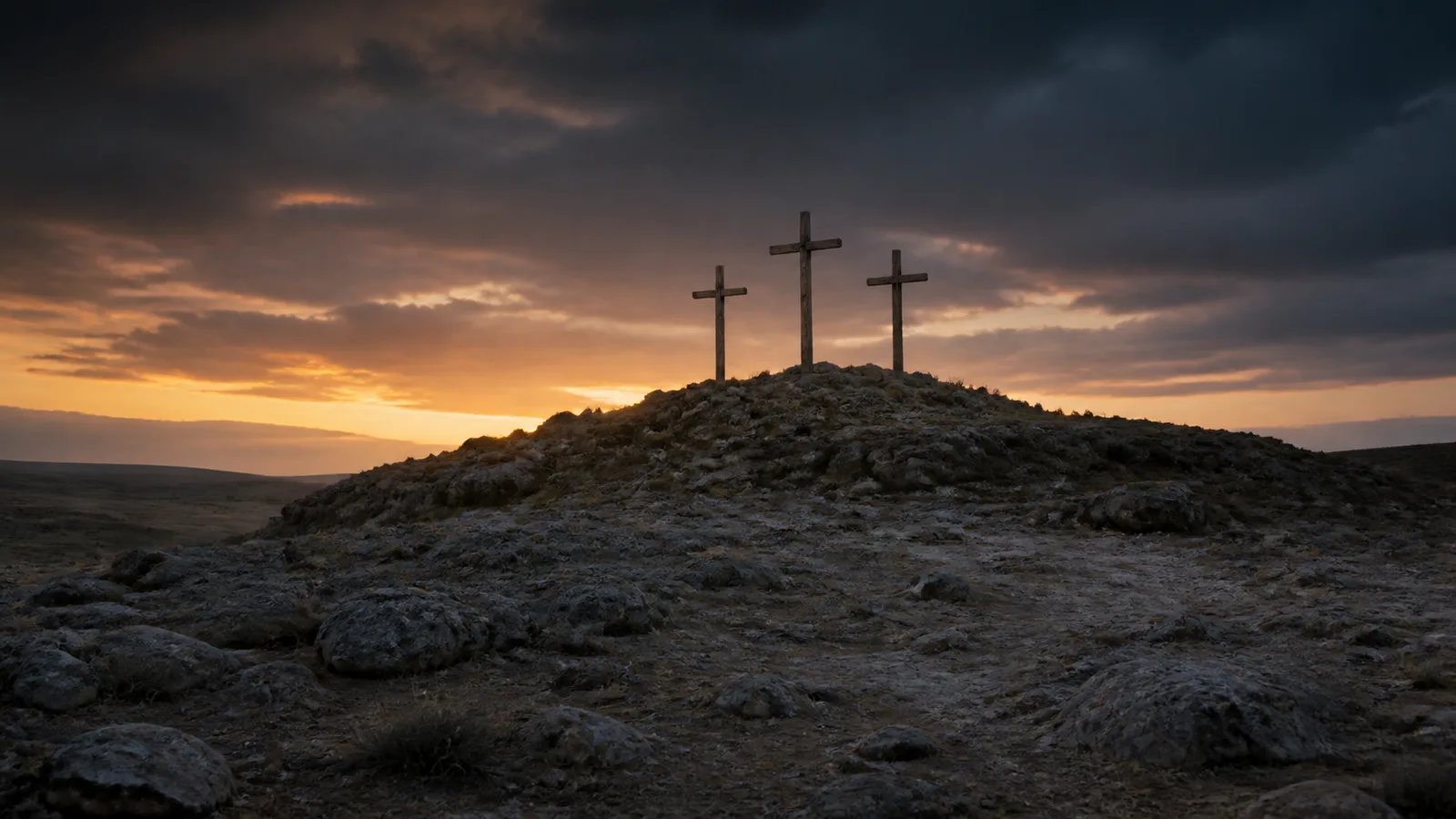
Run those tests across the ancient world and see which events score highest. Near the top of the entire list sits the public execution of Jesus of Nazareth outside Jerusalem, around the year 30, on the orders of Pontius Pilate. And one world religion denies it, in a single sentence, written roughly six hundred years later. This article is about what happens when that sentence meets the method.
What the method finds#
Start with the hostile witnesses. Tacitus, the Roman historian, despised Christians; he calls their faith “a most mischievous superstition.” Writing around AD 116, he still records the fact that anchors their movement: “Christus, from whom the name had its origin, suffered the extreme penalty during the reign of Tiberius at the hands of one of our procurators, Pontius Pilatus” (Annals 15.44; scholars overwhelmingly treat the passage as authentic). A Roman senator with access to Roman records, confirming the execution as a slur.
Josephus, the Jewish historian writing in the 90s, mentions Jesus twice, and honesty requires the caveats. The famous passage, the Testimonium Flavianum, was embellished by later Christian copyists; the majority position among specialists is that an authentic core stood beneath the embellishment, including the condemnation to the cross under Pilate (the interpolation debate, mapped with the scholarship). The second passage, naming “the brother of Jesus who was called Christ, whose name was James,” is accepted as genuine by nearly everyone in the field.
The earliest source of all is a creed. Paul writes to Corinth in the 50s: “For I delivered to you as of first importance what I also received: that Christ died for our sins in accordance with the Scriptures, that he was buried, that he was raised on the third day” (1 Cor 15:3–4). He says he received it, and scholars across the spectrum, critics of Christianity included, date the creed’s origin to within a few years of the crucifixion itself (Habermas’s survey of the academic literature). This is not late legend. This is what the first Christians were reciting while the eyewitnesses, friendly and hostile, were still alive to object.
Then apply the embarrassment test. A crucified Messiah was, by Paul’s own admission, “a stumbling block to Jews and folly to Gentiles” (1 Cor 1:23). Crucifixion was the empire’s shame-death for slaves and rebels; no one inventing a triumphant deliverer starts there. Enemies preserved the crucifixion as an insult, friends preserved it as a scandal they had to explain, and both preserved the same event.
So the field’s skeptics concede the point in language stronger than most pastors would risk. John Dominic Crossan, no orthodox believer: “That he was crucified is as sure as anything historical can ever be.” Bart Ehrman, an agnostic: the crucifixion is “one of the most secure facts we have about his life” (both statements, with citations). When Gary Habermas and Michael Licona built their “minimal facts” case for the resurrection, they restricted themselves to data granted by nearly all scholars, believing and skeptical alike, and the death of Jesus by crucifixion is the first fact on the list (the minimal-facts approach).
One sentence, six hundred years later#
Against all of that stands this:
And because of their saying: We slew the Messiah, Jesus son of Mary, Allah’s messenger - they slew him not nor crucified him, but it appeared so unto them; and lo! those who disagree concerning it are in doubt thereof; they have no knowledge thereof save pursuit of a conjecture; they slew him not for certain. But Allah took him up unto Himself. (Quran 4:157–158, Pickthall)
That is the entire case. The Quran was proclaimed between 610 and 632 (I walked through its textual history in What the Quran Actually Is), so the denial arrives roughly six centuries after the event. It names no source. It cites no witness. It offers no account of what happened instead, beyond “it appeared so unto them.”
Six hundred years is not an abstraction, so make it concrete. Joan of Arc was burned at Rouen in 1431, just about six centuries before our own day. Imagine a book published this year announcing, with no sources given, that she never burned; it only appeared so, and every contemporary record, French and English, friendly and hostile, describes an illusion. No historian would spend an afternoon on it. The claim isn’t weighed against the evidence. It arrives carrying none.
For any other ancient event, the analysis would stop there. The reason to keep going is that our Muslim neighbors receive that sentence as the direct speech of God, which means the conversation isn’t really about historiography. But before it becomes a conversation about God, the sentence has internal problems worth seeing clearly.
The substitute nobody can name#
“It appeared so unto them” requires that somebody appeared to die. Who, then, was on the cross? Classical Muslim exegesis answered with substitution: God cast the likeness of Jesus onto another man, and that man was crucified in his place. Ibn Kathir’s commentary transmits the version in which Jesus asks his gathered disciples for a volunteer, promising him paradise, and a young man receives Jesus’s face (Ibn Kathir on 4:157). Later popular tellings preferred poetic justice and made Judas the substitute, which is the plot of the so-called Gospel of Barnabas, a text scholars date to around the sixteenth century (the dating evidence), some fifteen centuries after the events it claims to report.
The idea itself is older than Islam, and its pedigree should give a thoughtful Muslim pause. Second-century docetists taught that Christ only seemed to suffer (the doctrine and its history), and Irenaeus, writing around 180, records the Gnostic teacher Basilides claiming that Simon of Cyrene was transformed and crucified in Jesus’s place (Against Heresies 1.24.4). The church examined that idea and rejected it as heresy more than four centuries before the Quran was recited. And notice what even Basilides never denied: a real man really died on that cross that day. The ancient dispute was over the victim’s identity, never over the event.
That makes the verse’s own aside strange. “Those who disagree concerning it are in doubt thereof,” it says. But in the seventh century, nobody doubted that the crucifixion had occurred. Rome recorded it, the Jewish community affirmed it, Christians staked everything on it, and the long-dead Gnostic dissenters had disputed the who, not the whether. The doubt the verse describes only came into existence after the verse itself.
What a staged crucifixion costs#
Suppose the substitution happened, and walk the mechanism through. Someone died: either a seized bystander or a volunteer wearing a divinely forged face. The mourners at the foot of the cross, including Jesus’s own mother in the Gospel accounts (John 19:25–27), grieved over that forgery. And on the substitution reading, the deception was not Satan’s work or human error. God authored it. The Quran comes close to saying so about this very plot: “And they (the disbelievers) schemed, and Allah schemed (against them): and Allah is the best of schemers” (Quran 3:54, Pickthall), a verse that sits in the passage about the plan against Jesus.
Now price that epistemically. If God manufactured the appearance of the event Christianity is built on, then eyewitness testimony about God’s acts is worth nothing; the most careful observers in the best position saw exactly what God arranged for them to falsely believe. On this account, Christianity is a divinely staged mistake. A Muslim who argues this way has purchased a defeater for testimony as such, and the purchase price includes the unwitnessed revelations his own faith asks him to trust.
Honesty requires the strongest reply available, and it comes from the academy rather than the mosque. Gabriel Said Reynolds, a Notre Dame Quran specialist, argues that Q 4:157 may deny not the death of Jesus but the Jews’ agency in it: they did not kill him, because God took his life and raised him to himself, and the substitution legends were imported by later commentators (his 2009 article, free in PDF). It is a serious, contested, minority reading, and a Christian should state it fairly, because look at what the rescue costs: it concedes that Jesus died, against what mainstream Islamic exegesis has taught from the classical commentators to the present. The verse escapes the historian only by abandoning thirteen centuries of its own interpreters.
Why the cross cannot be conceded#
On most points, Islam grants Jesus remarkable honor. The Quran affirms his virgin birth (Quran 19:16–22) and his miracles (Quran 3:49). A Muslim can concede a great deal about Jesus and remain a Muslim. The crucifixion is the exception, and the reason is structural on both sides.
For Christianity, everything hangs there. The creed calls Christ’s death for sins the matter “of first importance” (1 Cor 15:3), and Paul is blunt about the alternative: “If Christ has not been raised, your faith is futile and you are still in your sins” (1 Cor 15:17). No cross, no resurrection; no resurrection, no gospel. For Islam, the denial is equally load-bearing. If Jesus died for sins, then souls do not each carry their own burden, and the Quran insists that they do: no laden soul bears another’s load (Quran 17:15). The two faiths disagree at the exact point where forgiveness gets paid for, which is why every serious conversation between them eventually lands at Golgotha.
Islam’s own tradition grasps this better than many casual readers do. In Sahih al-Bukhari, Jesus returns at the end of the age as a just ruler, and the first thing the hadith says he will do is “break the cross” (Bukhari 3448, sahih). The symbol was never incidental. The cross stands for the claim that God himself dealt with sin, and the Islamic Jesus returns specifically to smash it.
Across the table from your Muslim friend#
The neighbor I wrote about in part 2 of the Muslim Neighbor series gave me chance after chance at this conversation. Living-room evenings, hours of programming and God, a man devout enough to pray right in front of me. I spent those evenings defending Christianity, because I only knew my half of the conversation, and the cross is where that ignorance would have cost the most. If he had recited 4:157 across his living room, I could not have told him where the substitution legend came from, or that the ancient dispute was over the who and never the whether, or what a staged crucifixion costs the God who staged it. Everything above is what I failed to bring to that room. Learn both books before the evenings start, not fifteen years after they end.
Your Muslim friend did not choose this verse. He inherited it, along with a real reverence for Jesus that will probably exceed your expectations, and he was likely taught that the crucifixion is a Christian legend the way you may have been taught that the Quran was written centuries late. Both of you were handed simplifications. You now know the evidence; he usually hasn’t seen it, because the verse settles the question before it can be asked.
Here is my conviction, labeled as conviction: the best-attested event in Jesus’s life is also the purpose of it, by his own word: “the Son of Man came not to be served but to serve, and to give his life as a ransom for many” (Mark 10:45). History can establish that he died on the cross. Only the gospel explains why he was willing to.
So don’t open the conversation with Q 4:157, and don’t open it with Tacitus either. Open a Gospel. Invite your friend to read Mark 14–15 with you; two chapters, about twenty minutes aloud. He will meet a man who saw the cross coming, could have escaped it, and walked toward it deliberately. When you’ve finished reading, ask him the one question this whole article has been protecting: if this really happened, what does it mean? Then answer it for yourself, out loud, from 1 Corinthians 15:3, and let him watch you mean it.
Go deeper#
- Michael Licona, The Resurrection of Jesus: A New Historiographical Approach (2010). The full scholarly version of the method this article opens with, applied to the crucifixion and what followed it.
- Michael Licona, Paul Meets Muhammad. A creative debate-format book putting the resurrection case directly into the Christian–Muslim conversation.
- Gabriel Said Reynolds, “The Muslim Jesus: Dead or Alive?” (BSOAS, 2009). The strongest academic case that the Quran itself may not deny Jesus’s death, free online.
- Nabeel Qureshi, No God but One: Allah or Jesus?. An ex-Muslim’s side-by-side weighing of both faiths’ central claims, with the crucifixion at the hinge.