How to Talk About Jesus With Muslims
A practical guide to sharing the gospel with Muslim friends: the common ground the Quran already grants, the fault line you can't soften, and the table manners that keep the conversation alive. Part 2 of the Your Muslim Neighbor series.
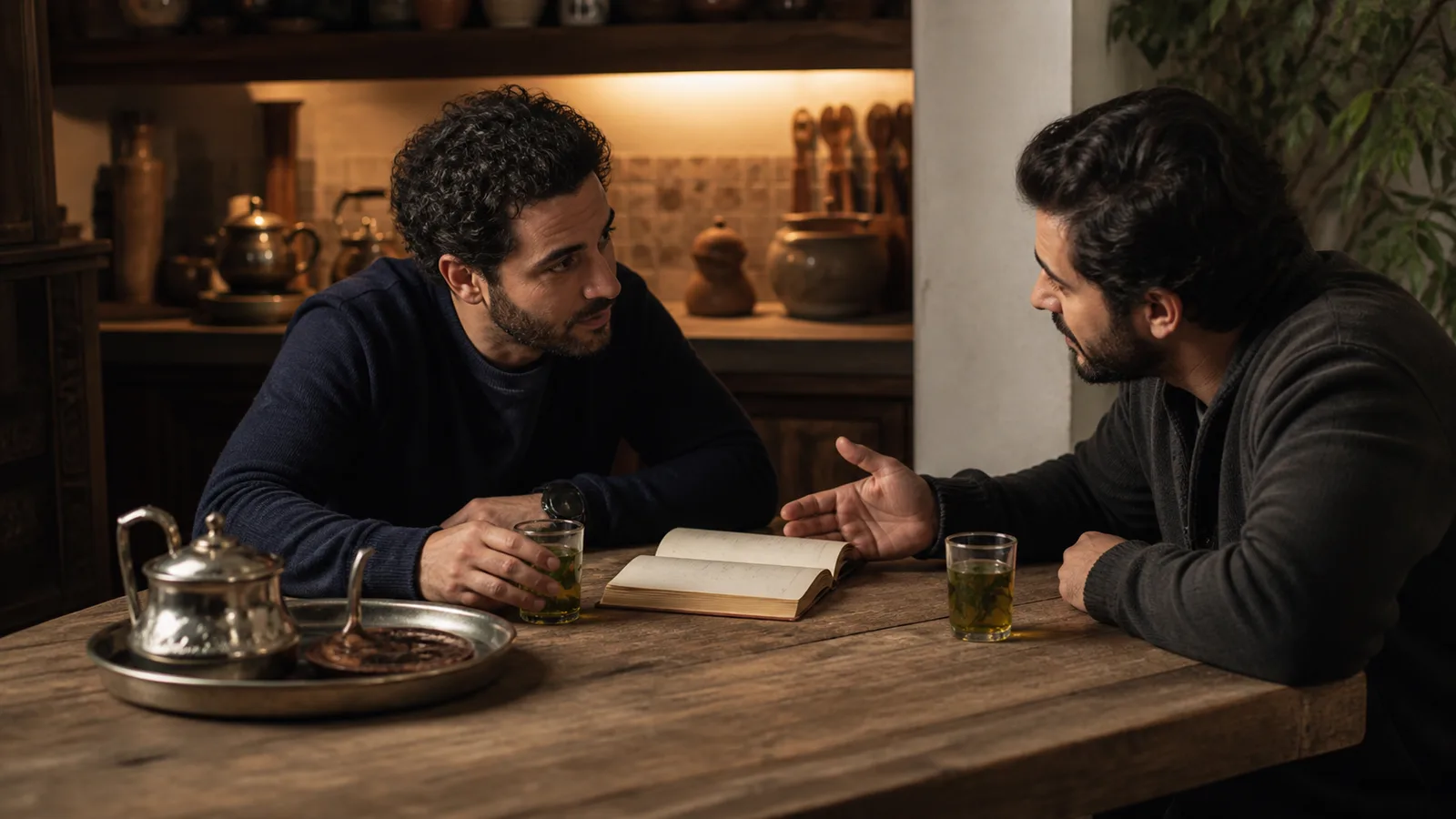
Years ago in the Bay Area, my neighbor was a young North African man in his mid-twenties, serious about Islam in a way that shaped everything visible about his household. I’d sit in his living room and we would talk for hours — sometimes about programming, mostly about God. When prayer time came he didn’t excuse himself or wait for me to leave. He prayed right there in front of me, and I sat in the awkwardness and quietly prayed too, to my God, for him. I’ll give you the honest scorecard from those evenings: I spent most of them defending Christianity and almost none of them asking hard questions about Islam, because back then I only knew my half of the conversation. He was kind, hospitable, completely sincere — and, as far as I could read him, exactly the kind of Muslim who would welcome sharia if it were on offer. Both of those things were true at once. I’ve carried those evenings for fifteen years, and this article is mostly what I wish I had known then.
Conversations like that are rarer than they should be, and the shortage is on our side of the fence. Part 1 of this series counted who your Muslim neighbor actually is. This article is about the conversation itself: how a Christian talks about Jesus with a Muslim friend without wasting the friendship or wasting the gospel. I’ve watched it done badly in both directions, and the two failures are mirror images. Some Christians love their Muslim neighbors so politely that Jesus never comes up. Others argue at Muslims they’ve never once fed. Neither has any record of working. There is a documented case of what works, so start there.
What it took to reach Nabeel Qureshi#
Nabeel Qureshi grew up in a devout Muslim home in Virginia, memorizing prayers before he could understand them and defending Islam against classmates by grade school (his story, told in his own bestselling memoir). At Old Dominion University he met David Wood, a Christian on the forensics team who did something almost no Christian had done before: he took Qureshi’s faith seriously enough to argue with it. For years. They roomed together at tournaments, ate together, and fought line by line over the reliability of the New Testament, the crucifixion, and the claims of Muhammad (The Gospel Coalition’s account of the friendship). In August 2005, roughly four years in, Wood baptized him. The book Qureshi wrote about it, Seeking Allah, Finding Jesus, became a New York Times bestseller and won Christian Book Awards for best new author and best non-fiction in 2015. He spent the rest of his short life telling Muslims about Jesus, and died of stomach cancer in September 2017, at thirty-four.
Notice what the conversion required, because Qureshi himself insisted on both halves. It required a friend who loved him, kept eating with him, and stayed for years. And it required that same friend to press real arguments and never pretend the two faiths agreed. Love without contention would have left Qureshi a comfortable Muslim with a nice Christian buddy. Contention without love would have lasted one lunch. The friendship carried the arguments, and the arguments gave the friendship somewhere to go.

That’s the model. Everything below is detail.
Start where his book already agrees#
Most Christians assume a conversation about Jesus with a Muslim starts from zero. It starts from surprisingly far up the hill, because the Quran itself honors Jesus in ways your Muslim friend learned as a child. His book affirms the virgin birth (Quran 3:47, Pickthall), credits Jesus with healing the blind and the leper and raising the dead “by Allah’s leave” (Quran 3:49, Pickthall), and calls him “the Messiah, Jesus son of Mary… a messenger of Allah, and His word which He conveyed unto Mary, and a spirit from Him” (Quran 4:171, Pickthall). Islam’s most trusted hadith collection adds that Jesus will return to “judge mankind justly” (Sahih al-Bukhari 3448). No other figure in Islam, Muhammad included, carries that portfolio. I walked through all of it, with the fences the Quran builds around each honor, in The Jesus of the Quran; read that piece before you lean on this one.
So you never need to talk a Muslim into caring about Jesus. You can open with a real question instead of a pitch: “Your book calls Jesus God’s Word. What do you understand that to mean?” Then listen to the whole answer. You’re not scoring points; you’re finding out what this particular man actually believes, which is the information every next step depends on.
The fault line you cannot sand down#
Common ground is the porch, not the house. The same Quran that honors Jesus denies, by name, the three claims Christianity stands on. Against the Son: “He begetteth not nor was begotten” (Quran 112:3, Pickthall). Against the cross: “They slew him not nor crucified him, but it appeared so unto them” (Quran 4:157, Pickthall). And with the cross goes the resurrection, about which Paul is unsparing: “if Christ has not been raised, your faith is futile and you are still in your sins” (1 Corinthians 15:17).
A Christian who blurs this to keep the peace has stopped doing evangelism and started doing diplomacy. Your friend’s own teachers won’t blur it; the denial of the Son is carved in gold inside the Dome of the Rock, and he learned it before you met him. Muslims generally respect a Christian who states his faith plainly and can say why. What reads as arrogance is not clarity about your book. It’s ignorance of theirs.
Dos and don’ts at the table#
Accept the tea. In most Muslim cultures hospitality carries moral weight, and refusing it insults the host. If your neighbor invites you in, go, and eat what’s put in front of you. When you host, know the two food rules that matter: the Quran forbids pork outright (Quran 5:3, Pickthall) and observant Muslims avoid alcohol (Quran 5:90, Pickthall). Serving neither, without being asked, tells your guest you bothered to learn something about him. Asking “what can I cook that your family will enjoy?” tells him more.
I got this rule from the receiving end. The neighbor I told you about had me in his home over and over, hours at a time, and none of it was arranged in advance; his door was simply open. Fifteen years later I can’t tell you what we ate or drank, and I won’t invent a menu for you. What I can tell you is that the welcome itself did work no argument of mine could do. It made us neighbors before it made us debaters, and every hard word between us landed inside that welcome.

Respect the devotion you’ll see. Observant Muslims pray five set times a day, and many will do it in front of you rather than skip it, the way my neighbor did. Don’t treat it as an awkward pause. A man who stops mid-evening to pray is showing you exactly how seriously he takes God, which is the seriousness your conversation gets to inherit. Plenty of Christians who tut about it haven’t prayed visibly in front of anyone in years.
Never mock Muhammad to his face. This site examines Muhammad’s record from the sources, hard, and will keep doing so; that work belongs in writing, where claims carry citations and a reader can push back. Across a table, ridicule of the prophet reads to your friend the way ridicule of your mother would read to you, and the conversation dies on the spot. You can lose the person to win a point. Wood spent four years pressing Qureshi on the historical Muhammad and never needed a sneer to do it.
Ask real questions, because your friend is not a textbook. Muslims run a wide spectrum, from strict traditionalists to the culturally Muslim family that keeps Ramadan the way nominal Christians keep Christmas. Among American Muslims, 64 percent say there is more than one true way to interpret Islam, and Western Muslim polling on Islamic law diverges sharply from Muslim-majority polling (the reform-movement data bears this out). Assigning your neighbor the textbook position is a factual error before it’s a social one. Ask what he believes. He’ll usually tell you, gladly, and then ask what you believe, which is the invitation you were waiting for.
Know your own book, because he’ll test it. The objection you should expect first is tahrif, the doctrine that Jews and Christians corrupted their scriptures, which is how your friend reconciles respecting the Injil in principle while rejecting your Bible in fact. There’s a sourced answer, and I’ve written it up in Answering Islam’s Questions; read it before the topic arises, because “I’ll get back to you” spends credibility you’ll want later. The general rule: a Christian who has read neither the Quran nor much of his own Bible brings nothing to this table but sentiment.
The question the scales can’t answer#
Everything above is method. Here is the message, and the place it lands hardest.
Islam’s picture of judgment is a weighing. “Then those whose scales are heavy, they are the successful. And those whose scales are light are those who lose their souls” (Quran 23:102–103, Pickthall). Your friend’s standing before God is an open ledger until the day it’s read, and his own scripture has Muhammad commanded to say: “I am no new thing among the messengers (of Allah), nor know I what will be done with me or with you” (Quran 46:9, Pickthall). If the prophet himself is told to disclaim knowledge of his own outcome, the devout man at your table lives with a question his devotion cannot close. I have heard that uncertainty from Muslims directly, offered not as complaint but as simple doctrine: no one knows.
The gospel’s answer is a finished verdict, not a heavier scale. “It is finished” (John 19:30). “For by grace you have been saved through faith. And this is not your own doing; it is the gift of God, not a result of works, so that no one may boast” (Ephesians 2:8–9). “I write these things to you who believe in the name of the Son of God, that you may know that you have eternal life” (1 John 5:13). Know, present tense, is a word Islamic soteriology does not offer, and in my experience no contrast lands with more force. So ask the question the scales raise: “If you stood before God tonight, do you know how it goes?” Then be ready to say why you do, which is not confidence in your own ledger but in someone else’s cross.
What saying yes will cost him#
Weigh what you’re inviting your friend into before you resent his hesitation. In 22 countries, leaving Islam is a crime, and if his family traces back to one of them, he knows it. Even in America the price is usually paid at home: Qureshi’s baptism cost him the unclouded love of the parents who raised him, a grief he carried publicly for the rest of his life. Jesus promised converts a hundredfold return in “houses and brothers and sisters and mothers and children” (Mark 10:29–30), and the church is how that promise gets kept. If you lead a Muslim to Christ and then leave him alone on Sundays and holidays, you’ve handed him the cross and kept the family. Don’t start what your congregation won’t finish.
Peter’s instruction covers the whole method in one verse: “always being prepared to make a defense to anyone who asks you for a reason for the hope that is in you; yet do it with gentleness and respect” (1 Peter 3:15). Prepared, so do the reading. A defense, so don’t dodge the fault line. Gentleness and respect, so accept the tea and honor the man. Qureshi got all three from one friend who stayed four years.
So here’s the assignment, and it isn’t rhetorical. Within the month, share a meal with a Muslim you know: accept an invitation or extend one, with the food rules above already handled. Somewhere over that table, ask the God’s-Word question and listen further into the answer than feels comfortable. The argument will come. Qureshi’s story says the table has to come first.
Go deeper#
- Nabeel Qureshi, Seeking Allah, Finding Jesus. The full account of the friendship and the arguments this article is built on; give a copy to the Christian who thinks evangelism to Muslims is hopeless.
- Nabeel Qureshi, No God but One: Allah or Jesus? The companion volume that weighs the two faiths’ central claims side by side, tahrif and the crucifixion included.
- James White, What Every Christian Needs to Know About the Qur’an. The homework for the “know your own book” rule, and their book too.
- David Wood, Acts 17 Apologetics. The friend in the story; his debate archive shows what contending without a sneer looks like in practice.