The Questions That Open Doors
Nine questions Christians can ask Muslim friends, why each one works, and where the conversation goes — from assurance of paradise to the Sana'a manuscript.
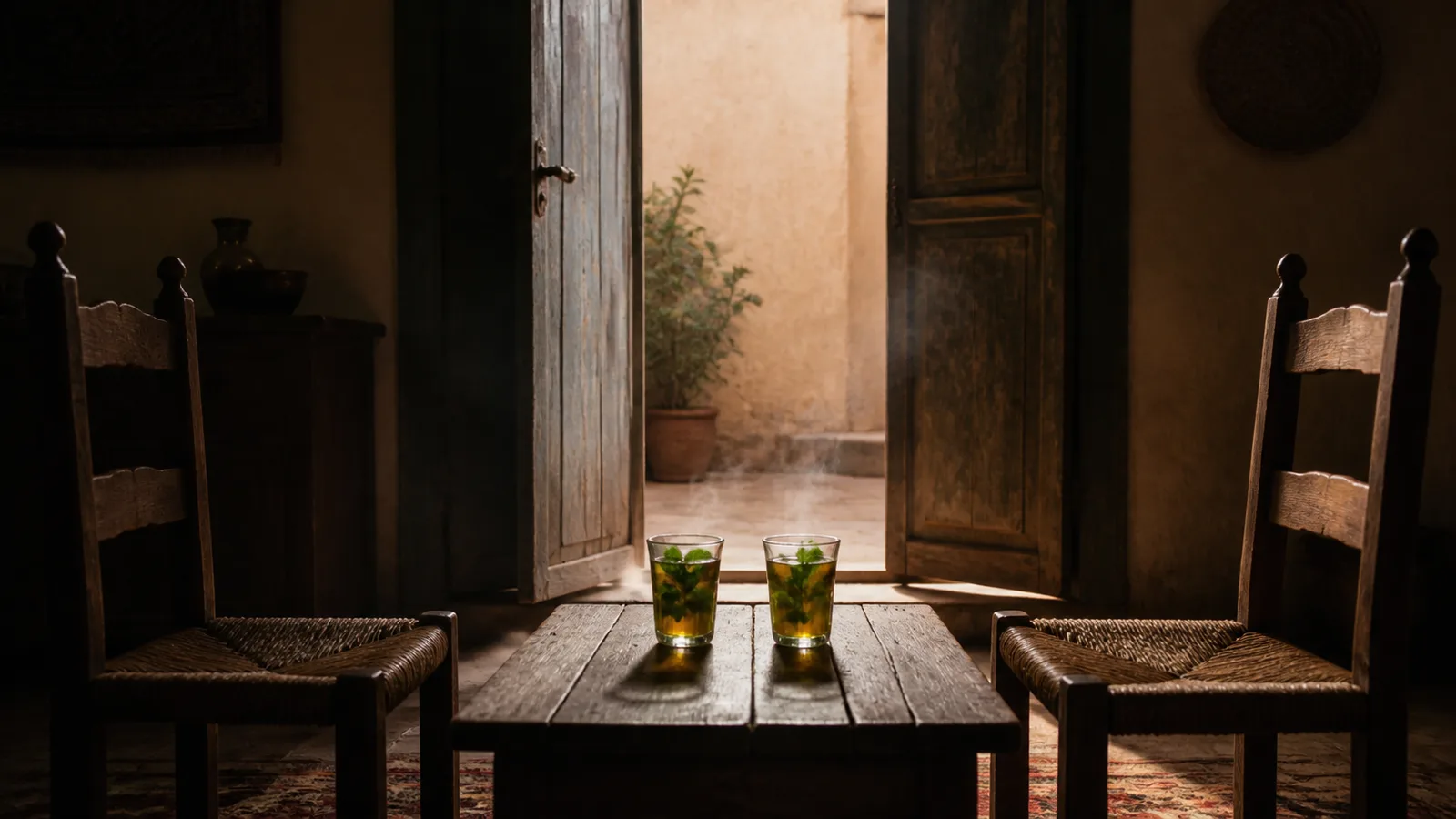
The best evangelists to Muslims I’ve read and watched share one habit: they mostly ask questions. That’s not a soft option for the timid; it’s how the work gets done, and there are two reasons why. The first is that Islamic civilization honors serious religious debate and has since its first centuries. Around 782 the caliph al-Mahdi hosted the Christian patriarch Timothy I for two days of theological disputation at his own court, and Theodore Abu Qurra spent a career making the Christian case in Arabic, in Islamic idiom, to Muslim audiences. The Quran itself sets the register: “Call unto the way of thy Lord with wisdom and fair exhortation, and reason with them in the better way” (Quran 16:125, Pickthall). A Muslim neighbor who would bin a tract will often lean into a serious question, because his own tradition tells him serious questions deserve serious answers.
The second reason is better than the first. A lecture treats your neighbor as a container to fill. A question treats him as a mind and a soul, which is what Peter requires anyway: give your defense “with gentleness and respect” (1 Pet 3:15). What follows are nine questions, the reasoning behind each, and where each one tends to lead. They are not a script. They’re a toolkit, and the tools only work in the hands of a friend.
The ground rules#
Listen 70 percent of the time and talk 30. Plant one seed per conversation; you are not trying to land all nine of these over one plate of food, you’re trying to leave behind a single question your friend keeps turning over after you’ve gone home. Never ask a question as a trap, because your friend will feel the trap before you finish the sentence, and a question asked to humiliate closes the very door these are meant to open. And let hospitality outrank the scoreboard. Share meals. Accept invitations. The conversations that matter happen at tables, not podiums.
The register these questions deserve is something my old neighbor taught me without meaning to. The North African man I wrote about in part 2 once had me over on an evening when three other young Muslim men were at his apartment. We played video games, and when prayer time came the four of them stopped and prayed right there, and I was welcome to stay where I sat. So I stayed, and I prayed silently to my own God for them. It felt awkward, and I wasn’t sure then, and am not sure now, what the right theological posture is for a guest in that moment. But those men assumed God could interrupt an evening of video games, and that a guest would understand. A friend who takes God that seriously will not be scandalized by a serious question. He may be relieved someone finally asked one.

Start with assurance#
“Do you know, today, whether you will enter paradise?”
This is the place to begin because it touches the point where Islam’s own architecture leaves a gap. The Quran’s picture of judgment is a weighing: “Then those whose scales are heavy, they are the successful. And those whose scales are light are those who lose their souls, in hell abiding” (Quran 23:102–103, Pickthall). The weighing happens at the end, so certainty now is structurally unavailable. Even Muhammad is told to say, “nor know I what will be done with me or with you” (Quran 46:9, Pickthall). Most Muslims answer this question with hope in God’s mercy, and mean it; what the system cannot hand them is a promise. Where it goes: John writes “that you may know that you have eternal life” (1 John 5:13). Read that aloud, slowly, and then stop. Let the word “know” do its work without your help.
“Can you show me where Muhammad offers you forgiveness?”
Muhammad is commanded in the Quran to seek forgiveness for himself: “ask forgiveness for thy sin and for believing men and believing women” (Quran 47:19, Pickthall). Nowhere in the book does he grant forgiveness to anyone. Then open Mark, where Jesus looks at a paralyzed man and says, “Son, your sins are forgiven” (Mark 2:5), and the scribes call it blasphemy because only God forgives sins, which is exactly Mark’s point. Where it goes: the mediator conversation. Islam offers prophets and scales; the gospel offers a priest.
Questions about Jesus and the Word#
“Who is Isa to you, and why does the Quran give him titles it gives no one else?”
Most Christians have no idea how high the Quran’s Jesus already stands. He is born of a virgin (Quran 19:20–21), called “His word which He conveyed unto Mary, and a spirit from Him” (Quran 4:171, Pickthall), announced as “a faultless son” (Quran 19:19, Pickthall), credited with healing the blind and the leper and raising the dead by Allah’s leave (Quran 3:49), and taken up alive by Allah himself (Quran 4:158). No other figure in the Quran carries that set of titles. Not Moses. Not Muhammad. Where it goes: ask your friend to read 4:171 with you and explain what “His Word” means. You aren’t springing anything on him; you’re asking him to walk you through the highest Christology in his own book.
“If the Quran is God’s eternal, uncreated speech, how is that different from what I believe about Christ?”
This one takes homework. Sunni orthodoxy holds the Quran to be God’s uncreated, eternal Word, a doctrine Muslims fought a state inquisition over in the ninth century (the mihna). So the standard Muslim objection to the Trinity, that nothing eternal can exist alongside God without becoming a second god, proves too much: Sunni Islam itself confesses an eternal Word with God. Christians noticed early. John of Damascus was posing this exact dilemma to Muslims within about a century of Muhammad’s death. Be honest about the limits: your friend does not secretly believe in two gods, and you should say so out loud. The payoff is symmetry, not a gotcha. Where it goes: it clears the road for the Christian claim that God’s eternal Word became flesh rather than a book.
Questions about the books#
“Why does the Quran tell Christians to judge by the Gospel?”
“Let the People of the Gospel judge by that which Allah hath revealed therein” (Quran 5:47, Pickthall) is a command to the Christians of Muhammad’s day to evaluate by the Gospel they held in their hands. Expect the reply that today’s Gospel is corrupted, and then ask when the corruption happened. Complete Greek New Testaments such as Codex Sinaiticus predate Muhammad by roughly three centuries, so corruption before his lifetime would make the Quran’s command an order to judge by a corrupted book, and corruption after his lifetime is ruled out by manuscripts we can still read today. The Quran even tells its own doubters to “question those who read the Scripture (that was) before thee” (Quran 10:94, Pickthall). Where it goes: your friend has likely never heard either verse discussed. Read them together and let the tension speak for itself.
“Has the Quran been perfectly preserved, letter for letter, and what do you make of the Sana’a manuscript?”
The standard teaching is an unqualified yes, grounded in the Quran’s own promise that God guards the revelation (Quran 15:9, Pickthall). The record, from Islam’s own sources, is more complicated: Sunni Islam’s most trusted hadith collection reports the caliph Uthman standardizing the text around 650 and ordering variant copies burned (Sahih al-Bukhari 4987), and the Sana’a palimpsest preserves an early Quran with the same substance but different wording in many places. I walked through the whole record, including what the evidence does not prove, in What the Quran Actually Is. Read that first, because a half-understood Sana’a reference does more damage than silence. Asked gently, this is the question most likely to send a thoughtful friend to the sources himself, and that is the goal, since preservation is the load-bearing wall of the Muslim case against the Bible.
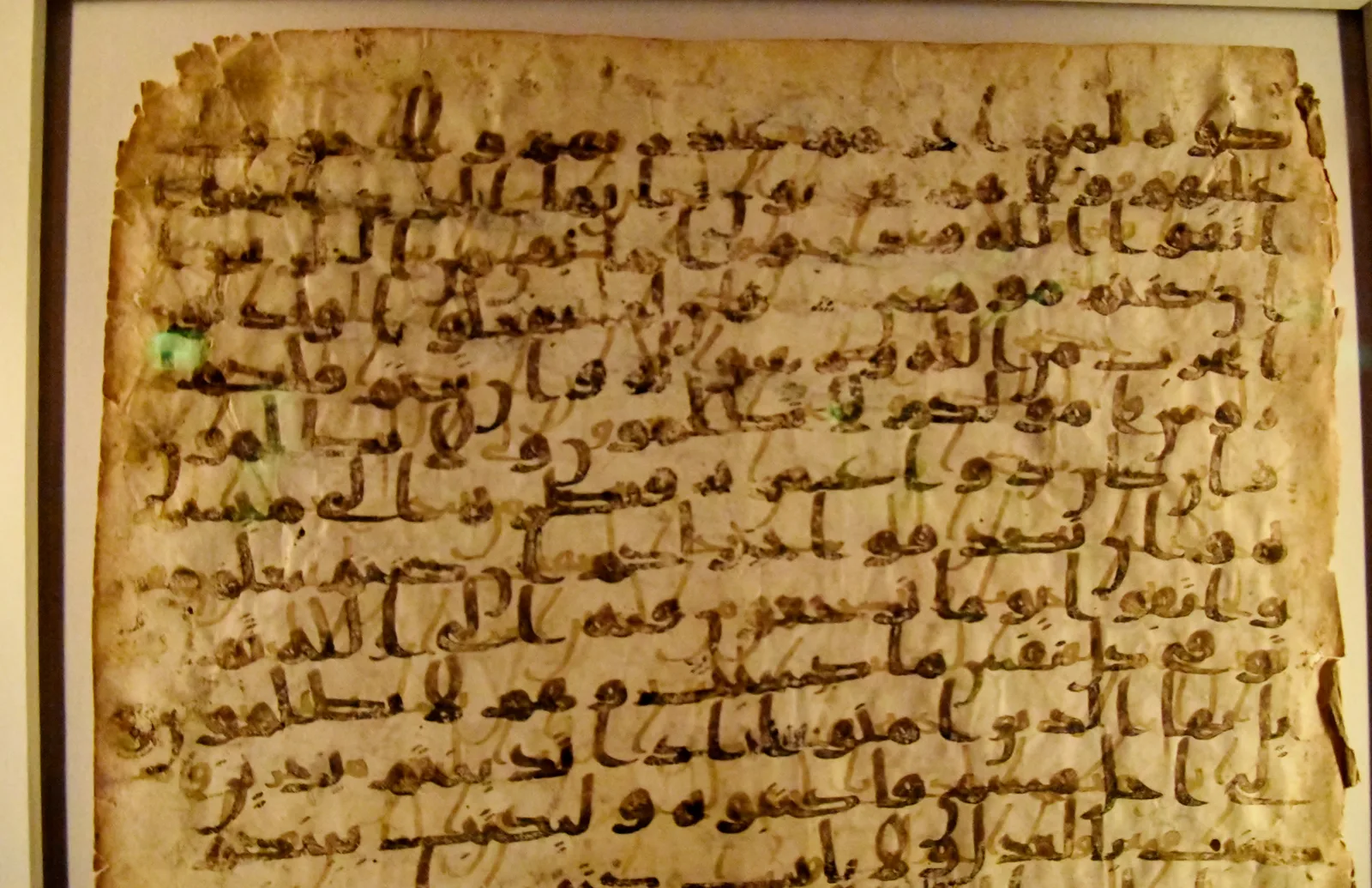
Photo: Richard Mortel, via Wikimedia Commons CC BY 2.0
The hard questions#
“What does sharia actually mean to you?”
This question refuses the stereotype, which is why it works. Pew’s landmark survey of the world’s Muslims found support for sharia as official law ranging from 99 percent in Afghanistan to 8 percent in Azerbaijan, with supporters disagreeing sharply about what it even contains, and majorities in most countries saying it should apply to Muslims only. Your neighbor is a person, not a poll result, and this question finds out which Islam you are talking with before you say another word. Where it goes: law and justice, and eventually grace, and what law can and cannot make of a person.
“What happens, back home or in your family, to someone who leaves Islam?”
Ask this one late, after trust exists, and ask it about the community, never as an accusation aimed at your friend. What it surfaces is documented: 22 countries criminalize leaving Islam per Pew’s count, the classical juristic mainstream prescribed death for apostasy, and the modern reformer who challenged that heritage most directly, Mahmoud Muhammad Taha, was hanged for apostasy in Sudan in 1985. Honesty also requires the other half: many Muslim scholars and most Muslim-majority states reject criminalizing conversion, and for your neighbor the live pressure is usually family and community, not courts. The reason to ask is pastoral, not polemical. Your friend may never have said out loud what leaving would cost, and naming the cost clarifies, for both of you, the difference between a faith that is held and a faith that is enforced. Where it goes: freedom. A gospel that can be refused is the only kind that can be freely believed.
The last question#
“Would you read one of the Gospels with me? I’ll read some of the Quran with you.”
Reciprocity is hospitality in book form, and the offer to read his scripture earns you the right to open yours. Suggest Mark: it is short, it moves fast, and Jesus does more in it than he says. Your friend has probably heard about the Injil his entire life without reading a page of it, and his own book points doubters toward the earlier Scriptures (Quran 10:94, cited above), so this is an invitation the Quran itself can approve. Where it goes: out of your hands, which is where it belongs. Jesus speaks for himself better than you speak for him.
Years, not conversations#
Nabeel Qureshi, whose conversion memoir Seeking Allah, Finding Jesus became a New York Times bestseller, met the Christian classmate who would contend with him, David Wood, in 2001 and did not confess Christ until 2005. Four years of friendship, argument, shared meals, and open books. Wood did two things across those years: he stayed in the friendship, and he kept the questions coming. That is the timescale you should expect, and it is why the ground rules matter more than the questions. One seed per conversation, watered by hospitality, over years.
I can vouch for the timescale. The two coworkers I wrote about in The Many Islams, the Iranian Christian and the Afghan engineer, worked beside me for about five years, in cars between site visits and in school buildings deep into the night. None of it was engineered for evangelism; we had work to do, and the work built the trust. Even so, part of what I carried away was a lesson in limits. The Iranian brother’s faith I knew firsthand. My sense that my Afghan friend held his Islam loosely was only ever my read on him, never his own account. Hundreds of hours bought me that much and no more, which is what one seed per conversation looks like from the inside.
So pick one question. Write it down, word for word, so you don’t fumble it under pressure. Invite your Muslim coworker or neighbor to tea or dinner this month, and when the conversation turns to God, ask your one question and then do the hardest thing in evangelism: stop talking and listen.
Go deeper#
- Nabeel Qureshi, Seeking Allah, Finding Jesus (2014). The inside view: what these questions feel like to the Muslim receiving them, over the years they take to work.
- James White, What Every Christian Needs to Know About the Qur’an. The homework behind the two book questions; models arguing from what the sources say.
- Sadeghi & Goudarzi, “Ṣan’ā’ 1 and the Origins of the Qur’ān” (2012). The manuscript study behind the preservation question, free online.
- Pew Research Center, The World’s Muslims (2013). The survey behind the sharia question; read it before assuming what your neighbor believes.