Nigeria's Middle Belt, Village by Village
Plateau, Benue, and Southern Kaduna by name: the massacres, the kidnapped clergy, Leah Sharibu and Deborah Samuel, what the United States has actually done since the October 2025 designation, and the half-million people living in Benue's camps.
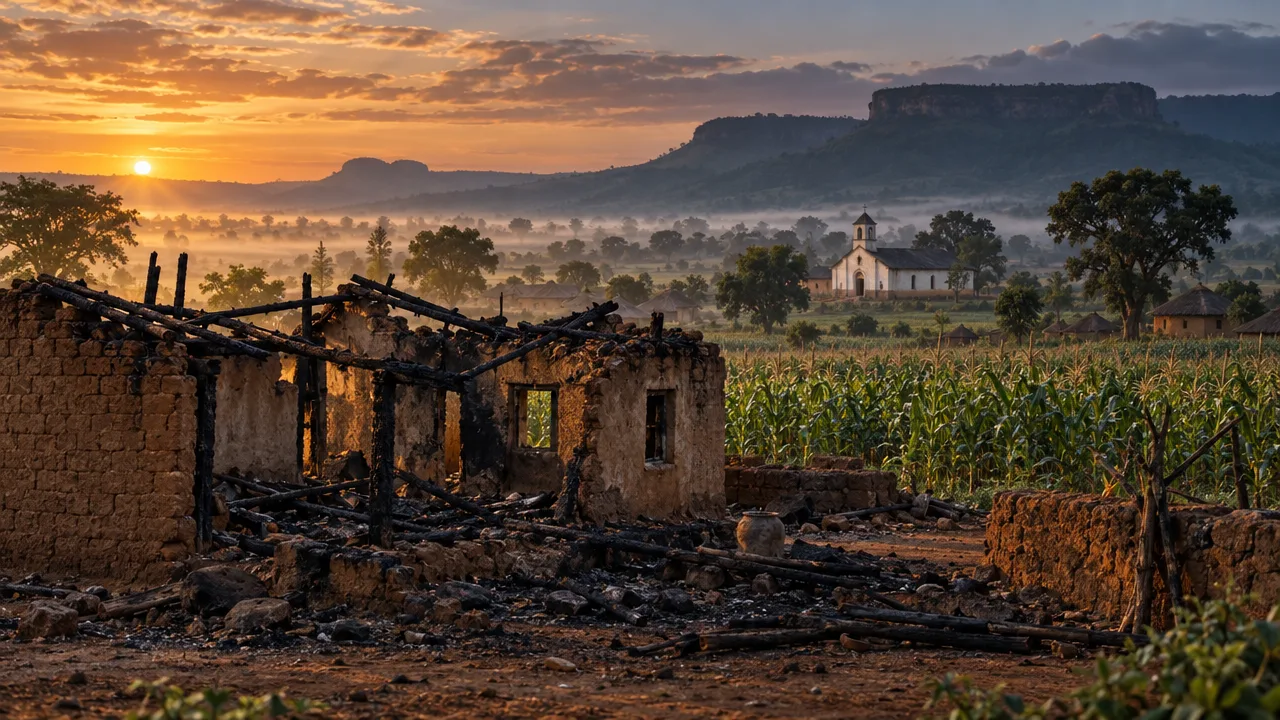
On Christmas Eve 2023, gunmen moved through the farming villages of Bokkos and Barkin Ladi on the Jos Plateau and kept killing for more than 48 hours. Amnesty International Nigeria’s field staff counted the dead as the week went on, and by New Year’s the organization put the toll at more than 190 people across over 20 villages. Its country director said the authorities could do nothing “apart from sympathizing with the victims, which shows helplessness on their side.”
Matthew records a Christmas like that one: “Rachel weeping for her children; she refused to be comforted, because they are no more” (Matthew 2:18).
The overview article in the last series covered the national numbers: the Observatory of Religious Freedom in Africa’s count of 79,323 dead, and why the Intersociety figures that circulated in Washington shouldn’t be repeated. This piece goes down to the villages, the actors, the named cases, and what has happened since the United States put Nigeria back on its religious-freedom blacklist eleven months ago.
Three states where most of the dying happens#
The Middle Belt is the band of central Nigeria where the mostly Muslim north meets the mostly Christian south. Three places carry most of the weight.
Plateau State is highland farming country around the city of Jos. The rural Berom and Mwaghavul peoples are largely Christian; Bokkos, Barkin Ladi, Mangu, Riyom, and Bassa are the local government areas whose names recur in the casualty reports. On 29 March 2026 gunmen hit Angwan Rukuba, a dense neighborhood, and killed more than 28 people as they fled, according to the state governor as reported by Human Rights Watch. Over one July 2026 weekend, attacks in Riyom and in Benue’s Otukpo area killed at least 27 people, Vanguard reported, including nine members of one family in Riyom, the youngest an infant.
Benue State, “the food basket of the nation,” lies south of Plateau along the Benue River. On the night of 13 to 14 June 2025, attackers raided the market town of Yelwata. Amnesty International staff who reached it afterward found bullet casings on the ground and newly dug mass graves; the organization put the dead at more than 100 and the newly displaced at 3,941. Benue officials at first confirmed only 45. When prosecutors charged nine men over the attack in February 2026, Reuters put the dead at about 150; Open Doors’ local partners put it above 200.
Southern Kaduna is the Christian-majority southern half of Kaduna State, with Kajuru and Kauru at its center. The violence there runs heavily to mass abduction. On Sunday 18 January 2026, gunmen took worshippers out of three church services in Kurmin Wali, Kajuru; Christian Solidarity Worldwide reported 167 abducted, and later counts ran higher. State officials first dismissed the reports as false before national police acknowledged the abductions. All the captives were free by 5 February, dozens by escape, and community leaders said they didn’t know who secured the rest or whether ransom was paid.
The killers across all three states are, in most of the documented incidents, armed groups drawn from the Fulani, a large and mostly Muslim pastoralist people. ORFA’s six-year dataset attributes 18,577 identified civilian deaths to Fulani militant groups against 4,941 for Boko Haram and ISWAP combined. That’s the armed groups, not the Fulani people, most of whom are herders and villagers with no part in it. In the northeast, Boko Haram and ISWAP run a separate jihadist insurgency. Farther north-west, “bandit” gangs kill and kidnap mostly Muslim villagers.
Pentecost at Owo, and a verdict four years later#
On Pentecost Sunday, 5 June 2022, gunmen opened fire and set off explosives at St. Francis Catholic Church in Owo, Ondo State, well south of the Middle Belt, and killed more than 40 worshippers. On 3 June 2026, Justice Emeka Nwite of the Federal High Court in Abuja convicted four men on all nine terrorism counts, including membership of a proscribed group the court tied to ISWAP, and sentenced them to death by hanging. A fifth defendant was acquitted.
It’s a rare thing in this story: a named court, named convicts, and a judgment. The Bokkos and Yelwata killings have produced nothing comparable in public.
Clergy in the crosshairs#
The Catholic Secretariat of Nigeria compiled the numbers that matter here. Between 2015 and early 2025, 145 Catholic priests were kidnapped in Nigeria; 11 were killed and 4 are still missing. The rest came home, typically after ransom. Read the geography before you quote it: the worst-hit ecclesiastical province was Owerri in the southeast, with 47 kidnappings, followed by Onitsha and Kaduna. Much of that southeastern total is kidnapping for money in a Christian-majority region. Clergy are targeted because they’re visible and their churches pay. In Southern Kaduna the line between ransom and religious targeting blurs, because the gangs pick church services.
Children are targets for the same reason. On 21 November 2025, gunmen took 303 students and 12 staff from St. Mary’s Catholic school in Papiri, Niger State. About fifty escaped at once; the government announced the last 130 freed on 21 December.
Two women the world should know by name#
Leah Sharibu was 14 when ISWAP fighters took her and more than a hundred classmates from the girls’ school in Dapchi, Yobe State, in February 2018. The others were returned within weeks. ISWAP kept Leah, according to her advocates, because she refused to renounce her faith in Christ. She turned 23 in captivity on 14 May 2026. In June 2026 her parents joined a campaign calling for justice for “Nigeria’s Leahs,” the many girls taken with less attention. USCIRF keeps a page for her in its religious-prisoner database. She is, as of this writing, still held.
Deborah Samuel Yakubu was a second-year student at a college of education in Sokoto. On 12 May 2022, after messages she posted in a class WhatsApp group were called blasphemous, fellow students stoned her and set her body on fire. Video of the killing circulated widely. Two students were charged, but with conspiracy and inciting public disturbance, not murder, and a magistrate later struck out the case and discharged them when the prosecution failed to appear. Nobody has been convicted for her death. Sokoto is not in the Middle Belt. It’s one of the twelve northern states running sharia criminal codes, and Deborah’s case belongs here because it shows the other half of Nigeria’s pattern: the mob that answers an accusation, and the impunity afterward. Part 2 of this series traces the same sequence in Pakistan.
What the October 2025 designation has produced so far#
On 31 October 2025 President Trump redesignated Nigeria a Country of Particular Concern, the religious-freedom law’s strongest label. President Tinubu answered that the label misrepresents Nigeria, which he said “opposes religious persecution and does not encourage it.” Here is what has followed, in order.
- December 2025. Secretary Rubio announced visa restrictions on those who direct or carry out religious-freedom violations, naming “Fulani ethnic militias” among others. By April 2026 the State Department said enforcement had begun; no names have been published.
- 25 December 2025. US forces, with Tinubu’s approval, struck two Islamic State camps in Sokoto State’s Bauni forest, in the north-west.
- 22 January 2026. A US-Nigeria Joint Working Group, led by Under Secretary of State Allison Hooker and National Security Adviser Nuhu Ribadu, met for the first time in Abuja.
- February 2026. Rep. Riley Moore and House appropriators delivered their report to the White House, and Moore and Rep. Chris Smith introduced H.R. 7457, which still sits in committee. About 200 US personnel deployed to train and advise.
- 16 May 2026. A joint operation in Borno State in the northeast killed Abu-Bilal al-Minuki, described as the Islamic State’s global second-in-command. Nigeria said 175 fighters died in the first days of the offensive. In July, most US troops left; intelligence cooperation continues.
- 15 July 2026. The House passed its fiscal 2027 State Department funding bill with an amendment from Rep. Greg Steube to withhold all US aid to Nigeria until the Secretary of State certifies Nigeria is protecting Christians. As of this writing, the Senate has not passed it.
- 12 August 2026. At the Working Group’s second session, in Washington, the two sides reviewed progress on resettling displaced people to their “ancestral homes,” and the State Department listed continuing reports of civilian deaths and gaps in humanitarian-spending transparency among the challenges still open. Nigeria wants off the list.
Set that record beside ORFA’s attribution table and one gap stands out. My read, and it’s mine: nearly all the American firepower went against the Islamic State in the north-west and northeast, while the armed groups that ORFA’s data says kill the most civilians operate in Plateau, Benue, and Southern Kaduna, where the tools so far are unpublished visa bans and a working group. The State Department’s own August statement lists protecting Middle Belt Christians first among its three priority areas. The measure of this designation will be whether the people of Yelwata go home.
Benue’s half-million displaced#
Amnesty International reported that, as of 31 December 2024, 500,182 people were living in displacement camps in Benue State alone, with a quarter of the camp population displaced in 2025. Amnesty described overcrowded, unhygienic camps short of food and clean water, where “disease runs rampant.” That was before Yelwata added its 3,941. An abandoned farm is how land changes hands in the Middle Belt, which is why the State Department’s language about “ancestral homes” matters.
What holds up, what’s contested, and what fails#
Established. Nigeria is the deadliest country on earth for Christians in absolute numbers. The Middle Belt massacres named above happened, at roughly the tolls given, with the sources given. Fulani-identified armed groups are the largest killers of civilians in ORFA’s data. Leah Sharibu is still held. Nobody has been convicted for Deborah Samuel’s killing.
Contested, with the contestants named. Whether the violence is religious persecution or a land war. ACLED-based analysts, HumAngle, the UN, and the Nigerian government stress competition for land and water, and reprisal cycles in which Christian farmer militias also kill Fulani civilians. Hudson’s Nina Shea, CSIS, and ORFA answer that a land war doesn’t explain Christmas Eve raids, church-service abductions, or a kill ratio that runs far above 2.4 Christians per Muslim in the Middle Belt states. The evidence supports both material drivers and disproportionate targeting of Christians. I think the second half of that sentence is what the skeptics most often leave out.
The fact that keeps us honest. On 3 February 2026, a Boko Haram faction attacked Woro and Nuku in Kwara State, bordering the Middle Belt, and killed at least 162 people. The victims were Muslims who had refused the militants’ version of sharia; International Crisis Group called it a new escalation. The jihadists kill Muslims too, in large numbers.
Fails. “Christian genocide,” stated as settled fact: most specialists and the UN reject the legal term, and even ORFA doesn’t use it. Intersociety’s “125,000” figure. And “just a farmer-herder clash,” which fails in the other direction.
Pray for these places and people#
- Bokkos and Barkin Ladi. For families still grieving Christmas Eve 2023, and for the people of Angwan Rukuba in Jos, attacked in March.
- Yelwata and Benue’s camps. For the half-million people in Benue’s displacement camps: clean water, food, medicine, and a safe road home to their own farms.
- Kurmin Wali and the churches of Kajuru and Kauru. For the worshippers freed in February and the pastors who still hold Sunday services on the Southern Kaduna roads where the gangs wait.
- Leah Sharibu and her parents. For her release, and for every girl like her whose name never trended.
- Deborah Samuel’s family. For justice in Sokoto. And for the Muslim families of Woro, who buried their own dead in February.
- The men at the table. Under Secretary Hooker, National Security Adviser Ribadu, Nigeria’s police and soldiers, and the gunmen themselves, that they would be stopped and turned. “Let the groans of the prisoners come before you” (Psalm 79:11).
Stand up this week#
Write your two US senators. The House has acted on Nigeria; the Senate hasn’t, and the Senate confirms and oversees the State Department officials who run the Joint Working Group. Find their contact forms at senate.gov’s contact page and send three sentences in your own words. Ask them to press the State Department to make two named cases standing agenda items at the next Joint Working Group session: Leah Sharibu’s release, and prosecution of Deborah Samuel Yakubu’s killers. Include the link to Leah’s USCIRF victims-database page so the staffer reading it has the file in one click.
Go deeper#
- ORFA six-year report. The best religiously disaggregated dataset on Nigeria’s killings, state by state; read its caveats on how victims’ religion is inferred.
- Amnesty International on Benue, July 2025. A secular human-rights group’s field account of Yelwata and the camps.
- State Department, Second Session of the US-Nigeria Joint Working Group. The government’s own scorecard on what the designation has and hasn’t changed.
- Human Rights Watch on the Angwan Rukuba attack. Short, sober, and pointed about the state’s failure to protect.
- Catholic Secretariat of Nigeria clergy data, via Fides. The province-by-province count of kidnapped priests.