The World Before Islam
Before any Muslim army moved, Rome and Persia spent 26 years destroying each other, and Arabia was already full of Jews and Christians. Part 1 of a sourced history: what Islam actually spread into.
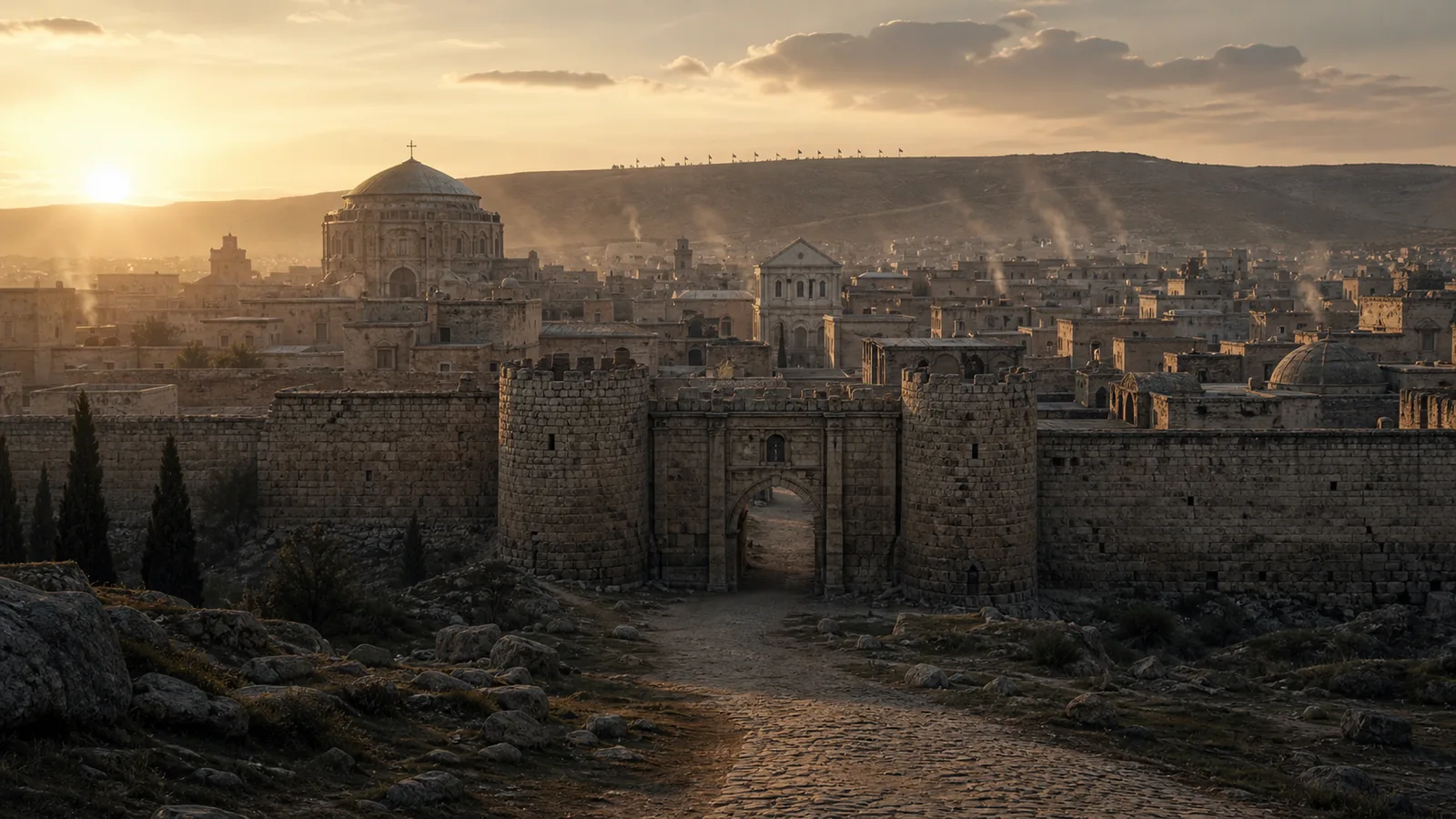
In May of 614, after a siege of about three weeks, a Persian army broke through the walls of Jerusalem. The city burned, and the conquerors carried off the relic Christians prized above every other: the True Cross, hauled east to the Persian capital at Ctesiphon (Robert Schick, The Christian Communities of Palestine from Byzantine to Islamic Rule). Christendom’s holiest city had fallen to a Zoroastrian empire.
No Muslim did any of it. By the traditional chronology, Muhammad was still an obscure preacher in Mecca; Arab forces would not fight a recorded battle in southern Palestine until 634, about twenty years later (Walter Kaegi, “Early Tests in Southern Palestine”). But you can’t understand those armies, or judge how a faith born in a desert town overran both of the world’s superpowers within a generation, unless you first understand the world it moved into: a house whose doors were already coming off their hinges. This series is a history of Islam for Christians who want to contend honestly, and honest contending starts here, before Islam existed at all.
Two empires bleed each other white#
For most of late antiquity, two superpowers dominated the Near East: the East Roman (Byzantine) Empire ruled from Constantinople, and the Sasanian Persian Empire ruled from Ctesiphon. They had fought border wars for centuries. In 602 the border war became something else. The Byzantine emperor Maurice was murdered by a usurper named Phocas, and the Persian shah Khosrow II, who owed Maurice his throne, used the murder to launch a new war (Ruth Altheim-Stiehl, Encyclopaedia Iranica).
What followed was a 26-year war across the Near East. For two decades Persia won almost everything: Syria fell, Jerusalem fell in 614, Egypt, the empire’s breadbasket, fell by 619, and in 626 Persian and Avar forces threatened Constantinople. Then the emperor Heraclius gambled the empire on a counterstrike into the Persian heartland, defeated a Persian army near Nineveh in 627, and watched a palace rebellion overthrow Khosrow in 628 (Walter Kaegi, Heraclius: Emperor of Byzantium; Encyclopaedia Iranica chronology). Khosrow’s successor made peace and returned the conquered provinces. Heraclius carried the True Cross back to Jerusalem, most likely in 630 (Schick).
On paper, the map of 630 looked almost like the map of 600. In reality both empires had spent a generation of men and money destroying each other. Provinces had been occupied, taxed by two masters, and handed back. Within roughly a decade of the peace, Arab forces defeated the main Byzantine army at the Yarmuk (636) and Persian armies at al-Qadisiyyah and in the campaigns that followed; the Sasanian state collapsed, and Byzantium lost Syria, Palestine, and Egypt (Kaegi, “Elements of Failure and Endurance”; Michael Morony, “Arab Conquest of Iran”).
I’m an engineer by trade, and here’s the thing every failure investigation teaches: when provinces held for centuries disappear in ten years, the explanation predates the final defeat. Any account of the Islamic conquests that skips the war of 602–628 isn’t history; it’s a highlight reel.
Arabia in the year 600#
The polemical picture of pre-Islamic Arabia, on both sides, is an empty wasteland: Muslim tradition calls the era jahiliyya, “the age of ignorance,” and Christian polemics often paint a void of camel nomads from which Islam inexplicably erupted. Both pictures are wrong. Much of inner Arabia lacked a single state and was poorer than the neighboring empires, but the peninsula sat inside real trade networks and imperial politics.
Trade, pilgrimage, migration, and imperial diplomacy connected the peninsula to the Red Sea, Syria, Mesopotamia, and the Horn of Africa. Yathrib, the future Medina, was a fertile agricultural oasis. Mecca, in the Islamic historical tradition, was a pagan pilgrimage town built around the Kaaba, a shrine housing the tribes’ idols, run by the Quraysh tribe into which Muhammad was born. The external and epigraphic evidence is much richer for north and south Arabia than it is for the central Hijaz, so the economic scale of pre-Islamic Mecca should not be stated with false precision (Lawrence Conrad, “The Arabs to the Time of the Prophet”).
Here the record requires honesty in two directions. Patricia Crone, the most famous skeptic the field of early Islamic studies ever produced, showed in Meccan Trade and the Rise of Islam (1987) that Mecca was no great international caravan hub, and the town is absent from securely pre-Islamic external sources; yet the same Crone concluded that Muhammad existed, was active in western Arabia in the early seventh century, and that the Quran substantially records his preaching (her openDemocracy memoir). Some Christian apologists have pushed far past her: Dan Gibson’s thesis that the original holy city was Petra, not Mecca, based on the orientation of early mosques, circulates widely on YouTube. The thesis remains outside the mainstream of early-Islam scholarship, but a small line of statistical papers has argued that Gibson’s orientation data deserve more than dismissal (Schumm, 2020; Schumm and Goldstein, 2021). That statistical case relies heavily on Gibson’s measurements and target classifications, now available in a public dataset, rather than a fully independent archaeological replication. David A. King, the leading historian of the qibla problem, raises the central methodological objection: comparing ancient buildings with modern great-circle bearings can mistake coincidental alignment or period orientation conventions for precise aiming. Read together, King’s rebuttal and Gibson’s full response are messier than confident YouTube summaries suggest, with real weaknesses on both sides (King, “The Petra Fallacy”; Gibson’s response). A modest Mecca is defensible. A relocated one isn’t established, and Christians who repeat it as settled fact hand their Muslim neighbor an easy win.
The Jews and Christians of pre-Islamic Arabia#
The “empty wasteland” picture also erases substantial Jewish and Christian communities in Arabia and along its frontiers. In South Arabia, religious and imperial conflict had already turned lethal.
Start in the south. The kingdom of Himyar, in today’s Yemen, was ruled in the early 520s by Yusuf As’ar Yath’ar, remembered in later sources as Dhu Nuwas, a king who adhered to Judaism. In 523 his forces attacked Najran. Christian martyrologies describe believers killed for refusing to renounce Christ, while inscriptions and modern scholarship confirm the campaign but make its motives and casualty totals harder to reconstruct than the martyr accounts suggest. An Aksumite invasion then overthrew Yusuf and placed Himyar under Christian-aligned rule. Abraha later seized power and ruled Christian South Arabia for decades; Islamic tradition connects him with the elephant expedition behind Quran 105, but the event’s chronology and narrative details remain debated. By the late sixth century, Persian intervention had brought Yemen into the Sasanian orbit (Valentina Grasso, “The Shape of the Sixth Century I”; Nathaniel Miller, “Yemeni Inscriptions, Iraqi Chronicles, Hijazi Poetry”). So in the century before Muhammad, Arabia’s richest region passed from a Jewish ruler to Aksumite-backed Christian rule to Persian control, with religious persecution and imperial competition along the way.
The Quran may preserve a memory of Najran. Muslim writers came to associate its “owners of the ditch” with Dhu Nuwas and the martyrs, although the Quran does not name the place or king and the identification remains an interpretation (Lasse Løvlund Toft, “Dhū Nuwās and the Martyrs of Najrān in Islamic Arabic Literature”): “(Self-)destroyed were the owners of the ditch, of the fuel-fed fire, when they sat by it, and were themselves the witnesses of what they did to the believers. They had naught against them save that they believed in Allah” (Quran 85:4–8, Pickthall). Whoever the passage originally meant, it shows a text steeped in the region’s monotheist martyr stories.
Now the middle and the north. Early Muslim historical sources describe three prominent Jewish tribes at Yathrib—the Banu Qaynuqa, Banu Nadir, and Banu Qurayza—alongside the Arab tribes of Aws and Khazraj; the exact treaty relationships among those groups are still debated (Michael Lecker, “The Jewish Participants”). On the northern frontiers, both empires worked through Christian Arab allies: the Jafnid leaders commonly called Ghassanids served Byzantium in Syria, and the Nasrid leaders commonly called Lakhmids served Persia from al-Hira (Conrad; Greg Fisher and Philip Wood on the Persian Arabs). Arabic-speaking Christian kings, bishops, poets, and martyrs were a normal part of the Arabian world for a hundred years before Islam.
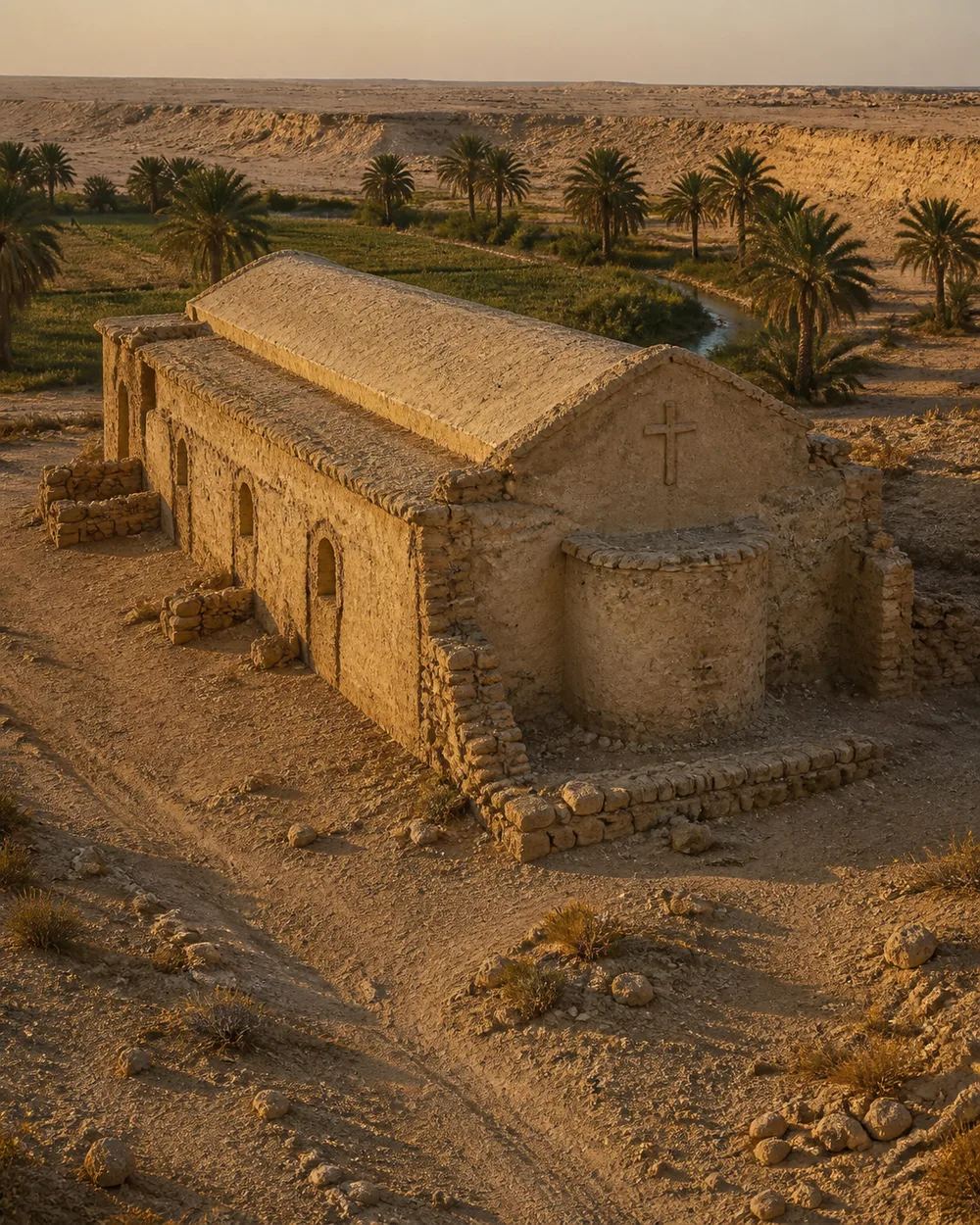
This matters for how a Christian reads what came next. Muhammad didn’t introduce the God of Abraham to Arabia; he preached to people who already knew Jewish tribes and Christian kingdoms. And within sixty years of his traditional death, the new empire’s first great monument, the Dome of the Rock in Jerusalem, carried inscriptions arguing against the Trinity in Quranic language: “Do not say ‘Three’… far be it from Him that He should have a son” (Dome of the Rock inscriptions, 691–92). The argument between Islam and Christianity is as old as Islam itself.
Doors already off their hinges#
Provinces that had been Roman for seven centuries, and a Persian empire four centuries old, fell to Arab armies within about a decade. Four conditions make that speed easier to understand without appealing to miracle or conspiracy.
First, the exhaustion above: two empires that had just spent 26 years burning each other’s tax base and killing each other’s soldiers (Kaegi; Morony).
Second, both empires had destabilized long-standing relationships with Arab frontier leaders. Byzantium arrested the Jafnid phylarch al-Mundhir in 581 and exiled his son in 584. In 602 Khosrow II imprisoned the Nasrid ruler al-Nu’man and abolished his dynasty at al-Hira (Conrad; Ella Landau-Tasseron, “Dhu Qar”). These dynasties had supplied military auxiliaries, diplomacy, and a buffer along the desert frontier. Their removal did not make allied tribes or imperial defenses disappear, and historians disagree about how much it contributed to the later conquests. It did, however, leave both empires renegotiating the frontier on the eve of a new Arab power.
Third, the contested provinces weren’t religiously or politically uniform. Syria and Egypt contained large Miaphysite communities whose churches had long clashed with Chalcedonian imperial policy, and both regions had just lived through Persian occupation and Roman reconquest. That does not prove they preferred a new Arab government. John Moorhead’s study of the Miaphysite sources found their initial response far more ambivalent than the familiar “welcomed as liberators” story assumes (Moorhead, “The Monophysite Response to the Arab Invasions”; Schick). Religious conflict and wartime disruption are documented; cheering crowds are not.
Fourth, the conquerors were not strangers to imperial war. Both empires had recruited and paid Arab forces on their frontiers for generations (Conrad; Fisher and Wood). The desert had watched the empires fight for a long time, including from inside their armies.
And we have a datestamp on how fast it all moved. A Greek Christian dialogue composed in the 630s and set in July 634, the Doctrina Jacobi, reports “a prophet… coming with the Saracens” proclaiming the anointed one to come, and records an old scholar’s verdict: “He is false, for prophets do not come with sword and chariot” (Robert Hoyland, Seeing Islam as Others Saw It). It is one of the earliest surviving Christian assessments of the Arab movement, and the speaker reaches for a theological test. Fourteen centuries of Christian engagement with Islam begin with Christians asking whether the message matches the biblical picture of a prophet, and that’s still the right first question.
By 643, a routine bilingual receipt from Egypt was already dated “year twenty-two” of the new era, the era counted from Muhammad’s move to Yathrib in 622 (PERF 558, discussed in Open Archaeology). The new state was already dating paperwork in a conquered province eleven years after Muhammad’s traditional death.
What this stage-setting buys you#
I want my Muslim neighbors to meet Jesus, and I want my Christian readers able to talk about Islam’s history without flinching and without exaggerating, because “the one who states his case first seems right, until the other comes and examines him” (Proverbs 18:17). The examination cuts both ways. A Muslim case that the conquests prove divine favor has to reckon with two empires that had already wrecked each other. A Christian case that Islam spread purely by uniquely wicked violence has to reckon with the same fact, plus a Jewish king burning Christians in Yemen a century before the hijra. Conquest was the common currency of that entire world. What Islam did with conquest, and what its texts teach about it, is a real question, and this series will press it hard in later parts, from the sources. But it has to be asked against the actual baseline of 600 AD, not against a peaceable kingdom that never existed.
One admission before we move to the sources. Years ago I spent long evenings talking about God with a devout Muslim neighbor, a young North African man I’ve written about elsewhere. I don’t remember any of the history in this article coming up, from either side. I brought my apologetics; he brought talking points, about his book and about mine. What surprised me most, once I noticed it, was how little sat underneath. He knew his half about as thinly as I knew mine, and neither of us knew this ground at all. Most of it I’ve learned in the years since. Some of it I learned writing this piece, alongside you.
Next in this series: the sources themselves. What can actually be known about Muhammad’s life, how late the Islamic biographies are, and why the earliest witnesses to Islam are Christian chroniclers writing in Greek and Syriac.
Go deeper#
- Robert Hoyland, In God’s Path (2015): the Arab conquests told through the earliest evidence, by the scholar who catalogued the non-Muslim sources; the best single book on this article’s subject.
- Robert Hoyland, Seeing Islam as Others Saw It (1997): the reference corpus of every 7th–8th-century non-Muslim notice of early Islam, including the Doctrina Jacobi and its kin.
- Sean W. Anthony, Muhammad and the Empires of Faith (2020): the current state of the art on what can be known about Muhammad from the earliest layers of evidence.
- Tom Holland, In the Shadow of the Sword (2012): a readable on-ramp to late antiquity and Islam’s origins; enjoy the narrative, but treat it as an introduction, not a citation of record.