The Slave Trades Nobody Taught You
The Islamic world's slave systems moved millions of people over thirteen centuries, from the Sahara to a fishing village in Ireland. An honest accounting, with numbers that survive hostile fact-checking and a ledger that indicts Christendom too.

They came ashore a little after two in the morning on June 20, 1631. The village was Baltimore, in West Cork, Ireland; the men moving through it with iron bars and pitch torches were Barbary corsairs. They worked cottage to cottage, hauling families into the lanes in their nightclothes. By sunrise the ships were standing out to sea with 107 captives aboard, most of them English settlers, bound for the slave markets of Algiers. At most three of the 107 ever saw Ireland again.
Two details complicate the clean version. The commander, Murat Reis the Younger, was born Jan Janszoon in Haarlem: a Dutch convert to Islam in a corsair fleet full of European “renegades.” And the pilot who guided the ships into the harbor was a local fisherman named Hackett, who hanged for it. This history refuses to stay simple.
American schooling teaches one slave trade, and it should. It just shouldn’t stop there. This piece is about the other great system, and about a ledger Christendom must sign too.
Thirteen centuries without a manifest#
The Atlantic slave trade can be counted because it kept books. The SlaveVoyages database reconstructs it from roughly 36,000 documented voyages: about 12.5 million Africans forced aboard and 10.7 million landed alive between 1501 and 1866. Those are counts.
The Islamic world’s slave systems (trans-Saharan caravans, the Red Sea and Indian Ocean routes, Crimean raiding for Ottoman markets) kept no comparable records; every total is an extrapolation. The baselines are Ralph Austen’s 1979 “tentative census” (his word) and Paul Lovejoy’s Transformations in Slavery. The serious range is roughly 10 to 15 million people over thirteen centuries, with error bars measured in millions. Claims of 100 or 200 million, or death tolls of 60 to 80 million, have no scholarly basis at all.
The honest comparison: the Islamic-world trades moved the same order of people as the Atlantic trade, spread across more than three times the centuries. The Atlantic trade’s annual intensity was several times higher. The eastern trades ran far longer and ended later. The Atlantic number is a count; the eastern numbers are models. All four clauses have to travel together.

The Atlantic system bought roughly two men for every woman, for plantation labor; the Saharan and eastern systems bought roughly two women for every man, for domestic service and concubinage, plus boys for soldiering and the eunuch trade. Mortality on the desert crossing was severe and unquantifiable; documented caravans sometimes lost large fractions of their captives, and any tidy multiplier (“for every slave who arrived, five died”) is invention.
Two institutions stand out. First the eunuch trade: Islamic law prohibited castration, so the operation happened at the Islamic world’s margins and the finished product was lawfully bought, an outsourcing arrangement Bernard Lewis documents in Race and Slavery in the Middle East (1990); eunuchs commanded the trade’s highest prices. Second the devshirme, the Ottoman levy of Christian boys, mostly Balkan, over roughly three centuries: taken by force from the sultan’s own Christian subjects and trained, after conversion, for the Janissary corps and palace service. Scholarly guesses run from 200,000 to 500,000 boys, extrapolated from scattered registers. Some rose to grand vizier; legally, all were the sultan’s slaves.
And it wasn’t all households and palaces. From 869 to 883, enslaved East Africans (“Zanj”) working the salt marshes of lower Iraq in gang-labor conditions rose in a fourteen-year revolt that sacked Basra before the Abbasids crushed it; a 2025 radiocarbon study in Antiquity dated the vast ridge-field earthworks that servile labor left near Basra. The Zanj falsify the soothing claim that Islamic slavery was mild. It was often domestic and elite-military rather than plantation-based, with stronger manumission norms, and it also included gang labor, mass castration, and concubinage.
The million-European question#
In 2003 the historian Robert Davis published Christian Slaves, Muslim Masters, estimating that 1 to 1.25 million Europeans were enslaved on the Barbary coast between 1530 and 1780, a model built from slave-population snapshots at Algiers, Tunis, and Tripoli plus an assumed 25 percent annual attrition. Historians split over whether the model holds: it multiplies soft numbers across 250 years and uses no Ottoman or North African archives. The defensible sentence is this one: certainly hundreds of thousands of Europeans, and by Davis’s disputed estimate as many as 1 to 1.25 million, were enslaved there.
The viral version says more whites were enslaved by Muslims than Africans were brought to America. On Davis’s contested figures, Barbary may indeed have exceeded arrivals in mainland North America before 1780 (about 389,000); but that compares a disputed model to a count, and the full Atlantic trade ran roughly ten times Davis’s figure. Use the claim with those caveats or not at all.
Baltimore was one night’s work in that economy.
America pays tribute, then goes to war#
Independence cost American ships the Royal Navy’s protection; roughly 700 American sailors were seized between 1785 and 1815 (Frank Lambert, The Barbary Wars, 2005). In 1786, Thomas Jefferson and John Adams met Tripoli’s envoy in London and reported his justification to Congress: the corsairs’ claim “was founded on the Laws of their Prophet, that it was written in their Koran… and to make slaves of all they could take as Prisoners.” The quotation is genuine. It is also the reported speech of a ransom-seeking diplomat: a window into Barbary self-justification, not a jurist’s summary of Islamic law.
America paid first: in 1795 it bought peace with Algiers for roughly $642,500 plus naval stores and an annual tribute (Lambert, The Barbary Wars). Jefferson had argued for force since the 1780s; as president he got his war, the First Barbary War of 1801 to 1805, then Decatur’s second in 1815. Corsairing died with the French conquest of Algiers in 1830.
One document from that era gets abused from both directions. The Treaty of Tripoli, ratified unanimously by the Senate and signed by President Adams in 1797, contains an Article 11 in its English text: “As the Government of the United States of America is not, in any sense, founded on the Christian religion…” In 1931 the State Department’s Hunter Miller examined the Arabic original and found no Article 11 at all; the corresponding page is an unrelated letter from the Dey of Algiers, and how Barlow’s English acquired the sentence “is a mystery and seemingly must remain so.” The clause was dropped from the 1805 treaty that superseded it. The Senate knowingly ratified the English text, so Article 11 stands as what the founding generation could publicly affirm without protest; Tripoli never agreed to it, so it fails as a meeting of minds. Secularists overread a diplomatic assurance that America would not crusade; Christian nationalists overread a translation discrepancy. It tells us what could be said to Tripoli in 1797, not what the Constitution is.
What Islamic law said#
The Quran regulates slavery; it nowhere abolishes it. It presses manumission as piety: “Ah, what will convey unto thee what the Ascent is! (It is) to free a slave” (Quran 90:12–13, Pickthall). And it grants a male owner sexual access to his female slaves, the “what your right hands possess” of several verses: “And all married women (are forbidden unto you) save those (captives) whom your right hands possess” (Quran 4:24, Pickthall; see also 4:3 and 23:5–6). Classical exegesis is unanimous that these verses permit concubinage without marriage; Jonathan Brown, whose Slavery and Islam (2019) is the most serious recent Muslim-scholar treatment, concedes the legal facts frankly while contesting the moral framing. Per the core Islamic sources, Muhammad himself owned slaves, took captives, freed slaves, and fathered a son, Ibrahim, by his concubine Mariya the Copt.
Classical jurisprudence built the rest into settled law: enslavement limited in theory to non-Muslims captured in jihad and children born to slave mothers; concubines unlimited beside the four-wife cap; and the umm walad rule, under which a slave woman who bore her master’s child could no longer be sold and went free at his death, her child free and legitimate — meliorative next to the American system, which enslaved even the master’s own children. And across thirteen centuries, no school of jurisprudence, Sunni or Shia, held slavery itself unlawful before modern states abolished it. Pre-modern Christian theology, as we’ll see, fares no better on that score.
Abolition arrived on British ships#
Tunisia’s Ahmad Bey issued the Muslim world’s most notable internal abolition in 1846, earlier than the United States and framed in Islamic legal terms. Nearly everything after came under outside pressure. The Ottoman firman of 1857 banned the Black slave trade empire-wide with one telling exemption, the Hijaz, after Mecca’s religious scholars resisted; Ehud Toledano’s standard studies conclude British diplomatic pressure was the prime mover and enforcement was weak. Zanzibar’s slave market closed in 1873 under a British ultimatum; the Royal Navy strangled the seaborne trades. W.G. Clarence-Smith, whose Islam and the Abolition of Slavery (2006) is the standard monograph, documents real internal abolitionists (Ahmad Bey, the Indian modernist Sayyid Ahmad Khan) yet concludes Islamic institutions had “an ambivalent and generally muted impact on the legal repudiation of slavery.” Abolition laws came overwhelmingly under European pressure or colonial rule; internal Muslim abolitionism was a late and contested minority position.
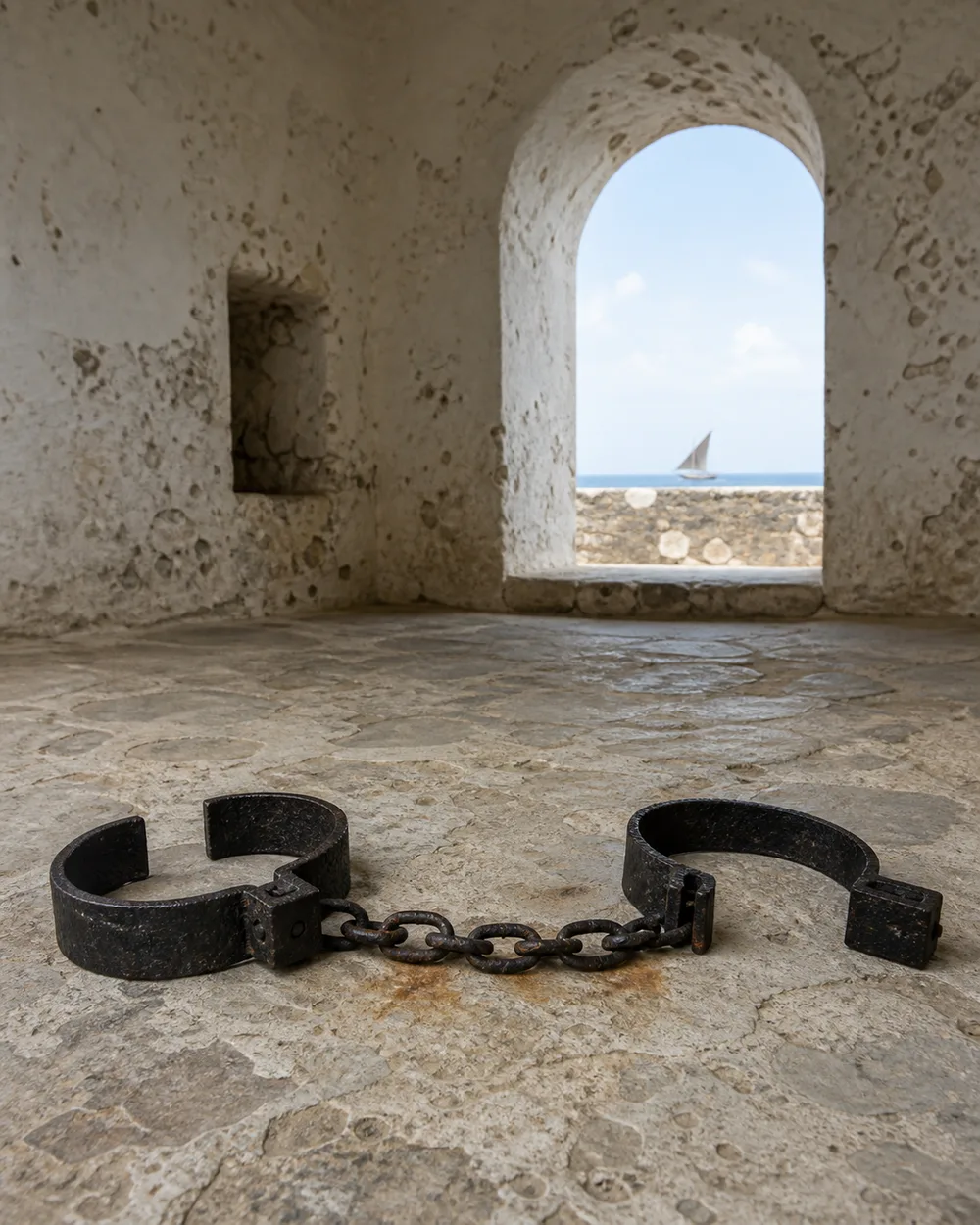
The dates land hard. Saudi Arabia abolished slavery in November 1962; Yemen the same year; Oman in 1970, the world’s last formal abolition. Mauritania decreed abolition in 1981, criminalized it only in 2007 and declared it a crime against humanity in 2015, and hereditary slavery of Haratin people persists now; Walk Free’s index ranks Mauritania at or near the world’s highest prevalence, the European Parliament and UN bodies concur, and convictions remain a handful.
Then came 2014. ISIS enslaved Yazidi women and children at Sinjar (about 6,800 kidnapped and 3,100 killed within days, by a peer-reviewed estimate) then published its justification in its magazine Dabiq, “The Revival of Slavery Before the Hour,” complete with legal citations and registered slave markets. More than 120 senior Muslim scholars answered in the Open Letter to al-Baghdadi, declaring re-enslavement forbidden, arguing from modern consensus rather than claiming classical law never permitted it. Both bumper stickers fail here. ISIS’s slavery was not “nothing to do with Islam”; it revived rules classical jurists really held. And it was not normative Islam; virtually every contemporary Muslim authority declares that legal door closed, which is why ISIS’s propaganda attacked mainstream Muslims for abandoning slavery.
The ledger Christians sign too#
Now the part a Christian writer doesn’t get to skip. The largest single slave system in history was built and run by Christian powers: the Atlantic trade’s 12.5 million, with Catholic Brazil receiving about 45 percent. It launched with papal sanction: Dum Diversas (1452) and Romanus Pontifex (1455) authorized Portugal to reduce “Saracens and pagans” to perpetual slavery. The Anglican SPG’s Codrington plantations branded the people they owned. And as Mark Noll shows in The Civil War as a Theological Crisis, the proslavery biblical argument was exegetically serious, and the American impasse was settled by war, not by exegesis. Anyone who tells you Christianity was always anti-slavery is selling something.
But finish the ledger. Organized abolitionism grew out of Christian societies: the Quaker Germantown protest of 1688, the evangelical mobilization behind Clarkson and Wilberforce, Britain’s abolition of the trade in 1807 and of slavery in 1833, and the naval suppression that then bore down on both trades (Christopher Leslie Brown’s Moral Capital is the standard account). Why did that fire catch in London and Philadelphia rather than Istanbul or Fez? Part of the answer is textual. The Quran and the Prophet’s practice give direct, positive legal warrant for slaveholding and slave-concubinage, so a Muslim abolitionist must argue around explicit permission and precedent. The New Testament contains no command instituting slavery and no warrant for concubinage, and it carries seed texts the abolitionists detonated: “There is neither Jew nor Greek, there is neither slave nor free… for you are all one in Christ Jesus” (Galatians 3:28); Philemon, an entire letter pressing a master to receive his slave back “as a beloved brother” (Philemon 16). Proslavery divines had verses too, and Christendom took eighteen centuries and a civil war to act on the seeds. But the seeds were there, and they grew.
The point of this comparison is not to win a contest of atrocities. It’s to know the record well enough to tell the truth with a straight face and a soft heart. I want my Muslim neighbors to meet Jesus, and I have learned that nothing ends that conversation faster than a Christian armed with inflated numbers he can’t defend.
So say “hundreds of thousands” for Barbary if you can’t defend a million and a quarter. Say “estimates, not counts” for the Sahara. Concede Brazil and Codrington before you’re asked. The record is heavy enough without inflation, and a man caught inflating it teaches his listener to discount everything else he says, including the gospel.
Baltimore’s stolen villagers have their memorial; their story ends in the past tense. Mauritania’s hereditary slaves are still current events: a handful of convictions against a standing crime. Any honest telling of this thirteen-century story ends with them.
Go deeper#
- Des Ekin, The Stolen Village: the 1631 Baltimore raid told in full.
- Robert C. Davis, Christian Slaves, Muslim Masters: the Barbary numbers argument firsthand; read it knowing specialists dispute the model.
- W.G. Clarence-Smith, Islam and the Abolition of Slavery: the standard account of how, and under whose pressure, abolition reached the Muslim world.
- Jonathan A.C. Brown, Slavery and Islam (Oneworld, 2019): the most serious Muslim-scholar treatment, candid on facts, contestable on framing.