Who Built the Golden Age?
The Islamic Golden Age was real, and so is the question of attribution. Syriac Christian translators, Sabian scholars, Persian and Central Asian scientists, Jewish physicians, and Abbasid patrons all belong in the ledger.
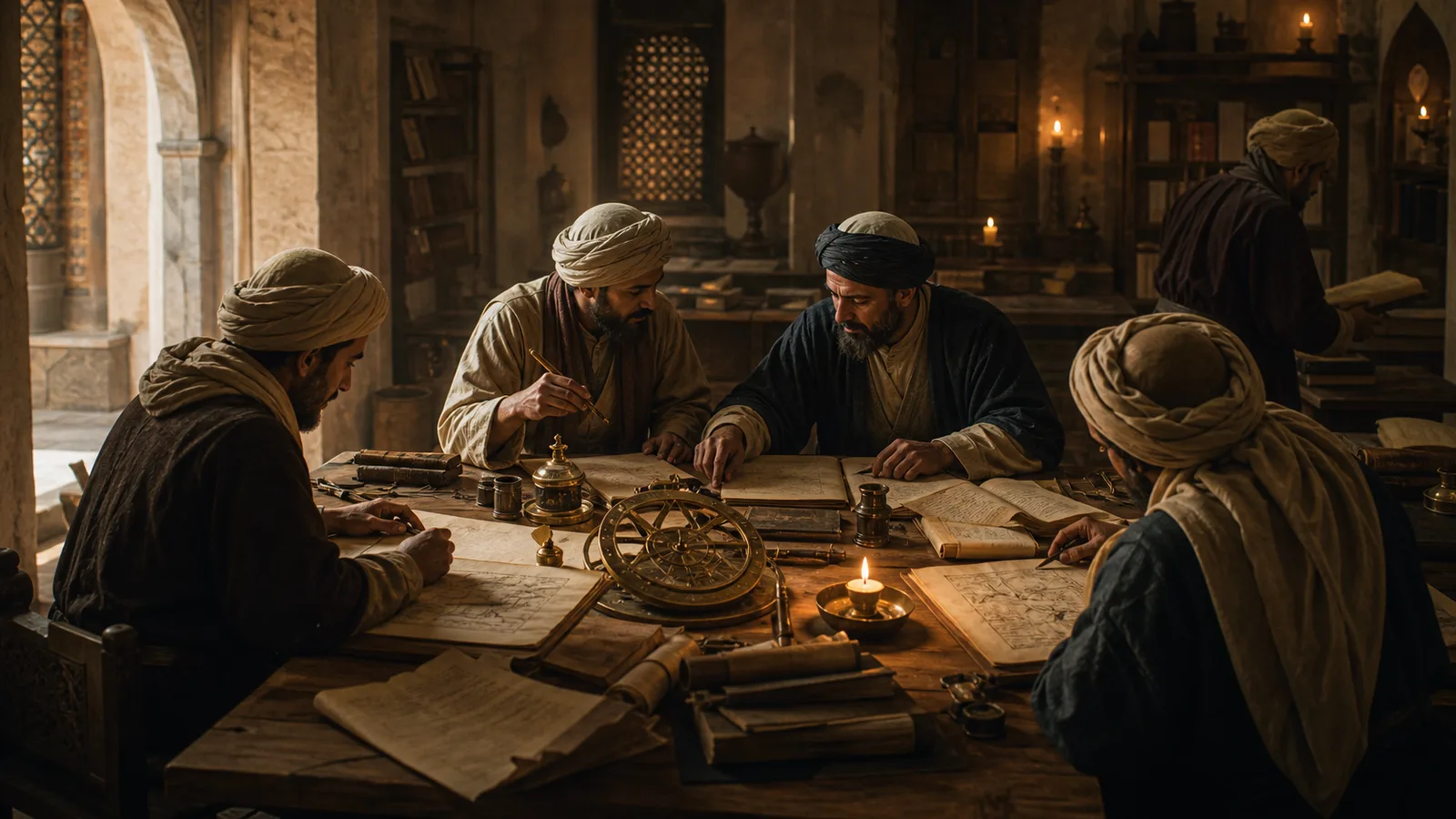
“It is a remarkable fact that, with few exceptions, most Muslim scholars in the intellectual sciences have been non-Arabs.”
That sentence was not written by a critic of Islam. It comes from Franz Rosenthal’s translation of Ibn Khaldun’s Muqaddimah, a work Ibn Khaldun completed in 1377. Ibn Khaldun applied the observation to both religious and intellectual learning, named Persian grammarians and jurists, and tied scholarship to long-settled urban culture. That is a medieval sociological argument, not a demographic census and not a clean map onto modern ethnic categories.
So when you hear the two stock claims about the Islamic Golden Age, the one from the da’wah pamphlet (“Islam gave the world modern science”) and the one from the comment section (“they stole it all from the Greeks”), it’s worth knowing that a Muslim scholar writing six hundred years ago already had the evidence that complicates both. This article is the attribution audit. I’m an engineer by trade, and when a system performs, I want to know which components did what. The answer here is documented, specific, and more interesting than either polemic.
The translators were mostly not Muslims#
Between roughly 750 and 1000, almost all the scientific and philosophical secular Greek works available in late antiquity were translated into Arabic, according to the scholarly overview of Dimitri Gutas’s Greek Thought, Arabic Culture. Look at who did much of that work.
Many leading translators were Syriac-speaking Christians. The towering one is Hunayn ibn Ishaq (808–873), a Nestorian Christian who, with his son and nephew, translated a large body of Galen and Hippocrates. He traveled through Syria, Palestine, and Egypt hunting manuscripts so he could compare copies before translating, a method philologists still respect. Some Greek medical works are known through this Arabic transmission. He served as physician to the caliph al-Mutawakkil and remained Christian. He was one name in a larger Syriac Christian translation tradition, and Christian medical families such as the Bakhtishu’ served Abbasid courts for generations.
The mathematics crossed confessional lines too. Thabit ibn Qurra (826–901), who translated and revised Euclid, Archimedes, Apollonius, and Ptolemy and did original number theory of his own, belonged to the Harranian community the sources call community Sabians of Harran A Syriac-speaking religious community associated with Harran. The mathematician and translator Thabit ibn Qurra belonged to it. Medieval sources call the group Sabian, but it should not be assumed to be identical with every community called Sabian in Quranic or later sources. The label Sabian was used for more than one community. This entry is specifically about the Harranian community linked to Thabit ibn Qurra. Open reference note Check the source ; his background and language work are summarized in a university history of mathematics. The community’s exact beliefs and its use of that Quranic name remain debated, so “pagan star-worshipper” is too neat a label. Persian bureaucrats and scholars carried Sasanian traditions into Baghdad. Jewish scholars participated in medicine, philosophy, and later translation across Arabic, Hebrew, and Latin.
Patronage was not a footnote. The Banu Musa brothers famously paid around 500 dinars a month for translation work. Al-Kindi, “the philosopher of the Arabs,” commissioned and revised translations and then built original philosophy on top of the results. Caliphs, court officials, booksellers, scholars, and translators all formed part of the same knowledge economy. The record does not support reducing Arab Muslims to check writers any more than it supports erasing the Christian and other non-Muslim specialists who did much of the translation.

The patron was an empire with an agenda#
If the story stopped there, the “they just borrowed it” crowd would win. It doesn’t stop there, and Gutas is the reason it doesn’t.
Gutas argues that Abbasid translation was massive, sustained, and connected to imperial ideology: al-Mansur’s use of Sasanian political culture, astrology as legitimation, and an anti-Byzantine claim to Greek learning. Elite demand made translation lucrative and high status. He also deflates a beloved image: on the evidence he reviews, the “House of Wisdom” was a palace library, not the proto-university of documentaries.
That influential account is not the last word. Historian of science Ahmed Ragab cautions against looking for one prime mover. He reconstructs a slower Arabization of administrators and scientific practitioners beginning under the Umayyads, with oral and practical translation preceding the famous Abbasid program. Gutas’s imperial patronage thesis and Ragab’s gradual language history can both explain part of the record.
A. I. Sabra, the Harvard historian of Islamic science, described what followed as “appropriation and naturalization”, not passive warehousing. Greek science was absorbed, criticized, and extended. The work drew on Christian, Sabian, Jewish, Persian, Central Asian, and Arab participants. Abbasid patronage and Arabic as a shared scientific language made collaboration across that diversity possible. Neither inheritance nor patronage alone explains the result.
The scientists did not fit one ethnic box#
Move from the translators to the celebrated original scientists and the eastern provinces still loom large. Al-Razi came from Rayy. Ibn Sina (Avicenna) was born near Bukhara; al-Biruni was associated with Khwarazm; Omar Khayyam came from Nishapur. But person Al-Khwarizmi A ninth-century mathematician at Abbasid Baghdad whose algebra treatise helped establish algebra as a discipline and whose Latinized name gave English the word algorithm. His exact birthplace is unknown. The biographical evidence is thin. His name suggests a connection to Khwarazm, while a disputed reading of al-Tabari points toward a district near Baghdad. Open reference note Check the source is a warning against false precision: his name suggests a connection to Khwarazm, while another early report connects him with a district near Baghdad, and his exact birthplace is unknown.
The counterexamples matter too. Al-Kindi was an Arab of the tribe of Kinda. Ibn al-Haytham was born in Basra, but the surviving evidence does not justify assigning him a confident modern ethnicity. Ibn al-Shatir was born and worked in Damascus and served as timekeeper of the Umayyad Mosque, doing astronomy in the service of Islamic prayer. The harder historians look, the less useful a modern ethnic scorecard becomes. Arabic itself was not a sealed ethnic container: the scientific archive developed through constant contact with Greek, Persian, Syriac, Sanskrit, Hebrew, and other languages. Its unity was primarily linguistic and institutional, not ethnic or confessional.
A note on my own posture here. I came to this article knowing Persia mattered to the story, and not much more than that. I’m learning the depth of it as I write, alongside you, and it has changed how I remember the two coworkers I wrote about in The Many Islams, two men from the very lands this section keeps naming. I did not know, back when we worked together, how much history stood behind them.
The original work, named and dated#
Honesty requires naming what was borrowed and naming what was new, because both lists are long.
Borrowed: the numeral system is Indian, and the Arabic tradition never hid it, calling them hindi numerals. The dominant astronomical framework was Ptolemy’s. Medicine inherited a heavily Galenic framework through Hunayn and other translators. Philosophy drew deeply on Aristotle and the Neoplatonists, often through Christian Syriac intermediaries.
New, and specifically new:
Algebra as a discipline. Al-Khwarizmi’s al-Jabr (c. 820) organized equation types and procedures into an elementary work devoted to algebra for its own sake; “algebra” and “algorithm” descend from his book’s title and the Latin form of his name. The honest caveat is not that he was simply ahead of or behind one Greek predecessor. His algebra was rhetorical and symbol-free, and it worked within Indian, Greek, and Babylonian inheritances. He helped establish a discipline; he did not conjure its material from nothing.
Experimental optics. Ibn al-Haytham’s Book of Optics, written in the early eleventh century, is a first-order achievement. He argued that sight depends on light entering the eye, produced a mathematical account of vision, and used experiment far more consistently than Ptolemy. His reflection apparatus is described in detail in A. Mark Smith’s scholarly history of optics. The book’s Latin translation became foundational for the medieval perspectivists and part of the optical tradition Kepler transformed. That is a strong transmission claim without the anachronistic title “father of the scientific method.”
Clinical medicine. Al-Razi produced the first clear clinical differentiation of smallpox from measles and directed major hospitals in Rayy and Baghdad. He is also the period’s sharpest complication for anyone scoring this story confessionally: hostile Ismaili sources report him denying the validity of prophecy and revealed religion outright; scholars still argue how far his heterodoxy went. Either way, a man his contemporaries called a heretic ran Muslim hospitals openly. That says something real about the period’s practical latitude.
The scientific model Maragha models Geometric devices developed by medieval Islamicate astronomers to repair problems in Ptolemaic planetary theory. Closely matching devices later appeared in Copernicus, while the precise transmission path remains under study. Compare individual models rather than saying every construction was simply identical. The Mercury parallel is especially close; the full route of transmission remains open research. Open reference note Check the source . Astronomers at Maragha and after, dissatisfied with Ptolemy’s equant, built new planetary mechanisms, including the Tusi couple (1247) and Ibn al-Shatir’s fourteenth-century models. Copernicus’s Mercury construction is virtually identical geometrically to Ibn al-Shatir’s, and related devices appear in the lunar models. The Max Planck Institute’s specialist record treats the similarities as evidence that technical details traveled beyond the Islamicate world while warning that the route and full transmission history remain open research. Ibn al-Shatir did not make Copernicus’s heliocentric move. He did reform geocentric mathematics with tools Copernicus later used.
That’s the ledger. Genuine transmission, genuine originality, side by side, each with names and dates attached.
Cordoba, without the myths#
No Golden Age argument stays out of Spain for long, so let’s handle Cordoba at the calibration the scholarship supports.
There were real periods of Jewish cultural and political opportunity. Hasdai ibn Shaprut served Abd al-Rahman III as physician, diplomat, and court official, and Arabic-speaking Jews helped launch a Hebrew literary renaissance. But concept Convivencia A modern historical label for the coexistence and interaction of Muslims, Christians, and Jews in medieval Iberia. It names real cultural exchange, but it does not mean equal citizenship or uninterrupted religious tolerance. Use the term as a debated analytical model, not as shorthand for a medieval interfaith utopia. Open reference note Check the source , or living together, is a debated historical model, not a verdict that medieval Spain was tolerant in the modern sense. Mark Cohen traces how the nineteenth-century “Golden Age” picture mixed genuine achievement with an interfaith-utopia myth.
The violent record is real too. Between 850 and 859, forty-eight Christians were executed in Cordoba, most after deliberately making public statements they knew could bring a capital sentence; local Christians disagreed sharply over their campaign. In 1066 a mob killed the Jewish vizier Joseph ibn Naghrela and attacked Granada’s Jewish community, although the surviving reports of the attack’s scale are problematic. Under the Almohads, Jewish and Christian communities faced forced conversion or flight. Darío Fernández-Morera built a whole book around the coercive file, while specialist S. J. Pearce has criticized his method and argued that he attacks a paradise no academic historian asserts.
The comparative finding in Mark Cohen’s Under Crescent and Cross rejects both reductions. Jews under Islamic rule were protected and legally inferior, with real discrimination and episodes of persecution. Compared with northern Latin Christendom, however, anti-Jewish violence was generally less frequent and severe. That is a comparison, not a declaration that either society met a modern standard of religious liberty.
One life holds both sides. Maimonides was a Cordoban Jew who wrote his Guide for the Perplexed in Judeo-Arabic and became a leader of the Jewish community in Egypt. His family left Cordoba after the Almohad conquest imposed a choice among conversion, exile, and death. In Egypt, he became physician to al-Qadi al-Fadil, Saladin’s vizier, and treated members of the ruling circle. “Saladin’s personal physician” is a common simplification, not the safest statement of his documented post. Religious security in the medieval Islamic world varied by ruler, dynasty, place, and period. It was not an essence.
The verdict, and why a Christian should care about getting it right#
The Golden Age was not a Muslim miracle, and it was not a Greek warehouse with Arab guards. It was joint production inside an Arabic-language enterprise: inherited Greek, Persian, and Indian materials; documented Christian, Sabian, Jewish, Persian, Central Asian, and Arab participation; Abbasid money and institutions; and original work by Muslim and non-Muslim scholars. That is where the specialist literature lands, and it is where I land.
Why does a Christian series about Islam spend a whole article refusing an exaggeration that would have flattered my side? Because “a false balance is an abomination to the LORD, but a just weight is his delight” (Proverbs 11:1), and that applies to historical weights too. I want my Muslim neighbors to meet Jesus. The moment I inflate a claim to win an argument, I’ve told them the rest of my case can’t be trusted either, and I’ve told them wrong things about the God I serve. The record as it stands is challenge enough for everyone: it confronts the triumphalist Muslim narrative with Hunayn, Thabit, and Ibn Khaldun’s own sentence, and it confronts the dismissive Christian one with Ibn al-Haytham’s optics sitting upstream of Kepler.
Learn the real ledger. It will cost you two lazy talking points and buy you the ability to say true things to people who will check.
Go deeper#
- Dimitri Gutas, Greek Thought, Arabic Culture. An influential account of the translation movement, and the book that replaces the “House of Wisdom” legend with a narrower documentary reading.
- George Saliba, Islamic Science and the Making of the European Renaissance. The Maragha astronomers, the Copernicus connection, and the case against the decline cliché.
- Mark Cohen, Under Crescent and Cross. A major comparative account of Jewish life under medieval Islam, against both the utopia and the counter-myth.
- Timur Kuran, The Long Divergence. The serious institutional answer to the question this article sets up: why the later scientific and economic race went to Europe.