The Crusades in Context
What primary sources and working crusade historians actually establish about the First Crusade: the real provocation record, the charter evidence on motive, the massacres of 1096, and the sack of 1099.
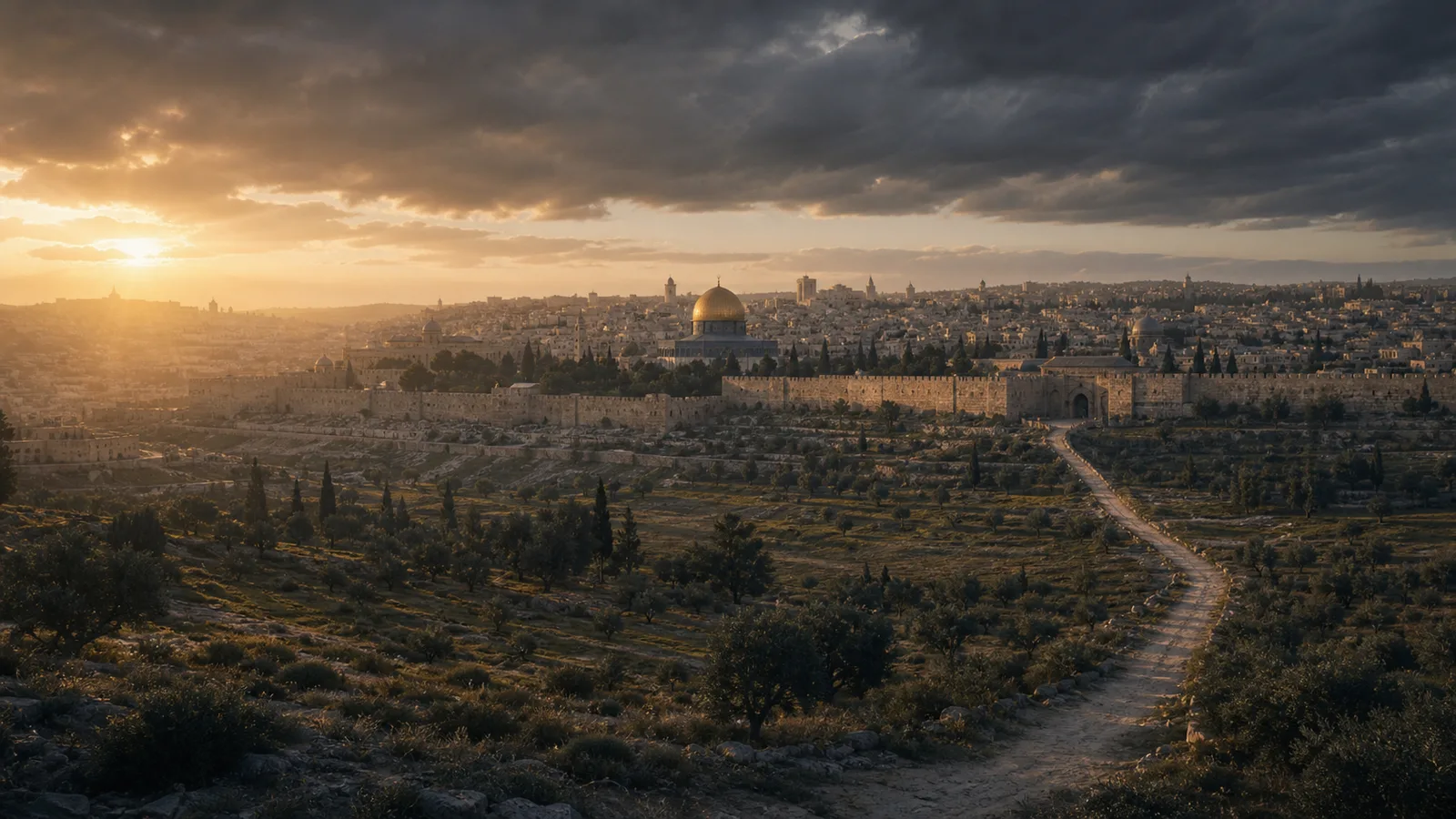
Late in 1009, on the orders of the Fatimid caliph al-Hakim bi-Amr Allah, workmen began demolishing the Church of the Holy Sepulchre in Jerusalem. The Christian chronicler Yahya ibn Sa’id of Antioch, writing near the events, reports that the church was largely razed and that the workers tried to destroy the rock-cut tomb venerated as the tomb of Christ; the surviving archaeology agrees that the damage was severe but not literally total. When the news crossed the Mediterranean, Latin chroniclers blamed Jews in Europe for instigating the demolition. The conspiracy charge was false, and scholarship connects these stories with anti-Jewish persecution in early-eleventh-century France, while still debating the chronology and exact relationship between the reports and the violence.
If you’re assembling the case that the Crusades were a defensive response to Muslim aggression, 1009 looks like exhibit A. So look at what the same record says next. Al-Hakim’s order was not a standing Muslim policy: his religious program shifted sharply, affected several communities, and his reign also witnessed the beginnings of the movement that became the Druze religion. His successor permitted reconstruction, and Byzantine-funded work under Constantine IX culminated in a church rebuilt and rededicated around 1048. Pope Urban II preached the First Crusade in 1095, more than eighty years after the demolition and nearly fifty after the rebuild.
That’s the whole Crusades problem in one building. The provocations were real. The slogans built on them fail. You’ve probably met both slogans: “the Crusades were a defensive response to centuries of Islamic aggression,” and “the Crusades were an unprovoked attack on a peaceful Muslim world.” I want to walk through what the primary sources and the working specialists actually establish, because this series runs on evidence, and because a Christian who repeats a bad version of this history will get taken apart by the first informed person he talks to. He’ll deserve it.
What actually happened before 1095#
Start with the chronology. The seventh-century conquests had placed the Levant, Egypt, and North Africa under Muslim rule long before 1095. The Seljuk advance into Byzantine Anatolia was recent. Both belong in the background, but they were not one continuous campaign by one state. A standard scholarly overview such as The Oxford History of the Crusades treats the movement in that changing political context, not as an eight-century war with a single combatant on either side.
The nearest provocation was Manzikert. In August 1071 the Seljuk sultan Alp Arslan defeated and captured the Byzantine emperor Romanos IV, and within two decades the Turks held most of Anatolia, with Nicaea, about a hundred kilometers from Constantinople, as a Seljuk capital. But Peter Frankopan’s The First Crusade: The Call from the East presses a point the older tellings skip: the defeat itself was survivable, and it was the decade of Byzantine civil war afterward, during which rival claimants hired Turkish warbands, that actually delivered Anatolia. External blow and internal collapse were co-causes.
Pilgrims faced real insecurity, and here again the details resist the slogan. A contemporary account of the Great German Pilgrimage of 1064–65 describes an ambush near Caesarea by Arab raiders before the Seljuks took Palestine. It also describes local intervention that helped the surviving pilgrims continue to Jerusalem. “Pilgrims faced danger” is true. “Muslim rulers had shut down pilgrimage” is not.
Then the appeal. In March 1095, envoys from the emperor Alexios I Komnenos asked Urban II for Western military aid at the Council of Piacenza. What Alexios wanted, on the model of earlier recruitment, was trained soldiers to help recover Anatolia. The lurid “letter of Alexios to Robert of Flanders” that catalogs atrocities and offers up Constantinople’s women and treasure has been regarded as a Latin forgery or propaganda rewrite since Einar Joranson’s 1950 study. And one more inconvenient turn: Fatimid Egypt, a rival of the Turks, retook Jerusalem in 1098 while the crusade was under way. The city the crusaders stormed in 1099 therefore belonged to a power that had not conquered Anatolia. Fatimid envoys had proposed cooperation against the Turks, but negotiations failed once the crusaders’ claim to Jerusalem became clear. Calling that a settled alliance would go beyond the evidence.
Five versions of one sermon#
We don’t have Urban’s speech at Clermont. That surprises almost everyone, but no transcript exists. What we have are several later reconstructions alongside one of Urban’s letters, including accounts by Fulcher of Chartres, Robert the Monk, Baldric of Bourgueil, and Guibert of Nogent. They diverge substantially, a problem historians have been triangulating since Dana Munro’s 1906 study. The famous atrocity catalog, Christians circumcised and their blood poured on altars, is Robert the Monk’s later rhetoric, not a transcript of Urban’s words. The pope’s surviving letters are firmer evidence for his stated program, and recent scholarship studies them separately from the narrative reconstructions. Whenever you see “Urban said” followed by a quotation, check which source is actually speaking.
What the crusaders’ paperwork says#
For most of the twentieth century, the standard account of crusader motive was economic. Landless younger sons, surplus knights, loot dressed up in piety. Jonathan Riley-Smith of Cambridge tested that thesis against a source nobody had used systematically: the charters, the property transactions crusaders signed with monasteries to raise cash before leaving.
The charters badly weakened that reduction. Riley-Smith estimated that the expedition might cost a knight roughly four or five times his annual income; later quantitative scholarship likewise emphasizes that the required funds excluded many poorer nobles. Men sold and mortgaged property to go. The documented participants include established lords, heirs, and kin groups, not a wave made up chiefly of landless younger sons. And the language of departure in Riley-Smith’s charter study is saturated with sin, penance, pilgrimage, and obedience. The honest caveat is that clerics drafted many charters and mixed motives cannot be measured like troop totals. But “second sons seeking loot” is not a responsible summary of the evidence, and penitential religion belongs near the center of any explanation.
Before anyone finds that comforting, sit with the implication. These men believed an armed pilgrimage could pay for their sins, and that belief made them more dangerous, not less. The piety was the problem. Which brings us to the part of this story too many Christian retellings skip.
The massacres of 1096#
Before the princes’ armies ever left Europe, crusader bands, above all Count Emicho’s, attacked Jewish communities along the Rhine. Speyer, Worms, and Mainz suffered the most famous massacres, and the violence extended into other towns. Thousands were killed or took their own lives, although a precise total cannot be recovered. We know the events from Latin and Hebrew traditions, but those sources have to be read critically. Robert Chazan’s study of the narratives, including the Solomon bar Simson Chronicle and the Mainz Anonymous, documents forced baptisms and the terrible cases in which Jewish parents killed family members rather than submit to conversion.
Two facts have to be held together. Bishops and secular authorities sometimes tried to protect Jewish communities, so “the Church ordered the massacres” is false. Their protection also failed catastrophically. And the killers were still crusaders who connected their violence to the expedition’s religious logic. Jonathan Riley-Smith’s study calls the 1096 attacks the first pogrom in western European history and examines them as part of the First Crusade. They were neither official policy nor an unrelated bandit episode. Our editorial standard on this site is that the evidence cuts wherever it cuts. Here it cuts against us, and it goes in the article.
Jerusalem, July 1099#
The crusaders stormed Jerusalem on 15 July 1099, and the massacre that followed is attested first of all by the victors. The anonymous Gesta Francorum says the men waded in blood up to their ankles. Raymond d’Aguilers, chaplain to the count of Toulouse, wrote that in the Temple area men rode in blood up to their knees and bridle reins, and called it God’s just judgment. The bridle image invokes Revelation 14:20. Simon John’s source study for the Historical Association explains why it should be read as apocalyptic imagery, not a measurement of liquid blood.
The standard modern study is Benjamin Kedar’s “The Jerusalem Massacre of July 1099” in Crusades 3 (2004). His findings run in both directions at once. The massacre was real, large, and by the sources’ own emphasis more extensive than was typical for stormed cities of the era, with killing continuing into a third day in one account. And the famous numbers are legend. The early Muslim witness Ibn al-‘Arabi, who had lived in Jerusalem until shortly before and wrote within a decade, gives about 3,000 killed at al-Aqsa. The 70,000 figure appears in later traditions and exceeds the city’s plausible population. Survivors are as well attested as slaughter: a contemporary Geniza letter says some escaped with the governor under safe conduct and records money raised to ransom Jewish captives, children, and sacred books. The formula that survives hostile fact-checking: a massacre of thousands, shocking in its scale and in the victors’ celebration of it, and neither a killing of every inhabitant nor the 70,000 of later legend.
The war over the history books#
For decades, the Crusades many English-speaking readers knew came from Sir Steven Runciman’s three-volume History (1951–54). Its prose and moral judgments were powerful; its method and some of its conclusions have not worn as well. A modern English Historical Review assessment calls it a remarkable work of literature as much as history while identifying its crude cultural analysis. Christopher Tyerman documents both the flaws and the persistence of Runciman as a base layer of popular opinion. The specialist rebuild since the 1970s (Riley-Smith on motive, John France on the campaign, Tyerman on the broader movement, Jay Rubenstein on apocalyptic thought, and Carole Hillenbrand on Muslim sources) is what any responsible treatment now stands on.
A word about the book conservative Christians often reach for instead. Rodney Stark’s God’s Battalions argues the strong defensive thesis. It is a popular synthesis by a sociologist, not the specialist source base used here. Where it summarizes historians such as Riley-Smith or Madden, cite those historians directly. Where it goes beyond them, test the claim instead of borrowing it because it is useful.
Hillenbrand’s work is useful here, but I previously stated its memory argument too strongly. Her synthesis shows that medieval Muslim writers did not organize the wars under the crusaders’ own religious category and that later political movements gave the Crusades new weight. Nineteenth- and twentieth-century anti-colonial, nationalist, and Islamist writers did reshape the wars into a template for continuing Western assault. But that does not mean Muslim societies had simply forgotten the Crusades or Saladin. Research on premodern Persian histories and on nineteenth-century Arab political discourse shows continuity as well as transformation. The careful conclusion is that modern politics reorganized and amplified older memories; it did not create them from nothing. Memory is one question; events are another.
I can offer a small live sample of that finding. During my Bay Area years I spent long evenings talking about God with my neighbor, a serious young Muslim man from North Africa, and I don’t remember us ever debating the Crusades. We couldn’t have; I didn’t know enough then to try. What I can tell you is the version in the air on both sides of those conversations, his as far as I could read him and mine for certain: Christian conquest, full stop. No Manzikert, no 1009, no Byzantine appeal. The nuance reached me years later, through the primary sources this article stands on, which puts me inside Hillenbrand’s finding rather than above it: the memory I carried was constructed too, and I had never once checked it.
Neither slogan survives#
So was the First Crusade a defensive war? Put working historians in a room and they split, which is exactly what happened when Andrew Holt reported a 2018 Society for Military History panel on the question. Some defend a qualified defensive framing; others call it a war of choice and an act of aggression. The actual shared core is narrower than either slogan: the crusade answered real Turkish conquests and a real Byzantine appeal, was preached and experienced as defense, recovery, and penance, and functioned strategically as an offensive expedition against powers, above all Fatimid Egypt, that had not attacked Latin Europe.
Here’s where I land, labeled as my own conviction on top of the sourced record. I don’t need the Crusades to be clean, because my faith doesn’t rest on the conduct of eleventh-century armies; it rests on a Lord who told his disciple to put the sword away (John 18:11). A Christian who launders this history to win an argument has already lost something worth more than the argument. And a Christian who swallows the opposite legend, the 70,000 and the unprovoked assault on a peaceful world, is just as far from the truth and twice as smug about it. Learn the record as the specialists have reconstructed it. Tell the Rhineland part without being forced to. You’ll find that honesty about your own house is the one credential that makes a Muslim friend lean in instead of brace, and that the God of truth never once needed our exaggerations.
Go deeper#
- Christopher Tyerman, God’s War: A New History of the Crusades: the current standard one-volume history; skeptical, thorough, nobody’s apologist.
- Jonathan Riley-Smith, The First Crusade and the Idea of Crusading: the charter research that rebuilt our understanding of why men actually went.
- Carole Hillenbrand, The Crusades: Islamic Perspectives: the Muslim sources and the modern-memory question, from the scholar who changed the field.
- Benjamin Kedar, “The Jerusalem Massacre of July 1099,” Crusades 3 (2004): the definitive study of what actually happened on 15 July 1099.