The Conquests
One Arabian city in 632; an empire reaching from Spain to the Indus by 750. What the documented record of the Islamic conquests actually shows, and what popular history gets wrong in both directions.
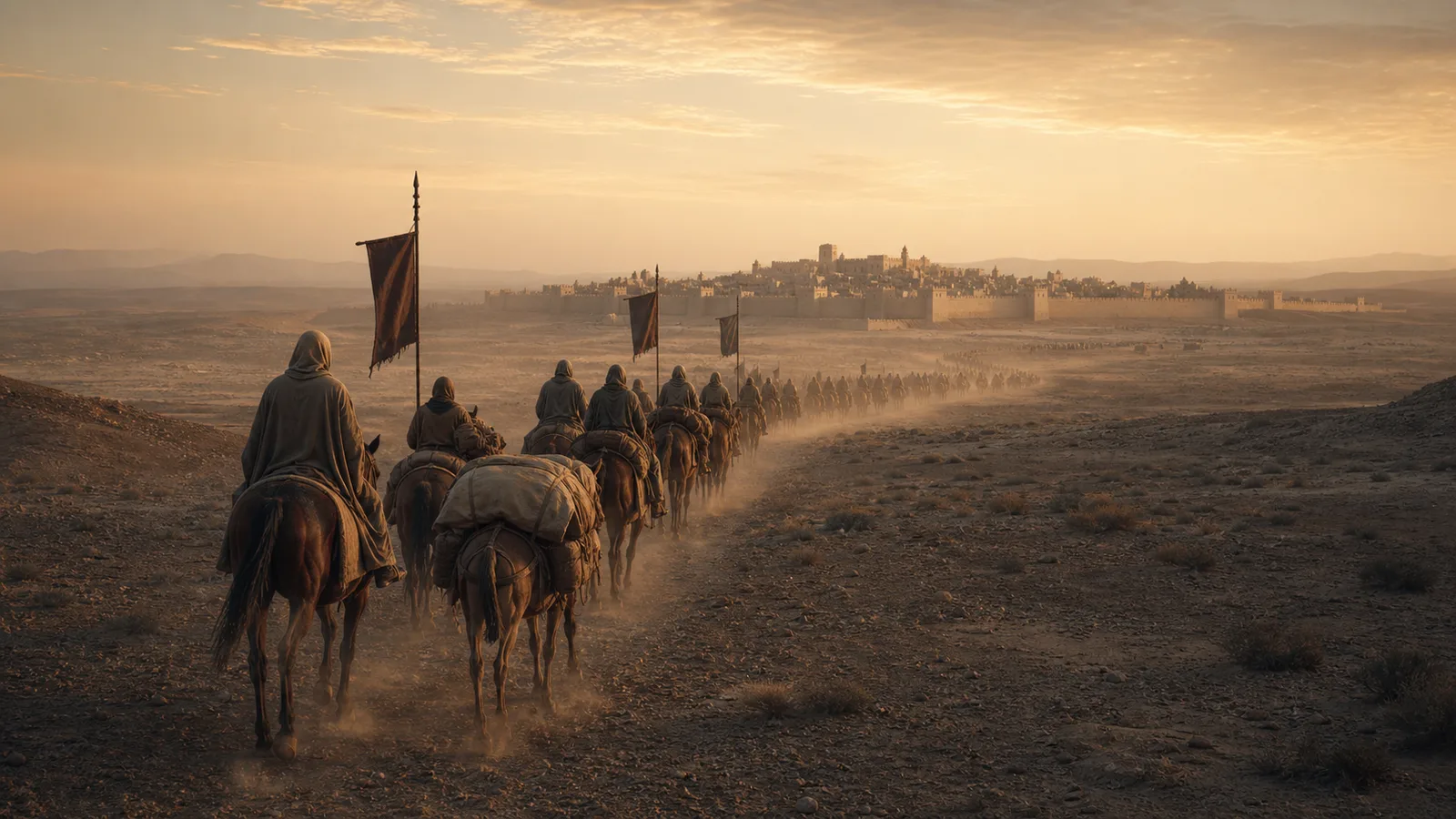
Measure the first century of Islam by its map. In June 632 Muhammad died in Medina, and the polity he built (an alliance of Arabian tribes held together by treaty and tribute) started shedding members almost immediately. By 750, when the Abbasid revolution replaced the Umayyad dynasty, the caliphate governed an empire stretching from the Atlantic edge of Iberia to the frontier of Sind (the standard academic chronology). One hundred eighteen years. One empire. Three continents.
No polemicist invented that speed, and no apologist can wish it away. It is the single most consequential fact about early Islam, and both the people who weaponize it and the people who soften it tend to get the details wrong. So this article walks the documented expansion and marks where it stopped, then corrects the two errors popular history makes about what conquest actually meant for the conquered.
The map, 632 to 750#
The first war was internal. When Muhammad died, tribes across Arabia renounced their agreements with Medina, and the first caliph, Abu Bakr, spent 632 to 633 forcing them back into the fold in what the tradition calls the Ridda wars, the wars of apostasy. Within a year Arabia was re-secured, and the same mobilized armies rolled north into Syria and Iraq. Historians read that pivot as continuity, not improvisation. Muhammad’s own largest expedition, Tabuk in 630, had already marched toward the Byzantine frontier and put tribute arrangements on frontier communities, and Fred Donner’s state-centered account treats the conquests as the continuation of political integration begun under Muhammad and Abu Bakr, not a break from it. The tradition ties this final period to the Quran’s tribute command: “Fight against such of those who have been given the Scripture as believe not in Allah nor the Last Day… until they pay the tribute readily, being brought low” (Quran 9:29, Pickthall).
Then came the middle of the 630s, the hinge of the whole century. In August 636, at the Battle of Yarmouk, six days of fighting near the Yarmouk River ended Byzantine rule in Syria. At al-Qadisiyyah, usually dated to 636 or 637 although the source chronology is uncertain, the Arab army broke the main Sasanian field force and opened the road to the capital at Ctesiphon. Byzantium survived, amputated. The Sasanian state unraveled through further campaigns and did not survive the century.

Egypt followed fast. In December 639 the general Amr ibn al-As entered Egypt with about 4,000 troops, won at Heliopolis in 640 and Babylon in 641, and entered Alexandria in 642. The conquest changed the sovereign without instantly replacing every local structure. Petra Sijpesteijn describes administrative continuity and change as a pragmatic response, not a clean transfer or a program of mass land confiscation. That distinction is a preview of the system below.
Then North Africa, and then the year the wave reached both ends of the empire at once. In 711 Tariq ibn Ziyad crossed at Gibraltar and the Visigothic kingdom of Spain collapsed within about seven years. The same year, Muhammad ibn al-Qasim entered the Indus Valley; by his recall three years later, Arab rule reached through Sind to Multan and had found its eastern limit. Iberia and Sind, in the same year, from a state that had been governed out of one Arabian oasis town eighty years before.
Where the advance stopped#
Constantinople checked the advance twice. Many older histories place the first sustained Arab attempt in 674 to 678, but Marek Jankowiak’s source reconstruction calls that chronology a major misunderstanding and dates the campaign of Yazid ibn Muawiya to 667 to 669. The second and far better documented attempt lasted across 717 and 718 and ended in catastrophic failure. Its importance is large enough without a myth attached to it: a recent history of the Umayyad Empire calls the failure in 718 the end of the Marwanid ambition to conquer and replace the Roman Empire. Byzantium survived and raids continued. The walls did not literally seal Europe’s land route for seven centuries.
The western halt is the famous one, and it needs handling with care. Tradition says Charles Martel’s Franks defeated an Umayyad army from Spain between Tours and Poitiers in October 732, and generations of writers, Edward Gibbon most memorably, credited that day with saving Europe from Islam. The actual record is thinner. The earliest sources treat the battle modestly, with little sense that conquest or religious survival was at stake; the world-historical framing was largely built in the eighteenth and nineteenth centuries; and even the date is argued, with some scholars preferring late 733 or 734. The defeat was real and the raids into Francia did lose momentum. But the honest statement is contested: some military historians still count Tours strategically significant, while the specialist drift says the deeper limits on the conquests were logistics and the walls of Constantinople, not one afternoon in Gaul. I am giving you both readings because you will meet people armed with only one.
Fast conquest, slow conversion#
Now lay a second map over the first, this one showing not who governed but who believed. The two maps do not match for centuries.
The key work here is Richard Bulliet’s Conversion to Islam in the Medieval Period, which tracked conversion by an ingenious proxy, the spread of distinctively Muslim names in genealogical records, and produced S-shaped conversion curves for region after region. On Bulliet’s estimate, Iran, conquered in the 630s and 640s, was around 80 percent Muslim by roughly 950, three centuries after al-Qadisiyyah. But the name records skew toward urban and formally educated people, so that curve is an estimate, not a census.
Egypt is a warning against printing one neat date. No religious census survives before 1897, and Mohamed Saleh describes the date at which Christians became a minority as a matter of strong debate. Serious estimates range from the ninth century to the fourteenth. That five-century spread is not a footnote; it is the state of the evidence. The ongoing “age of conversions” scholarship keeps refining regional timelines. The safe conclusion is the directional one: conquest changed rulers quickly, while conversion took generations and, in some regions, centuries.
I have a personal stake in that Iranian curve, though I didn’t know it at the time. Years ago I worked beside an engineer from Iran, a quiet, considerate man, and a Christian. I can’t tell you we ever discussed the history of his church; I doubt I knew Iran had a Christian history at all. I learned it years later, working through this material, and thought of him. The gentle man I knew was heir to a church in his homeland older than Islam itself, a Christian presence in Persia that was already centuries old when the Arab armies broke the Sasanian line at al-Qadisiyyah.
Sit with that for a second, because it quietly kills the crudest version of “spread by the sword.” If the sword had been pointed at every conquered throat with “convert” as the alternative, the conversion curves would be vertical cliffs in the 640s. They are slow S-curves stretching into the 900s and beyond.
Neither convert-or-die nor peaceful spread#
The actual system was neither mass forced conversion nor a merely peaceful diffusion of faith. It was conquest followed by developing systems of taxation and protected subordination that jurists later organized as the dhimma.
Conquered Jews and Christians, with protection extended in practice to Zoroastrians and other groups in some places, could keep communal life and worship while paying taxes and accepting legal inferiority under Muslim rule. Quran 9:29 supplied a central proof text for tribute from the People of the Book. It did not arrive as a complete medieval law code. Even Donner warns that the terminology in conquest accounts was handled by later jurists and can be confused. The institutions developed over time. Conversion happened through a mix of religious conviction, intermarriage, tax incentives, social advantage, state pressure, and intermittent persecution. The mix changed by place and century.
Subordination was the law’s letter, but enforcement ran hot and cold. The canonical list of restrictions, the so-called Pact of Umar (no new churches, distinctive dress, public deference), is attributed to Umar I in the 630s. Milka Levy-Rubin’s study traces its formation from early surrender agreements to a canonical document formalized under the early Abbasids in the first half of the ninth century. Enforcement varied: restrictions could sit dormant, then be revived by rulers such as al-Mutawakkil in the 850s, al-Hakim around 1004 to 1021, and the Almohads, who abolished dhimmi protection in the twelfth-century Islamic West. Yet Hunayn ibn Ishaq, a Nestorian Christian, could serve al-Mutawakkil as a leading court physician. Law, patronage, and persecution did not move in one straight line.
A famous Jerusalem story needs the same source discipline. The Christian Arabic historian Eutychius, writing in the early tenth century, relates that Umar refused to pray inside the Holy Sepulchre lest Muslims later claim it. A Cambridge architectural history correctly labels this a tradition rather than an eyewitness report. The church’s continued use as a Christian sanctuary is historical, despite destruction and rebuilding. That survival shows that Christian worship could persist under Muslim government. It does not prove Umar’s private motive or turn a tenth-century story into a contemporary transcript.
The field-standard comparative account belongs to Princeton’s Mark Cohen, in Under Crescent and Cross: reject both myths. Life under the dhimma was not an interfaith utopia. Jews and Christians were protected but ranked as inferior, and could suffer humiliation and persecution. Cohen also finds anti-Jewish violence much less severe in the Islamic world than in northern Latin Christendom. That is a comparison, not an acquittal.
This series also owes the record in the other direction. Christian victors in Iberia often converted a conquered city’s principal mosque into a church or cathedral, though other mosques had more varied fates. Later Spanish policy forced Muslims to accept baptism or leave Castile in 1502 and ultimately expelled the Moriscos between 1609 and 1614. That history matters. It neither erases the dhimma nor creates a simple symmetry between whole civilizations.
Where I land#
Now the conviction, labeled as such, layered on top of the sourced record.
Set the two founding centuries side by side. Christianity’s first century: an executed founder who told Pilate, “My kingdom is not of this world. If my kingdom were of this world, my servants would have been fighting” (John 18:36), followed by scattered congregations that held no territory and raised no army for roughly three hundred years. Islam’s first century: the Ridda wars, Yarmouk and al-Qadisiyyah, tax registers, garrison cities, two sieges of Constantinople. I take the tradition at its own word here; its earliest biographical genre for Muhammad’s life is literally called maghazi, campaigns. A religion whose founding century is imperial conquest has politics in its DNA, the way a religion whose founding century is martyrdom has the cross in its DNA. When Islam functions as a governing order and not only a private faith, it is running the founder’s original pattern.
That is a claim about a system, and I refuse to let it become a claim about people. The Muslim families in your neighborhood no more chose the seventh century than you chose the Crusades, and I want them to meet Jesus, not to meet suspicion.
I had years to practice that distinction. For several years my neighbor was a young man from North Africa, serious about Islam down to the details of his household, and we talked about God for hours at a stretch. I could love his curiosity, his zeal, and the seriousness with which he took eternal questions, and loving him meant wanting him to see the truth of Jesus Christ. I’ll be honest about the boundary too. The warmth had a limit, because parts of what he believed unsettled me, and pretending otherwise would have been a different kind of dishonesty. Both were real at once. The principle I came away with is the one I still use: love Muslims with the loving intention of sharing Jesus Christ, the same as any person on earth.
One more conviction, aimed at my own side. The honest record is strong enough without embellishment. Every time a Christian repeats the cartoon version, that every conquest was a forced conversion, that the sword hovered over every neck, a hostile fact-checker armed with Bulliet’s curves and Cohen’s verdict will take the whole argument apart, and the true parts fall with the false ones. You do not need the cartoon. You need four dates and two words: 632, 636, 711, 750; jizya and dhimma. Learn those, with the sources behind them, and you can tell the story of Islam’s first century accurately to anyone, including your Muslim neighbor, who may respect you more for knowing it than for pretending it away.
Go deeper#
- Richard W. Bulliet, Conversion to Islam in the Medieval Period: the name-data conversion curves behind “conquest was fast, conversion was slow.”
- Mark R. Cohen, Under Crescent and Cross: the standard comparative account of minority life under medieval Islam and Christendom, and the origin of the neither-utopia-nor-Christendom verdict.
- Fred Donner, Muhammad and the Believers: how the conquests grew directly out of the polity Muhammad built, from a leading academic historian of early Islam.
- Robert Hoyland, Seeing Islam as Others Saw It: the seventh century through the eyes of the conquered, in non-Muslim sources written while it was happening.