What the Hadith Are (and Why They Run Everything)
The five daily prayers aren't in the Quran. A guide to the hadith canon — the Six Books, isnad chains, what 'sahih' certifies, and what the most authentic collections actually contain.

Open the Quran and try to find the five daily prayers. The command to pray is everywhere; the Quran orders believers again and again to establish worship and pay the poor-due (Q 2:43 is one instance of dozens). But the number five is not there. Neither are the mechanics: how many cycles of standing and bowing, what to recite in each one, what times of day count, what invalidates the prayer. A Muslim who owned nothing but a Quran could not perform the most visible obligation of his own religion. The five prayers enter Islam through a hadith, the night-journey narration in which God prescribes fifty daily prayers and Moses coaches Muhammad into bargaining them down to five (Sahih al-Bukhari 349).
That one fact should reorganize how you read about Islam. The Quran is the scripture, but the sunnah (the example of Muhammad, transmitted in hadith reports) supplies the operating manual: the prayer, the details of the fast, the pilgrimage rites, most of what sharia actually says. If you want to understand Islam as it is lived and legislated, the Quran is the smaller half of the reading assignment. Sunni Islam gathers the other half into six canonical books, and this article is a map of that library.
I’ve watched that operating manual run. Years ago in the Bay Area my neighbor was a devout young North African man (his story gets fuller treatment in the Your Muslim Neighbor series), and one evening he had me over to his apartment: four young Muslim men, a video game console, and me. When prayer time came, nobody left. They invited me to stay, lined up, and prayed, the standing and bowing and foreheads to the carpet in the same order every time. I sat in the awkwardness and quietly prayed to my own God for them. Watching all that precision, I assumed I was watching the Quran. I wasn’t. Nearly every detail those men performed from body memory comes from this library, and it took me years to learn that.
The Six Books#
The Sunni hadith canon centers on the Kutub al-Sitta, the “Six Books”: the collections of al-Bukhari (d. 870), Muslim (d. 875), Abu Dawud, al-Tirmidhi, al-Nasa’i, and Ibn Majah. Each hadith in them is a short report (a matn, the text) attached to an isnad, a chain of named transmitters running back, link by link, to an eyewitness. “So-and-so told me, on the authority of so-and-so, from Anas ibn Malik, that the Prophet said…” The scholars who built these collections graded every report by its chain: sahih (sound), hasan (good), da’if (weak), mawdu’ (fabricated). Grading a chain meant checking that it was unbroken and that every man in it was known to be honest and precise, with no hidden defects in the transmission. The standard academic account of how this system worked and won its authority is Jonathan A.C. Brown, The Canonization of al-Bukhari and Muslim (Brill, 2007).
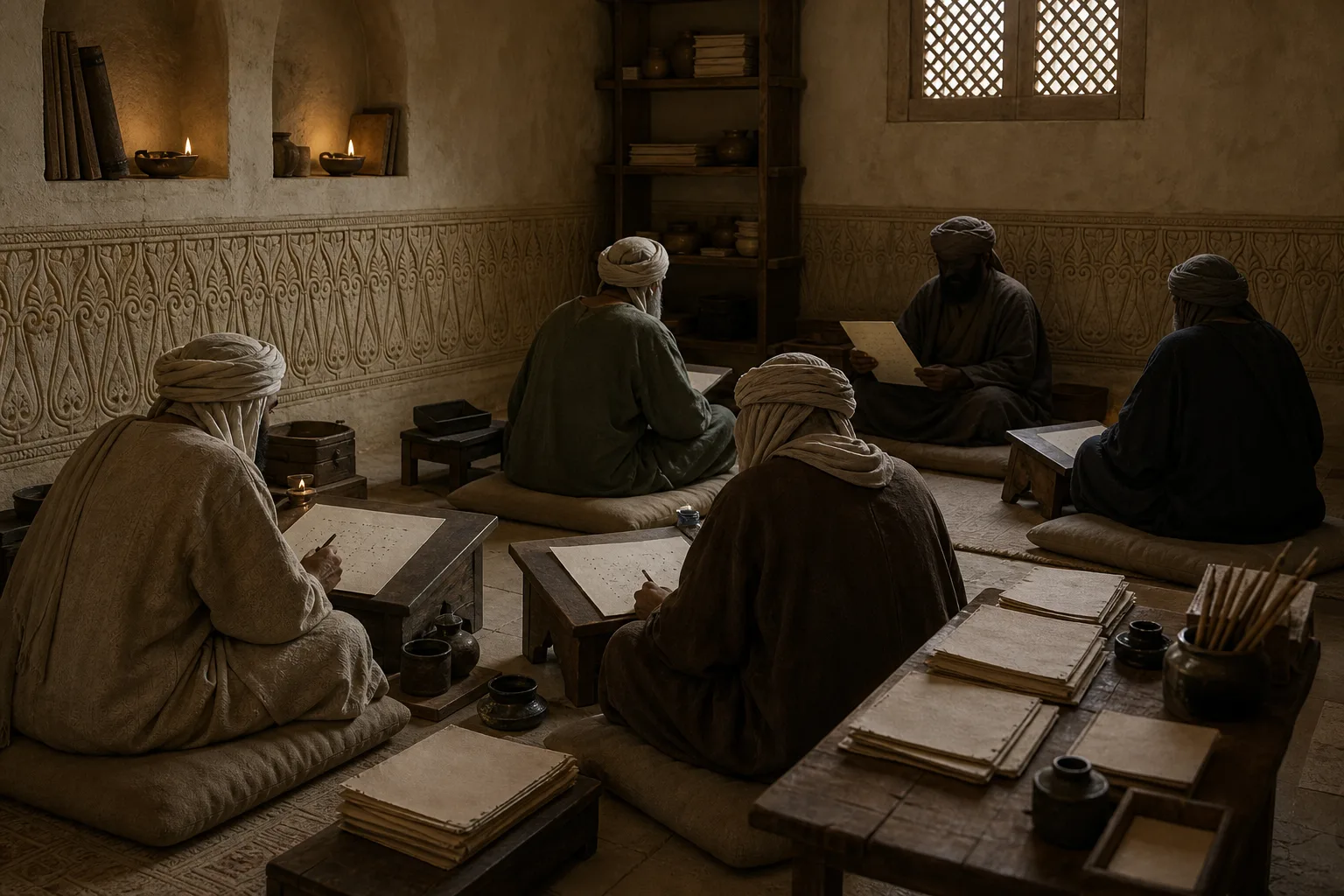
Two of the six stand above the rest. Bukhari and Muslim, “the Sahihayn,” admitted only reports they graded sahih, and mainstream Sunni orthodoxy came to regard their contents as authentic virtually en bloc; the tradition’s own phrase is that the community “received them with acceptance” (Brown, Misquoting Muhammad, Oneworld 2014). Hold onto that. When a report sits in Bukhari or Muslim with a sahih grading, Sunni Islam is committed to it by its own criteria. Whatever is in those two books is the certified center of the religion, not fringe material an apologist dug up.
What a sahih grading certifies#
One distinction separates careful writing about hadith from sloppy writing in both directions. A sahih grading is not a certificate about the event. It is a certificate about the chain. The 9th-century graders were answering the question “did reliable people faithfully pass this report along?”, using the biographical data available to them about men who had died generations earlier.
Western academic scholarship has spent 130 years pressing on exactly that gap. Ignaz Goldziher argued in 1890 that vast numbers of hadith reflect the legal and political fights of the 8th century read back onto Muhammad’s lips; Joseph Schacht built the “common link” method in 1950, tracing how chains converge on a single later figure who is likely the report’s real source; and Harald Motzki and the current generation refined this into isnad-cum-matn analysis, which cross-examines the chains and the texts together (the New Lines essay on the Little thesis walks through this arc for a general reader). The academic consensus that emerged treats even sahih hadith as strong evidence for what 8th- and 9th-century Muslims believed and transmitted, and much weaker evidence for what happened in 7th-century Arabia. The traditional verdict and the academic verdict are answers to different questions, and an honest writer keeps them separate.
But notice what does not follow. You cannot use academic skepticism to delete the hadith you find awkward while keeping the ones you like. The method dissolves the corpus wholesale or not at all, a point that will matter below.
The law lives in the hadith#
I called the hadith the half that runs everything, and the claim is precise: sharia’s working content is overwhelmingly hadith-derived. The Quran commands; the hadith specify. And sometimes the hadith carry law the Quran does not contain at all. The starkest case sits inside Bukhari itself: the caliph Umar, preaching from the pulpit, insists that a verse prescribing stoning for adultery was revealed to Muhammad and remained binding law even though it does not appear in the written Quran (Sahih al-Bukhari 6829). Stoning entered Islamic law on the strength of that report. When people argue about what “sharia says,” they are almost never arguing about the Quran alone. They are arguing about this library.

Which raises the question a Christian reader should actually care about. If the sahih grading is the tradition’s own gold standard, what did the gold standard certify into the canon?
Inside Bukhari and Muslim#
What follows is not a tour of obscurities. Every item below is sahih, sits in the two most authoritative books in Sunni Islam (except where flagged), and is cited by collection and number so you can check it yourself.
How Muhammad looked#
The Sahihayn describe Muhammad’s appearance repeatedly. Anas ibn Malik reports he was “neither conspicuously tall, nor short; neither very white, nor tawny” (Bukhari 3547); classical commentators gloss the term azhar there as a luminous white with a reddish tinge (the traditional harmonization is laid out at Hadith Answers). At Khaybar, Anas says the Prophet’s garment slipped and “I saw the whiteness of the thigh of the Prophet” (Bukhari 371). A visitor asking which man is Muhammad is told, “this white man reclining on his arm” (Bukhari 63). Abu al-Tufayl remembers him as “white, with an elegant face” (Muslim 2340).
One correction, because this gets misquoted constantly: the famous line that he was “as though fashioned of silver” is not in Bukhari. It comes from al-Tirmidhi’s Shama’il, a separate devotional collection whose narrations vary in grading. Cite it as Shama’il or don’t cite it.
And one caution that cuts both ways. Seventh-century Arabic color terms do not map onto modern racial categories, and the shama’il genre idealizes as much as it describes. The canonical descriptions are useful as a corrective to modern re-colorings of Muhammad in any direction; they are not ammunition for anyone’s racial politics. The texts say what they say, and that is all they say.
Aisha’s age#
Bukhari and Muslim record, in multiple sahih narrations transmitted in Aisha’s own name, that Muhammad married her when she was six and consummated the marriage when she was nine (Bukhari 5133; Bukhari 3894; Muslim 1422). For roughly thirteen centuries the tradition accepted these numbers without embarrassment; classical jurists cited Aisha’s case as precedent in rulings on the marriage of minors (documented by Jonathan Brown in Misquoting Muhammad and by Kecia Ali in Marriage and Slavery in Early Islam, Harvard UP 2010). The popular modern claim that she was “really” fifteen to nineteen is a 20th-century apologetic development with no classical authority behind it, and academic scholarship on both sides of the historicity question agrees the 6/9 reports are the canonical data.
There is exactly one rigorous academic challenge, and it must be stated honestly. Joshua Little’s 2023 Oxford thesis argues, by isnad-cum-matn analysis, that every extant version of the age hadith descends from a single archetype put into circulation by Hisham ibn ‘Urwa, Aisha’s great-nephew, in Abbasid-era Iraq (the full thesis is in the Oxford Research Archive; New Lines has an accessible summary). So the historicity is contested. But Little is a hadith skeptic across the board; his method indicts the corpus generally. A Muslim who invokes Little to dismiss this one report has purchased the dismissal at the price of Bukhari and Muslim entire. There is no selective rescue on offer.
The moon, split in two#
“The hour drew nigh and the moon was rent in twain” (Quran 54:1, Pickthall). Bukhari and Muslim record, from several Companions, that the moon literally split into two parts during Muhammad’s Meccan years, one part over the mountain (Bukhari 4864; Muslim 2800), and classical commentators read it as a public miracle. Academic historians such as Wensinck and Gril note that the Quran elsewhere pointedly declines to grant Muhammad confirming signs (Q 17:59) and read 54:1 as a statement about the approaching Hour, with the hadith as later concretization (the scholarly positions are surveyed here). The internet add-on that NASA confirmed a lunar rift is an urban legend that mainstream Muslim institutions themselves disclaim. The pattern repeats what we saw with the prayers: the Quran answers demands for miracles by pointing to itself, and it is the hadith library that supplies Muhammad’s evidentiary miracles.
The satanic verses#
The famous incident (Muhammad, reciting in Mecca, briefly uttering verses that praised the pagan goddesses before repudiating them as satanic interpolation) is not in Bukhari or Muslim, and you should never claim it is. Bukhari preserves only the narrative shell, the pagans prostrating at Surat al-Najm (Bukhari 4862). The incident itself pervades the earliest biographical and exegetical sources: al-Tabari, Ibn Sa’d, al-Waqidi, and material going back to Ibn Ishaq. The decisive modern study is Shahab Ahmed’s Before Orthodoxy (Harvard University Press, 2017), which collected some fifty early reports and concluded that the first two Islamic centuries broadly accepted the incident as fact; rejection came later, driven by the maturing doctrine that prophets are protected from error (a scholarly review of Ahmed’s findings). Even Ibn Taymiyya, the medieval scholar modern Salafis revere most, accepted a version of it. Whether the event happened is contested among academics. That the earliest Muslim memory-keepers believed it happened is established, and it is Islam’s own sources that say so.
Read the library before you argue with it#
I’ll put my cards on the table. I love Muslim people, I want them to meet Jesus, and I think most Christians who argue about Islam online have never read a page of the books that actually govern it. Both failure modes dishonor the truth. The Christian who quotes a hadith he found in a meme, misattributes the silver line to Bukhari, and gets the grading wrong hands his Muslim neighbor a permanent reason to dismiss him. The Christian who refuses to read the sources at all ends up arguing with a caricature. Scripture’s standard for this work is precision plus posture: make the case, “yet do it with gentleness and respect” (1 Peter 3:15).
The hadith library rewards the reader who takes it seriously. It is where Islam’s daily practice lives, where its law lives, and where its most difficult material lives, all certified sahih by the tradition’s own criteria. So here is the assignment. Bookmark sunnah.com, where the Six Books sit in searchable English with the standard numbering. Before you ever repeat a hadith quotation, look it up: collection, number, grading. And when a Muslim friend tells you the hadith define his prayer life, believe him, because he’s right, and now you know why.
Go deeper#
- Jonathan A.C. Brown, Misquoting Muhammad. A believing Sunni scholar’s account of how the tradition wrestles with its own hardest narrations; read it to hear the strongest internal case.
- Shahab Ahmed, Before Orthodoxy (Harvard UP, 2017). The definitive study of the satanic verses reports and how early acceptance became later denial.
- Joshua Little, The Hadith of ‘A’ishah’s Marital Age (Oxford, 2023), free online. Modern hadith criticism at full rigor, applied to the corpus’s most contested report.
- Nicolai Sinai, The Qur’an: A Historical-Critical Introduction (Edinburgh UP, 2017). The state of the academic field on how Islam’s scripture was composed and transmitted.