The Jesus of the Quran
The Quran honors Jesus as virgin-born Messiah and coming judge, yet denies the incarnation and the crucifixion. Why Jesus is the original fault line between Islam and Christianity, and why he is also the door.
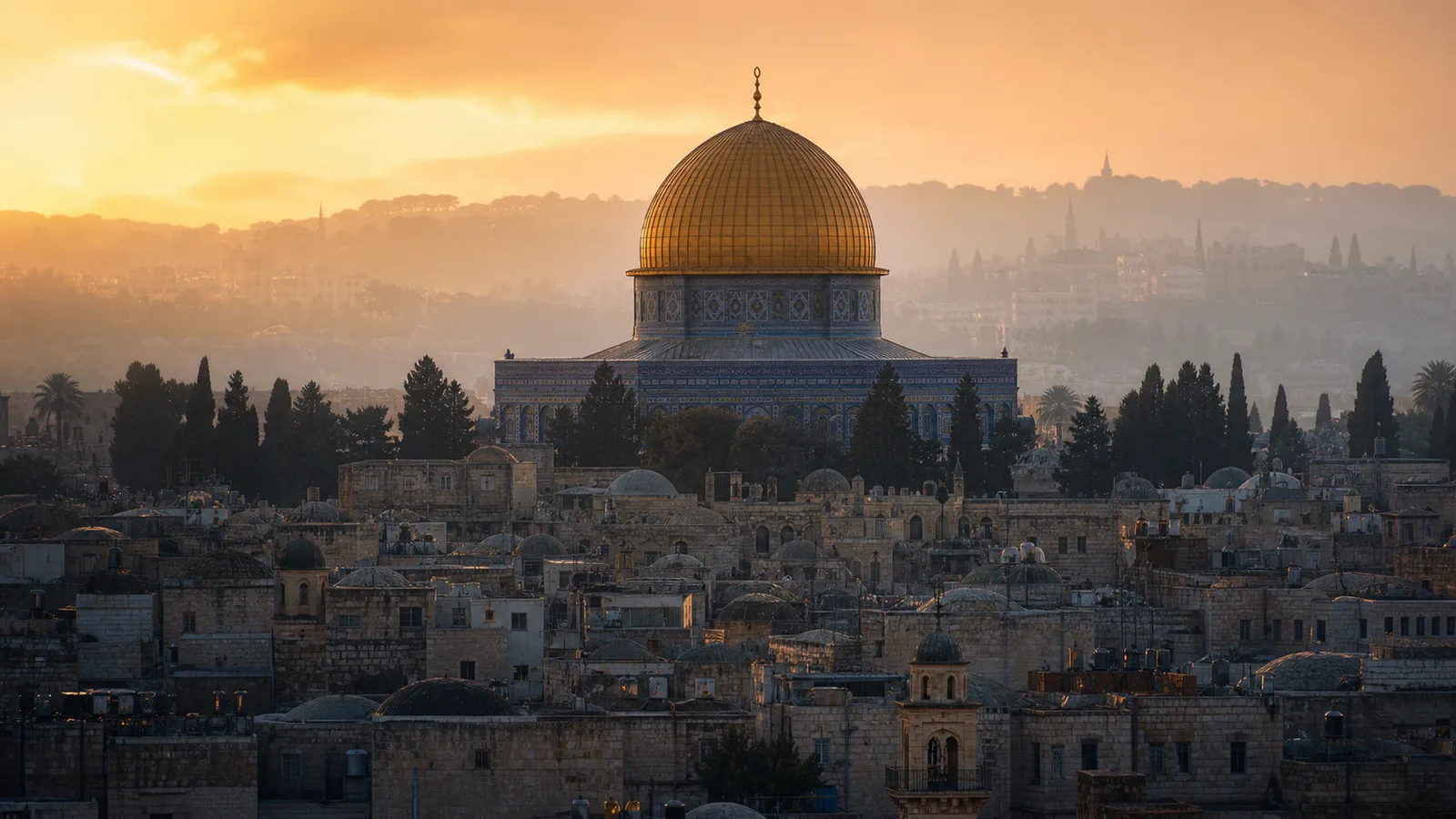
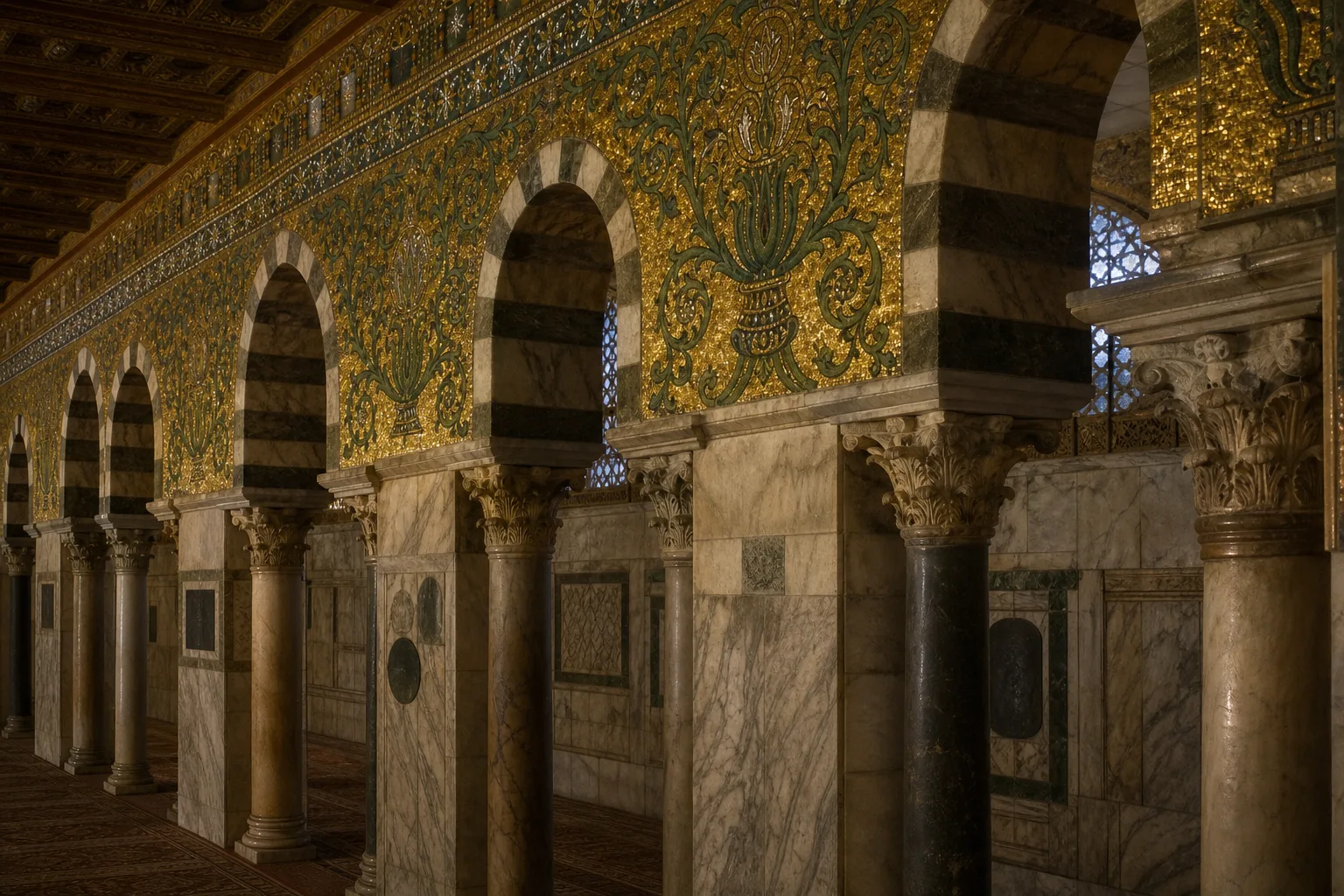
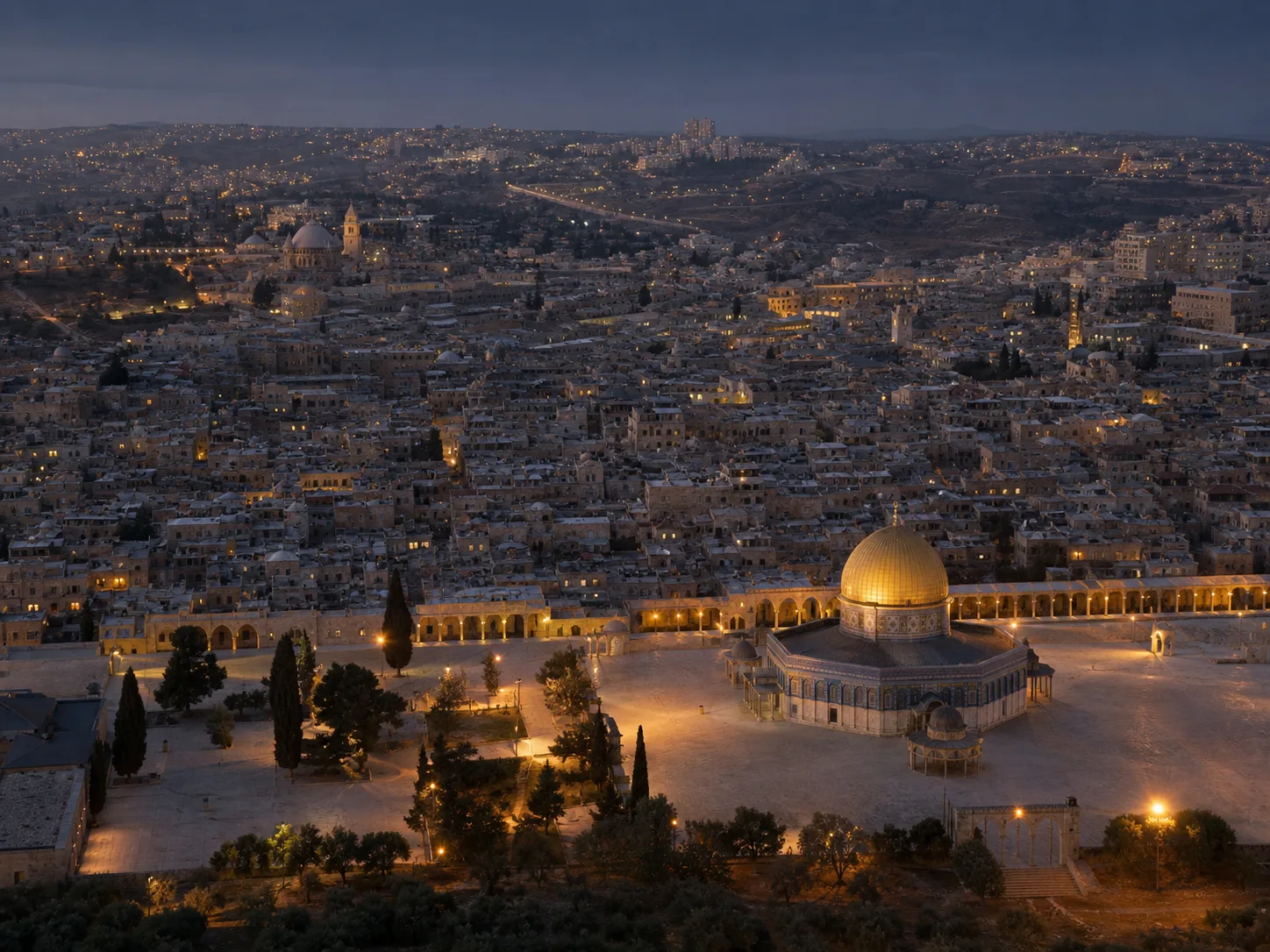
In 691 or 692, about sixty years after Muhammad died, the caliph Abd al-Malik finished a gold-domed octagon in Jerusalem, built on the platform where the Jewish Temple had stood and within sight of the Church of the Holy Sepulchre. Wrapped around the arcade inside the Dome of the Rock runs roughly 240 meters of mosaic inscription, dated 72 AH, and much of it is addressed directly to Christians: “Do not say ‘Three’… God is only one god; far be it from Him that He should have a son” (Dome of the Rock inscriptions, Islamic Awareness dossier).
That band of gold letters matters for a technical reason. It is the earliest securely datable monumental Quranic text in existence, almost two centuries older than the great hadith collections. Before Islam left us law books or biographies, it left us this. And what it left us is a rebuttal of the Nicene Creed, carved over the ruins of the Temple, facing the church built on the tomb of Christ.
The earliest large public statement of the Islamic faith is an argument about Jesus of Nazareth. This article, the last in the series, is about that argument: what the Quran gives Jesus, what it denies him, and why the denial makes him the permanent fault line between Christianity and Islam.
What the Quran gives Jesus#
Start with a count. The Quran names Jesus (‘Isa) twenty-five times; it names Muhammad four. And what it says about him, a Christian reading it for the first time will find startlingly familiar.
He is born of a virgin. Mary asks, “My Lord! How can I have a child when no mortal hath touched me?” and is answered, “So (it will be). Allah createth what He will. If He decreeth a thing, He saith unto it only: Be! and it is” (Quran 3:47, Pickthall).
He works miracles that no other prophet in the Quran works. He fashions a bird out of clay and breathes life into it, and says, “I heal him who was born blind, and the leper, and I raise the dead, by Allah’s leave” (Quran 3:49, Pickthall).
He carries titles no one else carries. He is “the Messiah, Jesus son of Mary… a messenger of Allah, and His word which He conveyed unto Mary, and a spirit from Him” (Quran 4:171, Pickthall). Messiah, God’s Word, a spirit from God: no other figure in the book, Muhammad included, is given those names.
And he is coming back. In a sahih hadith, Muhammad swears that “the son of Mary will soon descend amongst you and will judge mankind justly (as a Just Ruler)” (Sahih al-Bukhari 3448).
Sit with that before anything else, because the common ground is real. The Muslim at the next desk already believes Jesus was born of a virgin, worked miracles, holds the title Messiah, and will return in judgment. In my experience most Christians have no idea, and most have never asked.
What the Quran takes away#
Now reread the honor roll and notice the fences. The same verse that calls Jesus God’s Word insists he “was only a messenger of Allah” (Quran 4:171, Pickthall). Every gift arrives with a boundary attached, and the boundaries are not vague. Each one is aimed at a specific Christian claim.
Against the incarnation, the Quran sets its most concentrated statement of God’s nature: “Say: He is Allah, the One! Allah, the eternally Besought of all! He begetteth not nor was begotten. And there is none comparable unto Him” (Quran 112:1–4, Pickthall).
Against the Sonship, the surah named for Mary tells the nativity story at length and then closes the door on where a Christian reader expects it to lead: “It befitteth not (the Majesty of) Allah that He should take unto Himself a son. Glory be to Him!” (Quran 19:35, Pickthall). A later Medinan verse sharpens it into open confrontation: “the Christians say: The Messiah is the son of Allah. That is their saying with their mouths… Allah (Himself) fighteth against them. How perverse are they!” (Quran 9:30, Pickthall).
And against the crucifixion, a denial unique among the world’s scriptures: “They slew him not nor crucified him, but it appeared so unto them… they slew him not for certain” (Quran 4:157, Pickthall).
Here is where the Dome of the Rock stops being a travel photo and becomes evidence. Its inscriptions quote and adapt exactly this cluster of verses, the anti-Trinitarian core, in the most public medium the new state possessed, within about sixty years of Muhammad’s death. Whoever expected the argument with Christianity to be a later development, on either side, is out of luck. By 691 the new faith was defining itself against Christian teaching about Christ, in Quranic language, on Christianity’s home ground.
That closes off two comfortable theories at once. The first, popular with some Christians, holds that early Islam was a loose Abrahamic monotheism that only hardened against the gospel later. The second, popular in interfaith settings, holds that the quarrel between the two faiths is mostly a misunderstanding, stoked by crusades, colonialism, and cable news. The gold letters say otherwise on both counts. The denial of the Son was there at the foundation, load-bearing, paid for by a caliph.
Why the fault line runs through Jesus#
Every religion disagrees with Christianity somewhere. Only one disagrees like this. The Hindu and Buddhist scriptures never mention Jesus. Judaism’s scriptures were composed before he was born and so say nothing about him. The Quran stands alone: a scripture arriving six centuries after the New Testament that names Jesus again and again and specifically denies the two claims the entire Christian faith stands on.
Paul states those claims plainly: “For I delivered to you as of first importance what I also received: that Christ died for our sins in accordance with the Scriptures, that he was buried, that he was raised on the third day in accordance with the Scriptures” (1 Corinthians 15:3–4). He also names the stakes: “If Christ has not been raised, your faith is futile” (1 Corinthians 15:17). John states the other claim: “And the Word became flesh and dwelt among us” (John 1:14).
Surah 112 negates John 1:14. Surah 4:157 negates 1 Corinthians 15. I know of no other pairing like that between two living scriptures, and it is why the polite settlement “we basically worship the same God” cannot carry the weight people put on it. A God who gave his only Son and a God for whom sonship is an affront to his majesty cannot both be the last word. The disagreement between the two faiths isn’t a misunderstanding waiting on better dialogue. It’s a contradiction, present from the foundation, about who Jesus is.
Be clear about what that does and doesn’t mean. The books are in contradiction; the people who hold them are not enemies. Your Muslim neighbor inherited this argument the same way you inherited yours, and he is someone God loves and Christ died for. I hold both of those convictions at full strength, and this whole series has been built on refusing to trade either one away.
A denial six hundred years late#
Look once more at the crucifixion verse, because its position is strange in a way worth naming. Quran 4:157 is a single verse, delivered by the mainstream chronology of the Quran around six centuries after the event it denies. It gives no alternative account of that Friday in Jerusalem and no argument; the next verse simply says God raised Jesus to himself (Quran 4:158). “But it appeared so unto them” is the entire explanation on offer.
Set that against what it must overrule. Paul wrote about the crucifixion to people who could still check him, appealing to witnesses “most of whom are still alive” (1 Corinthians 15:6). All four Gospels narrate the execution in public detail. And Tacitus, a Roman historian with no Christian sympathies, records that “Christus… suffered the extreme penalty during the reign of Tiberius at the hands of one of our procurators, Pontius Pilatus” (Annals 15.44). The crucifixion is not a private article of faith; it is the kind of public, datable event ancient history is made of. The Quran asks its reader to set aside the earliest and best-placed witnesses on its own bare assertion, made six hundred years after the fact, from outside the country.
There is even a seam inside Islam’s own canon here: the sahih hadith of Jesus’s return says he “will break the Cross” (Sahih al-Bukhari 3448). The tradition still needs the returning Jesus to abolish the symbol of an event its scripture says never happened.
How a Christian should weigh late denial against early attestation, and how Muslims have answered, is a question of historical method that deserves more than a paragraph. It gets a full series of its own on this site. For now the modest point stands: on the one historical event both faiths agree matters most, the two books cannot both be right, and only one of them was written within reach of the evidence.
The Jesus they honor is the door#
I want to end with the neighbor rather than the argument.
Years ago in the Bay Area my neighbor was a devout young North African man, the same neighbor I wrote about in How to Talk About Jesus With Muslims. One evening in his apartment it was four young Muslim men, a video game, and me. When prayer time came they didn’t send me home. They invited me to stay, and while they prayed I sat there and prayed silently to my own God for them. It was awkward, and I’m still not sure what the right theological posture is for a moment like that. But I do know what I lacked. I couldn’t have told you then that their book names Jesus twenty-five times, or that it calls him Messiah, God’s Word, a spirit from Him. I was in the room with no door to open.
Here is my conviction, labeled as mine: the Jesus Muslims already honor is the door. A Muslim does not need to be talked into caring about Jesus; his own scripture already calls Jesus the Messiah and God’s Word (Quran 4:171, Pickthall). Christians living under the caliphate saw where that leads thirteen hundred years ago. John of Damascus, writing under Muslim rule in the eighth century, taught believers to press one question: is God’s Word created or uncreated? (John of Damascus on Islam). The Quran’s own titles for Jesus start the very conversation a Christian wants to have. You don’t have to open with a debate. You can open with the door: “Your book calls him God’s Word. Can I show you what my book means by that?”
So do the reading this week, both books, like this series has asked of you from the start. Pickthall’s translation is public domain and free online. Read Surah 3:42–55 and Surah 19:16–36, then Luke 1–2 and John 1. Make two columns on a piece of paper: everything the two books say together about Jesus, and the exact points where they part. The first column will buy you an hour of real conversation with any Muslim you know. The second column is where the gospel lives.
Thirteen centuries ago a caliph set his answer in gold above Jerusalem: far be it from Him that He should have a son. John had already written the other answer: “For God so loved the world, that he gave his only Son, that whoever believes in him should not perish but have eternal life” (John 3:16). Every conversation between a Christian and a Muslim about Jesus takes place between those two inscriptions. I intend to keep having that conversation, because I want my Muslim neighbor to meet the Son.
Go deeper#
- Gabriel Said Reynolds, The Qur’an and the Bible: a Notre Dame scholar’s verse-by-verse comparison without polemics; the best single tool for the two-column exercise above.
- Nabeel Qureshi, No God but One: a former Muslim weighs the central claims of both faiths, crucifixion and resurrection included, with his own life behind the question.
- Robert Hoyland, Seeing Islam as Others Saw It: the complete seventh-century evidence for early Islam, including the world that built the Dome of the Rock.
- James White, What Every Christian Needs to Know About the Qur’an: a careful, fair walk through the Quran’s actual claims about Christ, written for church readers.