Go First
Leadership at home means going ahead of your family: Deuteronomy 6 puts the words on the father's heart before they reach the kids, and Joshua answers for his house. A weekly practice for going first.

On Sunday morning the family minivan pulls into the church lot, and the father is in it. That’s not nothing; plenty of men aren’t. But look at who’s leading. His wife found the church. She signed the kids up for camp, she prays with them at bedtime, she fields the question about death that floats up from the back seat while he checks his mirrors and says nothing. He attends his family’s spiritual life the way a passenger attends a road trip: present for every mile, responsible for none of the navigation.
The seat assignment isn’t rare. When Pew Research surveyed American parents about who takes the lead in their children’s religious upbringing, mothers were more than twice as likely as fathers to say they do (39% versus 17%), and fathers were likelier than mothers to say a spouse or someone else was handling it. “Takes the lead” is a question about who drives, not about who cares.
I want to be precise about what the problem is, because it is not strong wives. A mother shepherding her children is not a malfunction; mothers have carried the faith of households since Lois and Eunice carried Timothy’s (2 Timothy 1:5), and any man whose wife prays with his kids should thank God for her tonight. The problem is the seat he never took. She’s driving because somebody has to, and the somebody who was supposed to be first out of his seat never moved.
A fair reader will notice that the texts ahead are wider than my audience: Deuteronomy 6 is addressed to parents and to all Israel, not to fathers alone, and Timothy is proof the faith can travel without you. This series is written to men about the charge we believe we’re called to, and the rest of this article assumes you count yourself one of them.
Here’s the part that should bother you: your kids can read a seating chart. Long before they can articulate a theology, they know who in the house treats God as load-bearing and who rides along. A boy who watches his father get chauffeured to church for eighteen years has learned a lesson, and it isn’t the one anyone said out loud.
I can tell you when this stopped being abstract for me. My wife usually drives the kids to school, and she has a routine on those rides: morning blessings and prayer, every trip, because that is simply who she is. When I finally noticed it as a routine rather than a nice thing that happens, the next thought landed hard: she would do this whether I ever showed up or not. About half the time the kids leave, I’m already in a meeting. And if I’m honest, about half of those meetings could survive a five-minute pause so their father could pray over their day too. The routine was never the problem. Who it belonged to was.
Risk flows toward rank#
On a Navy ship, “lead from the front” was a procedure. When a steam system was brought back after repairs, the most qualified man on watch stood at the valve while it was cracked open, because if something let go, the most qualified man was supposed to be standing closest to it. When a space had to be entered after a casualty, the senior man took the first look. The rule underneath is simple: the leader goes first into whatever might hurt, because he’s the one qualified to meet it.
The chow line ran the same rule in the other direction: instead of risk, food. The poster version says “officers eat last” and stops there, as if the point were humility. Aboard ship the point was sequencing. Sailors going back on watch ate first because the plant needed them fed and on station on time. The man who wrote the watch schedule ate when the line was empty, because he wrote the sequence and he answered for it. He stood where the schedule he wrote put him, and the schedule encoded a priority: load-bearers first, author of the plan last.
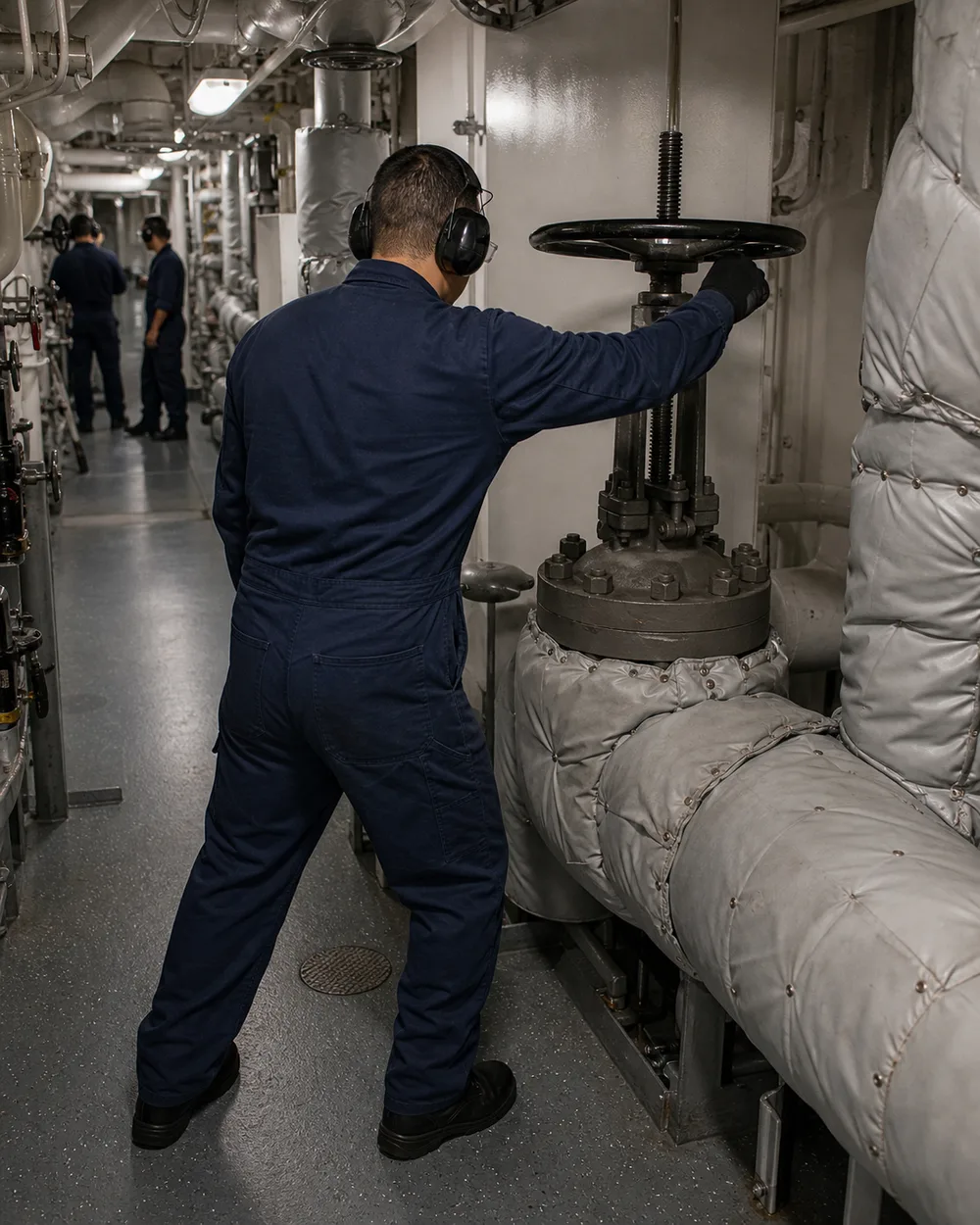
Hold the two pictures together. Aboard ship, the man who wrote the plan took the exposure. In the minivan, the father checks his mirrors.
On your heart first#
Deuteronomy 6 is where God installs family discipleship, and the order of operations matters more than almost anything else in the passage. Right after the Shema comes the command every Christian parenting book eventually quotes:
“And these words that I command you today shall be on your heart. You shall teach them diligently to your children, and shall talk of them when you sit in your house, and when you walk by the way, and when you lie down, and when you rise.” (Deuteronomy 6:6–7)
Verse 6 comes before verse 7. The words go on your heart, then they get taught diligently. That ordering is a flow path. Any engineer will tell you the source is upstream of the distribution: you cannot deliver pressure from an empty header, and in the Navy you could not sign another man’s qualification card for a watch you had never stood yourself. Deuteronomy assumes the same physics. A father transmits what he carries. If the words aren’t on his heart, there is nothing in the line to deliver, and the diligent teaching of verse 7 becomes a performance the kids see through by age nine.
Notice, too, where the teaching happens: sitting in the house, walking on the road, lying down, getting up. Deuteronomy locates the teaching in the ordinary rhythm of a household with a man in it who actually carries the thing he’s passing on. And then verse 9 puts the words “on the doorposts of your house and on your gates,” the entry points, the interfaces between your household and everything outside it. The home itself gets labeled with what it runs on.
You can’t do any of that from the passenger seat. You can delegate a carpool. You cannot delegate what’s on your heart.
Joshua answers for his house#
At the end of his life, Joshua assembles Israel and gives them the least coercive leadership speech in Scripture. Serve the LORD or don’t, he tells them; choose this day whom you will serve. Every family present gets a real choice. And then he closes with the line men have carved over their doors for three thousand years:
“But as for me and my house, we will serve the LORD.” (Joshua 24:15)
Watch what Joshua does not do. He doesn’t poll his household, or wait to see which way the tribal consensus breaks so he can position accordingly, or hand the question to his wife because she’s better at the spiritual stuff. He goes first, in public, and answers for his house, and because he has declared a position, his house has something to follow.
A shepherd doesn’t drive sheep from behind. The Middle Eastern shepherd walked out in front, and the flock moved because he moved.

First to plan, first to pray, first to own it#
On an ordinary Tuesday, going first comes down to three practices. None of them requires a gift you don’t have.
First to plan. Sunday night, twenty minutes, before anyone asks you to. Walk the coming week the way you’d walk a plant before taking the watch: every appointment, every practice, every pinch point where two obligations collide, every kid who has something hard coming (the test, the tryout). Then bring it to your wife having already looked, so the conversation starts at “here’s what I see, what am I missing?” instead of “what’s happening this week?” The difference between those two openings is the difference between a watchstander and a passenger. In my house the week lives on a shared Shprd dashboard where everyone can see it; paper on the refrigerator does the same job.
First to pray. You don’t have to be the best pray-er in the house, only the first. Tonight at dinner, you’re the one who says “let’s pray,” and then you pray twenty plain seconds in your own voice. Same thing at bedtime, and in the truck before the tryout. Your prayers will be clumsy for a while; mine were, and sometimes still are. Clumsy and first beats eloquent and never, and your kids will remember whose voice went first long after they’ve forgotten every word you said.
First to own what went wrong. This is the one that separates the men from the managers. In the Navy, after a casualty, the watch team reconstructs the timeline in a formal critique, and the standard is brutal honesty about your own actions, because you cannot fix a plant you won’t accurately assess. Run the same critique on yourself weekly: where you were harsh, where you checked out. Then own it by name and by item, out loud, to the person who took the hit: “I was short with you Tuesday about the shoes. That was wrong, and I’m sorry.” It feels like the kind of confession that should cost a father his authority. It works the other way: a man who can log his own failures in front of his family demonstrates that the standard in this house applies to the man at the front first. No other kind of authority is worth following.
What going first costs#
Jesus described how a real shepherd moves his flock, and the physical arrangement is the point:
“When he has brought out all his own, he goes before them, and the sheep follow him, for they know his voice.” (John 10:4)
Before them. The shepherd is first across the stream, first up the exposed slope, first to meet whatever is standing in the path. Going first is exposure. It means you pray badly in front of people before you pray well, and your kids watch you attempt things you’re not good at yet. It means when the family’s plan fails, there’s no one upstream of you to blame, because you wrote the sequence and you ate last.
That cost comes with the watch. The true Shepherd is distinguishable from the hired hand by what the work costs him. Leadership that costs you nothing is commentary.
Men will bear the cost of a calling that means something. What repels us is a role that costs nothing and means nothing. Going first is the most expensive seat in the house, and it’s the one you were built for.
Prepare · Ask · Act#
Prepare: This Sunday evening, take twenty minutes alone with the family calendar and walk the week before anyone briefs you on it. Write down the three pinch points and the one kid who has something hard coming. Show up to your wife already knowing them.
Ask your wife one question this week: “Where in this family’s spiritual life do you wish I’d go first?” Then listen to the whole answer. The list she gives you is your turnover checklist.
Act: Be the first voice at dinner every night this week. “Let’s pray,” then twenty plain seconds, yours. Seven nights. Don’t announce the program to anyone. Just go first and see who follows.