Build for Generations
Proverbs 13:22 says a good man leaves an inheritance to his children's children. Four accounts make up that estate: skills, money, paperwork, and faith. Money is the smallest, and the rest transfer deliberately or not at all.

Every asset on my civilian maintenance register sits in one of two categories. Either it’s on a lifecycle plan (inspected and overhauled on a known schedule, with replacement budgeted years before it dies), or it’s designated run-to-failure: use it until it breaks, then swap it.
Run-to-failure is a legitimate strategy. We choose it on purpose, for things that are cheap and instantly replaceable. A light bulb. A fan belt on a unit with a spare on the shelf. Nobody runs a boiler to failure, because when a boiler fails it takes the plant down with it, and the replacement has a lead time measured in months.
Then I look at how most American households are run (mine was run this way longer than I’d like to admit), and the maintenance strategy is unmistakable. Run to failure. There’s no plan past the current billing cycle. The skills will die with the man who has them, because nobody was ever trained on the replacement. The will exists only as a recurring intention. The faith is something the kids are expected to absorb through the drywall.
Your household is not a light bulb. It doesn’t get a spare on the shelf.
Two generations out#
Proverbs puts the provision pillar on a specific time horizon: “A good man leaves an inheritance to his children’s children” (Proverbs 13:22). Read the target again. Children’s children. The verse asks you to plan for people who may not exist yet, on a timeline that runs past your own funeral. In asset-management terms, it demands a plan longer than your own service life.
Every incentive in the modern economy points the other way. Public companies plan in quarters. Careers plan in two-year jumps. Social feeds plan in seconds. A man who plans in decades is the anomaly now, and Proverbs treats him as the baseline for good.
When I wrote that Genesis Labs builds for generations, not quarters, I meant it as an engineering commitment: you architect differently when the thing is meant to be handed down. But that sentence didn’t start as a business principle. It started as a description of the charge I hold at home as the family’s shepherd. The company got it secondhand.
So what actually transfers to the third generation? Money is part of it, and Scripture won’t let you spiritualize it to zero. Paul takes it as obvious that parents save up for their children, not the reverse (2 Corinthians 12:14). But money is the smallest account in the estate, and the only one a stranger could manage for you. The accounts that transfer only through you are skills, paperwork, and faith. All of them move the same way: deliberately, or not at all.
The apprenticeship the economy deleted#
I didn’t become a Machinist’s Mate by reading about steam plants. The Navy handed me a qualification card and put me on watch under a petty officer who had stood that watch a thousand times. He did it while I watched. I did it while he watched. Then a board of men who knew the plant cold asked me questions until they were satisfied I couldn’t get anyone killed. That’s an apprenticeship, and for most of human history it’s how nearly everything worth knowing moved between generations. Sons watched fathers farm, forge, fish, keep books, treat customers, handle a bad day.
The modern economy quietly deleted that channel. For more and more of us, work is invisible to our kids. Mine is a laptop and a headset; from across the room, managing a capital project looks identical to reading the news. A kid can’t apprentice into what he can’t see. That means the transfer of real skills no longer happens by default in your house. It happens if you build it, and only then.
In our house the qualification card is already open. I’ve taught my son to change the oil in the lawnmower — though the honest status is that he hasn’t done it without me yet, which by Navy rules means the qual isn’t signed off, just under instruction. He can spray the house for bugs, run the weed whacker for edging and trimming, and hold his own on general yard work, and he knows his way around the computer tasks a kid actually needs. Sports were their own apprenticeship: years of basketball with both kids back in the day, volleyball with my daughter. And both of them know a school project in this house comes with a father attached. None of that is exotic. All of it is transfer, and every lesson runs the same sequence the Navy ran on me: watch me, then I watch you, then one day I don’t need to.
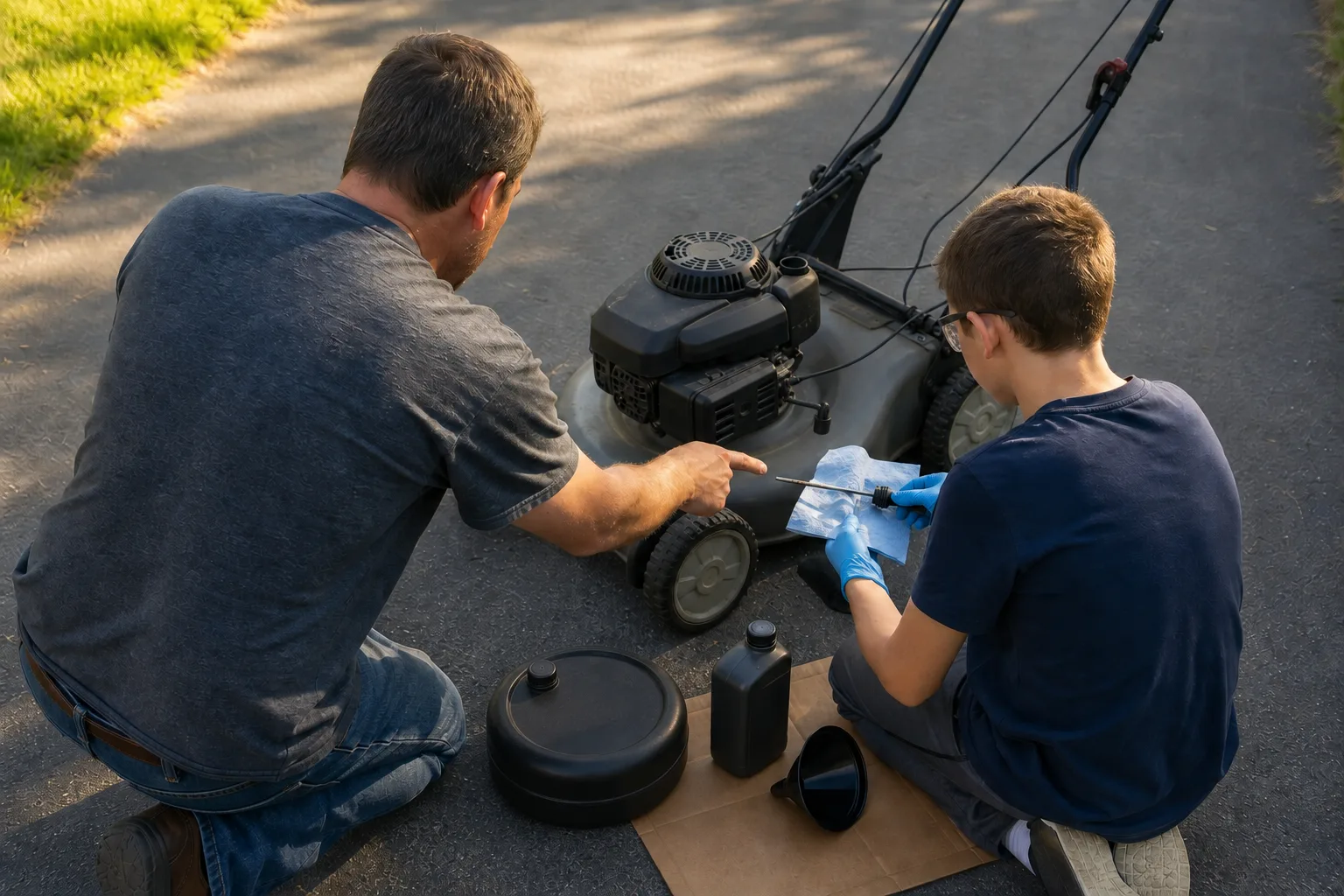
So build it. Decide which skills you want your grandchildren to have and start the qualification card now. How to change a tire and check the oil. How to cook six real meals. How to read a paystub and a lease before signing either. How to use a drill, a multimeter, a fire extinguisher. How to apologize and repair a relationship, which is the skill carrying the most load on the list. None of this requires you to be a master craftsman. It requires you to be present and a step ahead.
Money your kids can watch you handle#
The financial account is the one most fathers assume they’ve got covered, and the national numbers say otherwise. In the Federal Reserve’s 2024 household survey, 63% of adults could cover a $400 emergency expense with cash or its equivalent. That means more than a third of adults have no cash answer to a dead alternator. And the stress lands hardest exactly where inheritances are supposed to be forming: when the American Psychological Association measured it, money was a somewhat or very significant source of stress for 64% of Americans, and for 77% of parents, and finances had held the top-stressor spot since the APA began tracking in 2007. That survey is a decade old; nothing in the Fed’s numbers since suggests the picture improved.
Generational financial stewardship is boring on purpose, the same way a maintenance schedule is boring: an emergency fund, then no consumer debt, then steady investing, then giving that’s planned instead of leftover. You don’t need a novel strategy. You need the discipline to run the standard one for thirty years.
The generational part is that your kids watch it happen. Let them see a bill get paid on time and without drama. Let them earn money, then make them split it three ways: give, save, spend. Walk your teenager through one real month of the family budget, actual numbers on the table. A kid who has watched money handled calmly a hundred times inherits the calm along with whatever is in the account. A kid who has only ever heard money fought about inherits that instead.
The paperwork you keep not signing#
Now the unglamorous one. In Caring.com’s 2025 estate-planning study, only 24% of Americans reported having a will, and the most common reason among those without one isn’t cost or complexity. More than 40% say they haven’t gotten around to it. They’re procrastinating on the one document whose whole reason for existing is that its deadline arrives unannounced.
Here’s what “haven’t gotten around to it” costs if you have young kids. If you and your wife die without naming a guardian, a judge who has never met your children decides who raises them. The state has a default plan for your family. Signing the paperwork is how you override it.
The list is short and finishable. A will. A named guardian who has agreed, out loud, to the job. Life-insurance beneficiaries checked against present reality instead of an ex or a deceased parent. And one document that tells your wife where everything is: accounts, policies, passwords, the location of the will itself. Families without that document grieve twice, once for the man and once through the months spent excavating his filing system.
I have to level with you here: I don’t have a will yet. I found the gap the way I find most gaps lately — building Shprd keeps forcing me to inventory what a family needs squared away, and this item came back marked missing at my own address. Most of us never refused this paperwork; we just never saw it on a list with our name next to it. So the thirty days in the Act section below isn’t advice from the far shore. I’m on the same clock, starting now.
This is provision and protection in the same envelope. It costs a few hundred dollars and two evenings, and it is the cheapest insurance your children will ever hold.

The inheritance with the longest service life#
Psalm 78 reads like a knowledge-transfer procedure. God “established a testimony in Jacob and appointed a law in Israel, which he commanded our fathers to teach to their children, that the next generation might know them, the children yet unborn, and arise and tell them to their children, so that they should set their hope in God” (Psalm 78:5–7). Count the generations in that one sentence: fathers, children, children yet unborn, and their children after them. Four deep. And notice the verb attached to the fathers. Commanded. Teaching the next generation isn’t presented as a devotional lifestyle option for the especially keen. It’s the standing order.
God routes the transmission through fathers, teaching, at home, on purpose — not through the professional clergy, not through the surrounding culture. It’s the same channel as the apprenticeship, because that’s the channel God built. The psalm even names the failure mode a few verses later: a generation whose heart was not steadfast, a generation that forgot his works (v. 11). Spiritual inheritance has a run-to-failure mode too. It looks like assuming an hour of church a week will do the teaching for you. One generation of silence zeroes the account.
The will transfers your assets. Only you transfer your faith — out loud, at the table, in the car, badly at first, like every apprenticeship ever run. Of the four accounts in this article, this is the one with the longest service life, and the only one stored where Jesus said moth and rust don’t destroy (Matthew 6:19–20).
Prepare · Ask · Act#
Prepare: One page, four columns: skills, money, paperwork, faith. Under each, write what would transfer to your kids if you died this year. Not what you intend. What exists. Blank cells are your project list, and the paperwork column is almost always the fastest to fix.
Ask your oldest kid this week: “What do you think I actually do all day?” The answer tells you how visible your working life is to the people who are supposed to be apprenticing in it. Then ask your wife: “If something happened to me this month, would you know where everything is?” If either answer is a shrug, you’ve found the transfer that’s failing.
Act: Thirty days. Draft the will, name the guardian (ask them first), and check every beneficiary designation. An online will with two witnesses beats the perfect estate plan you’ll get to someday. When it’s signed, tell your wife where it lives — then pick one skill from your list and put the first lesson on the calendar.