Lead the Table
A 15-minute family huddle agenda a six-year-old can follow, a Sunday-night look-ahead run like a Navy watch turnover, and the research on why the dinner table is where discipleship actually happens.

In an engine room, a watch never just ends. It turns over.
The oncoming watchstander shows up early. He reads the logs. He walks the plant with the man he’s relieving: what’s running, what’s tagged out, what the engineering officer of the watch is worried about tonight. Then the formal words, said out loud, every time: the oncoming man says “I am ready to relieve you,” then “I relieve you,” and the man he’s relieving answers, “I stand relieved.” From that answer, the plant belongs to the new man. Continuity between people is a designed thing: a fixed time, a fixed agenda, formal words, and a procedure that guarantees the plant is never unowned for a single minute. Good intentions were never the mechanism.

Now look at how most households run a week. The schedule lives in one parent’s head, usually mom’s. The kids find out about the dentist in the car on the way to the dentist. Nobody asks what dad read in Scripture this morning, and the answer would be nothing anyway. Nobody prays for the math test because nobody knew there was one. This isn’t a family that doesn’t love each other. It’s a family that never designed the venue where loving each other gets coordinated.
So build the venue: a daily huddle a six-year-old can follow, and a Sunday-night look-ahead run like a proper watch turnover.
The venue God named first#
When God gave Israel the central command of family discipleship, he specified the settings. The last article walked through Deuteronomy 6:6–7 in full; what matters here is the list of venues it names: talk of these words “when you sit in your house, and when you walk by the way, and when you lie down, and when you rise.”
Read the list again. Sitting in your house. Walking on the road. Bedtime. Morning. God planted the command in the ordinary recurring moments of a household, not in the synagogue or a class run by professionals. The first moment named is sitting in your house — which, for nearly every family in history, has meant the meal. The table is the discipleship venue. Church and youth group are supplements to it. Somewhere along the way we flipped the ratio, outsourced the teaching to the professionals, and kept the table for chewing.
Deuteronomy never authorized the flip. The verbs are aimed at parents, and the location is your own house at the times you’re already sitting down anyway. God built the command around a rhythm every family already has. All you have to do is stop wasting it.
What the table measurably does#
I don’t ask anyone to take the table’s importance on my say-so. The research here is some of the most consistent in the family-outcomes literature.
Columbia University’s National Center on Addiction and Substance Abuse surveyed American teens on this question for well over a decade. The 2011 report found that teens who had infrequent family dinners, fewer than three a week, were almost four times likelier to use tobacco, more than twice as likely to use alcohol, and two and a half times likelier to use marijuana than teens who ate with their families five to seven times a week.
The academic effects start much earlier than the teen years. Harvard’s Home-School Study, led by Catherine Snow with Diane Beals, tracked how small children acquire vocabulary and found that dinner conversation beat storybooks on rare-word exposure: young kids picked up about 1,000 rare words at the dinner table, against 143 from parents reading aloud, and a bigger vocabulary means reading earlier and more easily. On vocabulary alone, the table your six-year-old sits at is out-teaching the bedtime story.
Now the objection a smart reader is already forming: these are correlations. Families that manage dinner together five nights a week probably differ from families that don’t in a dozen ways the studies can’t fully control, and the researchers themselves say frequent dinner works largely as a proxy for engaged, reachable parents. I grant that entirely, because it’s my whole argument. The table has no power of its own. It’s the scheduled place where an engaged parent becomes reachable, on the record, every day. You cannot be a proxy for engagement you never exhibit, and you cannot exhibit it at a table you never sit down at.
The daily huddle#
Call it whatever your family will actually say. Huddle or table time both work. The name matters less than the design constraints: the agenda must be simple enough for a six-year-old to follow and eventually run, and short enough to survive the worst night of your week. And every seat gets a job.
Here’s the agenda we use as a baseline. Fifteen to twenty minutes, at a meal you already eat. And if your schedule doesn’t give you a shared dinner (shift work, a custody calendar), attach the huddle to any recurring fifteen minutes you do have: breakfast, or the drive to school. The meal is the default, not the requirement.
1. Scripture (about 5 minutes). One passage, a few verses, read out loud. Not a sermon. Rotate the reader, and when your new reader takes six minutes to get through three verses of Mark, let him. That slow reading is the whole point of the exercise. A kid who reads the Bible aloud to his family at seven will not find it strange to open it alone at seventeen.
2. One question (5–7 minutes). Exactly one, asked to everyone, answered by everyone including you. “What was the hardest part of your day?” or “Where did you see God today?” Resist the follow-up interrogation; the goal is that talking at this table feels safe, not efficient. Your kids will say nothing worth hearing for two weeks. Keep asking.
3. Calendar (about 3 minutes). Tomorrow only. Who goes where and who needs what. This is thirty seconds per person and it’s the piece that teaches kids the family is an operation they belong to, not a service they consume.
4. Prayer (2–3 minutes). One sentence each, out of what was just said. The question surfaced that your daughter is scared of the test; somebody prays for the test. Assign a closer. Little kids fight for this job if you let them own it.
That’s the whole agenda — no workbook, no performance. The bar for success is “we showed up,” because the compounding is in the streak, not in any single night. And one standing rule that costs the man most: no phones at the table, yours first.
Ours started sideways. I’ve been building Shprd for almost two years, and my family uses it every day, which means “how should a family actually meet?” stopped being a product question and became a dinner-table conversation. The huddle came out of those conversations, and we worked out the details jointly, kids included, which is exactly why they hold us to it. It isn’t friction-free: this year one of ours is homeschooled and the other is in private school, so the schedules don’t naturally line up on anything. That’s not the argument against a fixed time. That’s the argument for one.
The Sunday-night turnover#
The daily huddle keeps the family connected. It does not keep the week owned. For that you need the weekly variant, and this is where I stopped inventing and just brought the watch turnover home.
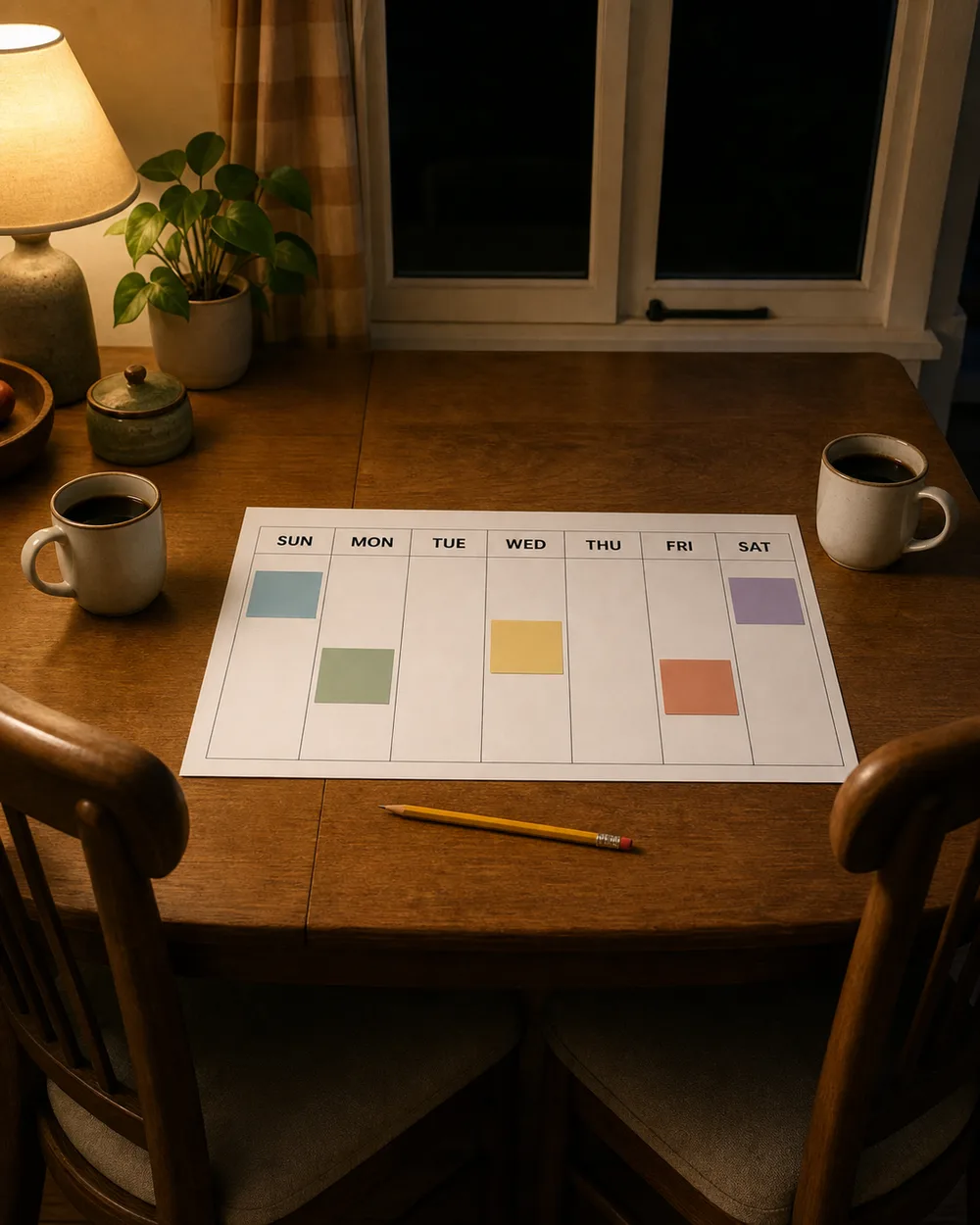
Run it Sunday night after dinner: twenty minutes, with the calendar where everyone can see it. Four steps, same order every week.
Read the log (5 minutes). Go over last week, honestly: one win, one thing that went sideways. Dad reports first and owns his part of the sideways thing first, because the off-going watch doesn’t get to hide the valve he left misaligned. Your kids learning that dad audits himself out loud is worth more than most sermons they’ll hear.
Walk the plant (7 minutes). Walk the coming week, day by day. Every event gets an owner by name: who’s driving, and who’s bringing the form. Conflicts between Wednesday’s practice and Wednesday’s recital surface on Sunday, when they’re a planning problem, instead of on Wednesday, when they’re a fight.
Standing orders (3 minutes). The one thing the family is working on right now: a memory verse, or a habit you’re building. One, not five. Standing orders exist because a watch team can’t keep twelve priorities; neither can a household.
Pass the word, then pray (5 minutes). Ask who’s carrying something heavy this week. Name it, then pray over the week specifically: the test, the hard conversation somebody has coming.
The format is rigid on purpose. In the Navy nobody relieves the watch with “yeah, I got it.” The formal words exist so that ownership is never ambiguous, and the ambiguity is exactly what kills family weeks. The turnover guarantees the plant is never unowned for a minute; the Sunday huddle guarantees the week is never unowned either. And notice who this relieves. If the whole week has been living in your wife’s head, the turnover is the moment the household’s operating picture becomes shared property instead of her private, invisible burden.
I build family software for a living, and I’ll disclose the bias plainly: the weekly-planning surface in Shprd exists because of this Sunday ritual, not the other way around. Any shared calendar can prep the turnover. No calendar can sit down at the table and lead it. That job doesn’t automate.
Two failure modes to expect. First, you’ll miss nights. Sickness, or a kid melting down at 5:47. Miss the night, keep the habit; a watch team that loses a man doesn’t abandon the watch rotation; it adjusts and turns over anyway. Second, around week three it will feel mechanical, and you’ll be tempted to quit because it isn’t “authentic.” Stay at it. Nobody calls the turnover inauthentic because it follows a format. The format is what makes it survive the nights when nobody feels like it, and those are the nights that decide whether your family has a rhythm or a memory of one.
Prepare · Ask · Act#
Prepare: Pick the slot this week. One daily meal your family already mostly shares, plus twenty minutes Sunday night. Write the four-line agenda on an index card (Scripture, one question, calendar, prayer) and set it on the table where everyone can see it. The card is the commitment.
Ask: Have your wife tell you everything she’s currently tracking for the next seven days, and write it down while she talks. Every appointment, form, gift, and deadline. That list is the log of a watch you’ve never once read, and it’s the agenda for your first turnover.
Act: Run both, the huddle and the Sunday turnover, for two full weeks before you judge them. Tell your kids the plan out loud on night one so they can hold you to it, and give the youngest a job by name. The bar is presence, not polish. Take the watch. Then turn it over properly, every Sunday, for as long as they live under your roof.